Cart
0

Ashwagandha works best for chronic, high-cortisol stress: the kind that keeps you wired at night, anxious, and sleeping poorly. Rhodiola works best for acute fatigue and low motivation: the flat, foggy feeling that hits during a demanding stretch of work or a bad night’s sleep. Many people eventually take both, rhodiola in the morning and ashwagandha at night, but start with one herb and add the second only after checking for interactions.
TL;DR:
- Ashwagandha requires at least six to eight weeks at moderate doses to produce noticeable stress and sleep benefits, especially for cortisol reduction.
- Rhodiola can show energy and mental clarity improvements within one to two weeks but may cause jitteriness or insomnia in sensitive users.
- Combining both herbs is safe with proper timing, taking rhodiola in the morning and ashwagandha in the evening, to prevent sleep disruption.
- Standardized extracts like KSM-66, Sensoril, or SHR-5 are essential for efficacy, along with third-party testing and clear dosage information.
- If no improvement occurs after six to eight weeks, or side effects arise, adjusting dosage or timing before discontinuing is recommended.
Table of Contents
- Ashwagandha vs Rhodiola: A Quick Comparison
- How Do Ashwagandha and Rhodiola Actually Work?
- Which Herb Fits Your Symptoms?
- Dosage, Timing, and How Long Before You Notice Anything
- Side Effects, Contraindications, and Drug Interactions
- Can You Take Ashwagandha and Rhodiola Together?
- What Quality Markers Should You Look for in a Supplement?
- How to Tell If It’s Working, and When to Adjust
- Ashwagandha vs Rhodiola: Which Adaptogen Fits Your Type of Stress?
- Try Quantum Vitality for Organic, Third-Party Tested Support
- Sources
Ashwagandha vs Rhodiola: A Quick Comparison
Before you commit to either one, match the herb to your dominant symptom rather than picking whichever one has better marketing. Here’s the fast version:
- Ashwagandha is best for chronic stress, anxiety, and disrupted sleep. Clinical doses typically range in the mid hundreds of milligrams daily, and full effects on cortisol generally take several weeks to manifest.
- Rhodiola is best for daytime mental fatigue, sluggishness, and performance under pressure. Doses in trials vary widely up to several hundred milligrams daily, and people often notice a difference within days to two weeks.
- Ashwagandha’s main caution: avoid during pregnancy, use carefully alongside thyroid medication, and expect occasional drowsiness or mild stomach upset.
- Rhodiola’s main caution: it can cause insomnia or jitteriness in sensitive people and interacts with certain antidepressants and blood pressure medications.
If your problem is racing thoughts at 11 p.m., start with ashwagandha. If your problem is dragging through the afternoon with no drive to do anything, start with rhodiola.
How Do Ashwagandha and Rhodiola Actually Work?
The two herbs target different systems entirely, which is why they solve different problems.
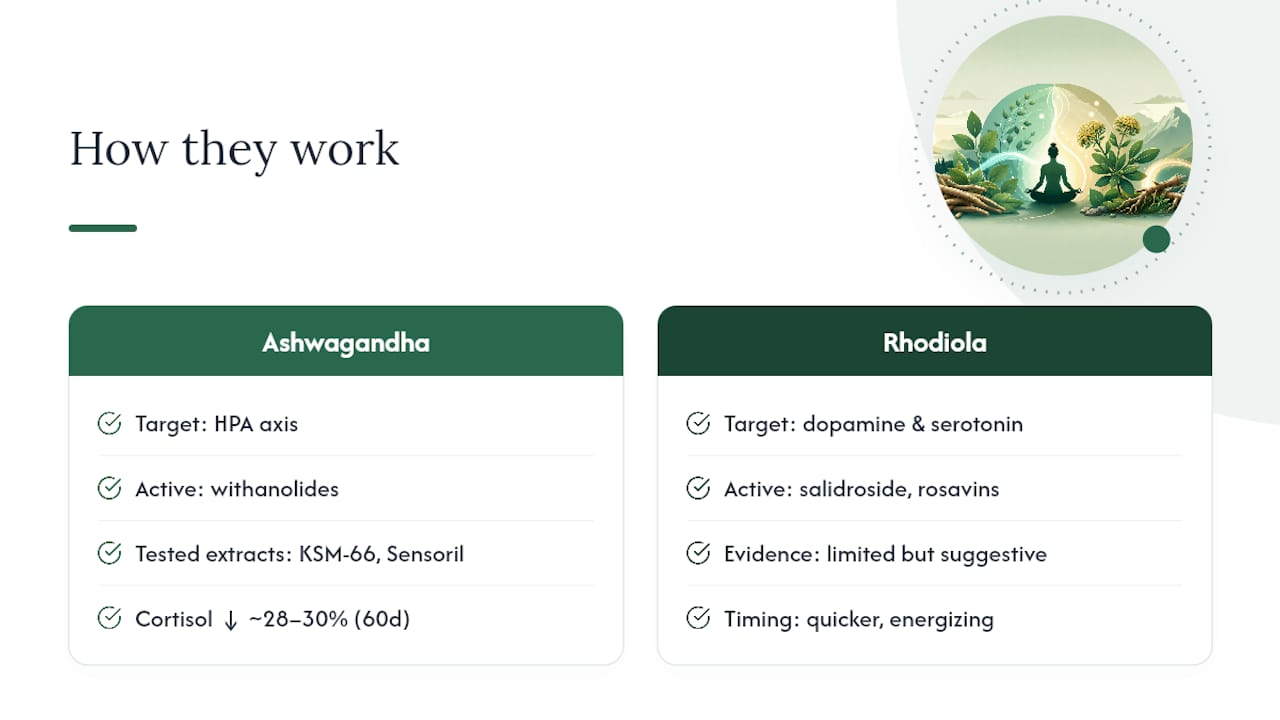
Ashwagandha’s primary action is on the HPA axis, the hormonal loop that governs your cortisol response to stress. Randomized trials on standardized extracts report cortisol reductions of roughly 27.9% to 30% over 60 days at daily doses between 300 and 600 mg. Most of the strongest trial data comes from standardized extracts, particularly KSM-66 and Sensoril, so the raw root powder you find in a bulk bin isn’t the same thing tested in these studies.
Rhodiola works through a different route. Its active compounds, salidroside and rosavins, act more on monoamine neurotransmitters like dopamine and serotonin, which is part of why users often report a quicker, more energizing effect rather than a slow calming one. The National Center for Complementary and Integrative Health describes the evidence for rhodiola as limited but suggestive for stress-related fatigue, a more cautious label than ashwagandha’s larger trial base carries.
A 2026 review in Frontiers in Nutrition found complementary evidence for both herbs across stress, mood, and cognition, but the authors are blunt that trials need to get bigger and run longer before anyone can call the case closed.
Which Herb Fits Your Symptoms?
Picture two people. One is exhausted but can’t switch off, replaying the day at 1 a.m. with a racing heart. The other is running on fumes by 2 p.m., unable to concentrate, with zero drive to start the next task. These are not the same problem, and they don’t respond to the same herb.
- Wired and can’t sleep: ashwagandha’s cortisol-lowering action tends to help here, and its calming effect is one reason it’s commonly dosed in the evening.
- Flat, unmotivated, and mentally foggy: rhodiola’s effect on neurotransmitter activity is a better match, especially for students cramming, shift workers fighting circadian mismatch, or anyone facing a short burst of demanding cognitive work.
- Endurance athletes and performance-focused users: rhodiola shows up more often in research tied to physical and mental performance under stress, including notes from Medical News Today’s overview of rhodiola’s safety and use.
- Anxiety with a physical edge (tight chest, restless legs, irritability): ashwagandha’s HPA-axis effect targets the physiological stress response more directly than rhodiola’s.
If you genuinely have both patterns, that’s common, and it’s the case where stacking makes practical sense.
Dosage, Timing, and How Long Before You Notice Anything
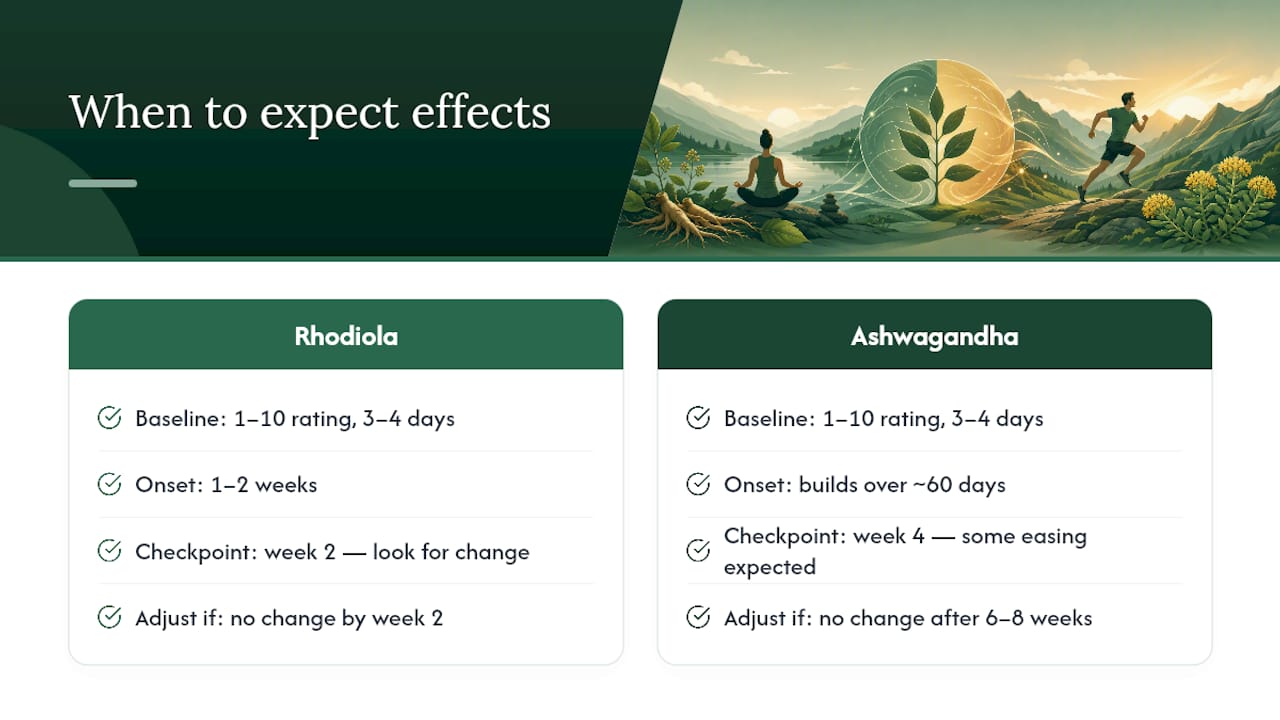
Ashwagandha trials most often use moderate daily doses, and the calming effect makes evening dosing the practical choice for most people managing anxiety or sleep issues. Don’t expect fast results. The cortisol-lowering effect measured in trials builds over roughly 60 days, so give it a genuine six to eight weeks before deciding it isn’t working.
Rhodiola trials commonly use doses within a moderate range per day, taken in the morning or early afternoon. Dosing late in the day risks the insomnia and jitteriness the NCCIH lists among rhodiola’s known side effects. The upside is speed: practitioners often see a noticeable lift in energy or focus within days, certainly within two weeks, which is a much faster feedback loop than ashwagandha offers.
For either herb, the same starting rule applies: pick the lower end of the dose range, run it for two to six weeks, and keep a simple log of sleep quality, energy, and mood. If you take any prescription medication, talk to your doctor before adding either supplement, and never assume a “natural” label means zero risk of interaction.
Side Effects, Contraindications, and Drug Interactions
Ashwagandha is generally well tolerated, but it isn’t risk-free. Pregnant women should avoid it, people on thyroid medication need caution since ashwagandha can influence thyroid hormone levels, and there are rare reports of liver effects worth flagging to a doctor if you notice unusual fatigue, dark urine, or yellowing skin. The more common complaints are mild: drowsiness, an upset stomach, or loose stools, usually resolved by lowering the dose.
Rhodiola’s caution list centers on the nervous system and drug interactions. The NCCIH notes that side effects can include dizziness, headache, and insomnia, and rhodiola may be safe for use up to 12 weeks based on current evidence, though longer-term data is thinner. It can interact with SSRIs, MAOIs, and some blood pressure medications, so anyone on antidepressants needs to check with a prescriber first.
For both herbs: stop and call a clinician if you notice unusual heart palpitations, mood changes that feel wrong, or any signs of liver trouble. If you’re pregnant, breastfeeding, or managing a chronic condition, get medical clearance before starting either one, not after.
Can You Take Ashwagandha and Rhodiola Together?
Yes, and it’s a common approach. Harvard Health’s review on combining the two recommends temporal separation, rhodiola in the morning for energy, ashwagandha in the evening for calm, specifically because taking both at the same time can blur which herb is doing what and increase the odds of sleep disruption from rhodiola’s stimulating effect.
A sensible starter protocol:
- Pick the herb that matches your dominant symptom and take it alone for two to three weeks.
- Log sleep, energy, and mood daily, even briefly.
- If the primary symptom improves but a secondary one persists, add the second herb at a conservative dose, keeping the AM/PM split.
- Reassess after another two to three weeks and adjust dose or timing based on what you’re tracking.
Pro Tip: If rhodiola in the morning still leaves you jittery by midday, cut the dose in half before dropping it entirely, some of the wired feeling fades with a smaller amount rather than none.
What Quality Markers Should You Look for in a Supplement?
Extract standardization is the detail most shoppers skip and most researchers care about most. Trials on ashwagandha lean on named extracts like KSM-66 and Sensoril, not generic root powder, and rhodiola research often specifies SHR-5 or a standardized rosavin and salidroside content. A label that just says “ashwagandha root” without a standardization mark or percentage tells you very little about what dose of active compound you’re actually getting.
Pure Blue’s approach to its Quantum Vitality NAD+ Booster + Detox reflects the same standards researchers look for: organic ingredients with no artificial fillers, third-party testing for purity and potency, and manufacturing in an FDA registered facility. Those are the same categories of proof, extract clarity, lab verification, and manufacturing oversight, that matter when you’re comparing any adaptogen product, not just Pure Blue’s own line.
Before buying anything with ashwagandha or rhodiola in it, check for:
- A named, standardized extract (KSM-66, Sensoril, SHR-5) rather than a vague “proprietary blend”
- A published certificate of analysis (COA) from third-party testing
- Clear per-serving milligram amounts, not just a plant name on the label
- A realistic trial duration recommendation, since neither herb works overnight
How to Tell If It’s Working, and When to Adjust
Give yourself a real baseline before judging anything. Rate your primary symptom, sleep quality for ashwagandha, energy and focus for rhodiola, on a simple 1 to 10 scale for three or four days before you start. Without that baseline, it’s easy to talk yourself into feeling better (or worse) than you actually are.
For rhodiola, look for change within the first one to two weeks. If mental fatigue and afternoon crashes haven’t budged at all by week two, the dose may be too low, or rhodiola simply isn’t the right match for your symptom pattern. Trial and clinical practitioner reports both point to a faster feedback window here than with ashwagandha.
For ashwagandha, patience matters more. The cortisol reductions measured in trials build over roughly 60 days, so judging it at week two is judging it too early. A reasonable checkpoint is week four: some easing of anxiety or improved sleep onset by then is a good sign you’re on the right track, even if full effects haven’t arrived yet.
If you see zero change after a full six to eight weeks at a mid-range dose, or if side effects show up (jitteriness with rhodiola, unusual drowsiness or GI upset with ashwagandha), that’s your signal to adjust. Try a dose change first, then a timing change, before abandoning the herb altogether. And if you’re stacking both, isolate variables: change one thing at a time, or you’ll never know which adjustment actually worked. For a deeper look at how these mechanisms interact with other stress-response pathways, Essence Zenith’s breakdown of adaptogens and the HPA axis is a useful next read.
Ashwagandha vs Rhodiola: Which Adaptogen Fits Your Type of Stress?
The conventional advice on adaptogens treats them as interchangeable, grab whichever one is trending, take it daily, hope for the best. That’s backwards. Ashwagandha and rhodiola solve opposite problems: one calms an overactive stress response, the other lifts a depleted one. Treating them as equivalent is why so many people report “adaptogens don’t work for me,” when really they just took the wrong one for their symptom.
What gets underrated is timing discipline. Most people who stack these herbs skip the temporal separation entirely, take both in the morning, and then wonder why sleep gets worse instead of better. The fix is not complicated: rhodiola early, ashwagandha late, and enough patience to let ashwagandha’s slower cortisol effect actually show up before writing it off.
If there’s one thing worth prioritizing above dose or brand, it’s matching the herb to the actual symptom pattern first. Everything else, extract quality, timing, stacking, only matters once that match is right.
— Organic
Try Quantum Vitality for Organic, Third-Party Tested Support
If you’ve decided which adaptogen fits your stress pattern, the next question is whether the supplement itself holds up to the same standard the clinical research does. Quantum Vitality NAD+ Booster + Detox is built around that idea: a 3-in-1 organic formula aimed at energy, mental clarity, and detox support, with every batch third-party tested for purity and potency in an FDA registered facility.

It’s a fit for anyone who wants a clean, transparent option instead of guessing what’s actually in a bottle. If you’re pregnant, breastfeeding, or currently taking medication, talk to your doctor before adding it to your routine. Ready to see how it fits your own energy and clarity goals? Check out Quantum Vitality here or browse the full Pure Blue lineup to compare options.
This article is general information, not a substitute for advice from a qualified doctor. Consult a qualified healthcare professional about your own circumstances before acting on anything here.
Sources
- Ashwagandha - Health Professional Fact Sheet | Office of Dietary Supplements (ODS), NIH
- Rhodiola | NCCIH
- Rhodiola rosea, Ginkgo biloba, and Ashwagandha as novel antidepressant supplements | Frontiers in Nutrition (2026)