Cart
0

A Supplement Facts label is the box on every dietary supplement that lists serving size, the amount of each ingredient per serving, and its % Daily Value, required under 21 CFR 101.36. Read that box before you read anything on the front of the bottle. It tells you exactly what you’re getting, in what dose, and whether the marketing claims hold up against the actual numbers underneath.
TL;DR:
- Most supplement labels omit zeros for nutrients that are not present, making it crucial to identify the actual active ingredients and their doses.
- Proprietary blends conceal individual ingredient amounts, so verifying an ingredient’s form and dose requires checking third-party databases or transparent brands.
- Serving size manipulation can inflate perceived doses, necessitating careful reconciliation of label math with marketing claims before consumption.
- % Daily Values on supplements may exceed 100% or be misleading, especially for nutrients targeted for therapeutic doses, unlike the purely informational role on food labels.
- Brands that publish full ingredient breakdowns, disclose individual doses, and receive third-party testing provide the most trustworthy and transparent supplement information.
Table of Contents
- What a Supplement Facts Panel Is (and How It Differs From Nutrition Facts)
- What Has to Appear on the Panel, and How It Has to Look
- How to Read a Supplement Facts Label in Six Steps
- Common Pitfalls and Red Flags on Supplement Labels
- Where to Verify Labels and Daily Value Numbers
- How Pureblue Approaches Label Transparency
- Why Labeling Accuracy Actually Affects Your Health
- The Misconceptions That Trip Up Even Careful Shoppers
- Recent Shifts in Supplement Labeling Rules
- The Claims and Disclaimers You’ll Find on Every Label
- Why Supplements and Foods Play by Different Labeling Rules
- Reading Daily Values on Supplements Versus Food
- What the Label Rules Get Right, and Where They Fall Short
- Where Pureblue Fits Once You Know What to Look For
- Sources
What a Supplement Facts Panel Is (and How It Differs From Nutrition Facts)
The panel you see on a vitamin bottle or protein tub is legally called a “Supplement Facts” panel, not a Nutrition Facts label, and the distinction isn’t cosmetic. Under FDA’s Dietary Supplement Labeling Guide, any product marketed as a dietary supplement must list serving size, servings per container, and the quantitative amount and name of each dietary ingredient inside that specific box. Conventional foods carry a Nutrition Facts label instead, governed by a related but separate set of rules.
The two formats look similar at a glance, but the details diverge. Supplement Facts panels can skip nutrients that aren’t present at all, while Nutrition Facts labels often show a “0g” entry for something like trans fat even when the product contains none. Calories don’t get the bold, oversized treatment on a supplement label the way they do on a cereal box, because calorie count isn’t usually the point of a supplement purchase.
Most products marketed with a structure/function claim, dosage instruction, or ingredient list beyond basic food constituents need this panel. Exceptions exist for products that qualify as conventional foods (a fortified snack bar sold as food, for instance) even when they contain added vitamins. The line gets blurry fast, which is exactly why checking the panel format itself, not just the ingredient list, tells you how a product is legally classified.
What Has to Appear on the Panel, and How It Has to Look
The FDA doesn’t just require certain information. It dictates the layout, type size, and even how numbers get rounded. Here’s what a compliant panel must include:
- Serving Size: stated in a common household or metric measure (one capsule, one scoop, 5 mL).
- Servings Per Container: the total number of servings in the package, which you need for real cost and dose math.
- Amount Per Serving: the quantity of each vitamin, mineral, or other dietary ingredient, listed in appropriate units (mg, mcg, IU, or grams).
- % Daily Value (%DV): a column showing how much of the established Daily Value one serving provides, when a DV has been set for that nutrient.
- Mandatory core nutrients, when present in the product at reportable amounts: vitamins, minerals, protein, and other dietary ingredients added intentionally.
- Dietary ingredients without an established DV (many herbs and botanicals, for example) still need to be listed by name and amount, just without a %DV figure.
Formatting rules matter more than most consumers realize. The panel needs a bordered box, a bold “Supplement Facts” heading in a specific minimum type size, and the serving size line must sit directly under that heading. One quirk worth knowing: unlike Nutrition Facts labels, a Supplement Facts panel generally cannot declare a nutrient at a “zero” amount. If it’s not meaningfully present, it simply doesn’t appear on the panel at all.
Calories, when included, sit in a smaller, less prominent position than on food labels, reflecting the fact that dose and ingredient identity matter more than energy content for most supplement categories. Minimum type sizes scale with the available label space, but the panel always has to remain legible without a magnifying glass, at least in theory. In practice, some smaller containers push the limits of that requirement, which is one more reason to know what you’re looking for.
How to Read a Supplement Facts Label in Six Steps
Reading a label properly takes about ninety seconds once you know the sequence. Skipping steps is how people end up taking half the dose they think they’re getting, or paying for ingredients that don’t do what the front label implies.
- Reconcile the serving math first. Check units per serving against servings per container, then compare that to any front-of-pack claim like “1,000 mg of turmeric.” If the serving size is two capsules, and the claim describes one, you’re getting half of what the marketing implies per dose.
- Check Amount Per Serving numbers and units. Milligrams, micrograms, and international units aren’t interchangeable, and a sloppy label sometimes mixes them in ways that inflate perceived potency. Compare the %DV column to see whether a nutrient is a token amount or a meaningful dose.
- Inspect the chemical form of vitamins and minerals. Magnesium oxide and magnesium glycinate absorb very differently, even at identical milligram amounts. The same goes for folate versus folic acid, or methylcobalamin versus cyanocobalamin for B12.
- Spot proprietary blends. If you see a blend name followed by one combined milligram figure instead of individual amounts, you have no way to know how much of any single ingredient is actually in the mix.
- Read the Other Ingredients list. This is where fillers, binders, capsule material, and allergens show up. If you have a soy, shellfish, or gluten sensitivity, this line matters as much as the main panel.
- Look for third-party seals and manufacturer contact information. A verified seal and a real address or phone number on the label are small signals that a company stands behind what it prints.
Pro Tip: Keep your phone camera handy in the supplement aisle. Snap the Supplement Facts panel of anything you’re considering, then cross-check the ingredient forms and doses against the Dietary Supplement Label Database before you buy, not after.
Common Pitfalls and Red Flags on Supplement Labels
Proprietary blends are the single biggest trick to watch for. A label might read “Energy Complex: 500 mg” followed by six ingredient names with no individual breakdown, which means the active ingredient you actually want could be present at a dose too low to do anything.
Serving size manipulation is the quieter cousin of that trick. A product can advertise “5,000 mg of collagen” on the front while the Supplement Facts panel reveals that dose only applies across three scoops, not one, which triples the real serving size and the real cost.
Watch for these specific red flags:
- Structure/function claims like “clinically proven to boost energy” with no dose disclosed anywhere on the panel.
- A %DV over 100% presented as a selling point rather than a neutral fact. High %DV on a water-soluble vitamin usually just reflects formulation choice, not superior quality.
- Ingredient names that sound scientific but appear nowhere in the Other Ingredients or Amount Per Serving sections with an actual quantity attached.
- A blend name substituting for individual ingredient disclosure.
If something looks off, search the product name in DSLD to compare the label on file against what’s printed on the bottle you’re holding. Genuine discrepancies are worth reporting through FDA’s consumer complaint channels.
Where to Verify Labels and Daily Value Numbers
You don’t have to take any brand’s word for it. A handful of primary sources let you check the facts directly:
- DSLD stores actual label images for thousands of products, so you can view the printed Supplement Facts panel rather than relying on a retailer’s product description.
- 21 CFR 101.36 is the actual federal regulation that spells out formatting, placement, and required declarations, useful if you want the legal text rather than a summary.
- FDA’s Daily Values reference lists the current established DV for each nutrient, so you can judge whether a %DV figure reflects a meaningful dose.
- Third-party seals like USP or NSF indicate a product underwent independent testing for identity and quantity, which is a different kind of verification than anything printed on the label itself.
How Pureblue Approaches Label Transparency
Pureblue’s Quantum Vitality NAD+ Booster+ Detox publishes its full Supplement Facts panel directly on the product page, listing each ingredient and its individual amount rather than folding them into an undisclosed blend. That’s a deliberate choice, and it’s the same standard this article just walked through: no hidden proprietary blend, no vague “energy complex” masking the actual dose.
Each product is manufactured in an FDA-registered facility and goes through third-party testing for purity and potency before it reaches a customer. The brand’s free sample offer carries the same disclosures, so you can review the panel before committing to a full purchase.
If you’ve read the checklist above, you now have everything you need to hold any label, including Pureblue’s, to the same standard. Pull up a product page, find the Supplement Facts box, and run it through the six steps. Ingredient form, serving math, and blend disclosure should all check out clearly, with nothing buried in fine print or combined into a mystery total.
Why Labeling Accuracy Actually Affects Your Health
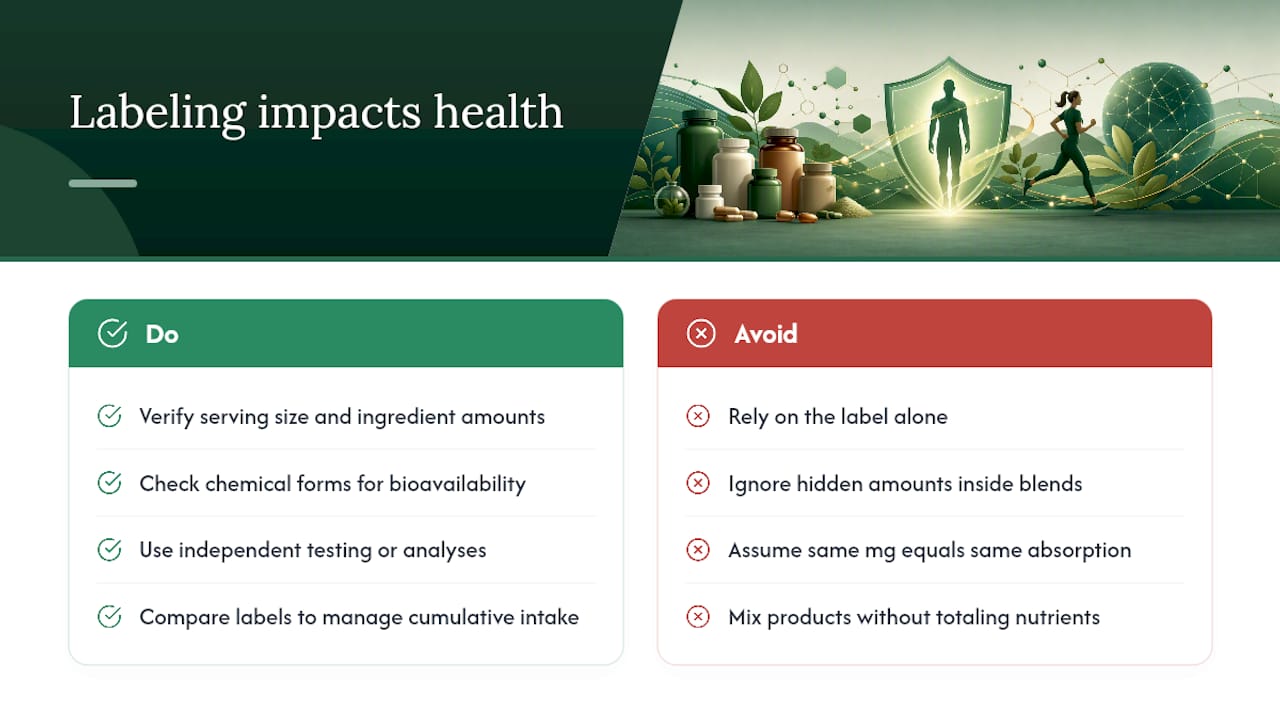
A mislabeled dose isn’t just a paperwork problem. If a product understates its serving size or hides individual ingredient amounts inside a blend, you could be taking a fraction of the dose that clinical research on that ingredient actually used, which means you’re paying for a product that can’t deliver the effect you’re expecting.
The reverse risk matters too. Some ingredients carry real upper limits, and a label that overstates serving size or rounds inconsistently can push a regular user over a safe daily intake without them realizing it, particularly with fat-soluble vitamins like A and D that accumulate in the body over time.
Chemical form compounds this problem. Two products can list identical milligram amounts of a mineral, yet one uses a form the body absorbs efficiently while the other uses a form that passes through largely unused. The label satisfies the letter of the regulation either way, but only one product delivers meaningful nutrition. This is precisely why independent testing and analyses matter. They catch discrepancies between what’s printed and what’s actually in the capsule, something the label alone can’t guarantee.
Accurate labeling is what allows a health-conscious consumer to actually manage their intake across multiple products. If you take a multivitamin and a separate calcium supplement, you need trustworthy numbers on both panels to avoid accidentally doubling up on a nutrient that has a defined upper limit.
The Misconceptions That Trip Up Even Careful Shoppers
The biggest misconception is treating “natural” or “organic” claims on the front of a package as a substitute for reading the Supplement Facts panel itself. Those front-label words describe sourcing or ingredient status. They say nothing about dose, chemical form, or whether the amount present matches what research on that ingredient actually used.
A close second: assuming a higher %DV always means a better product.
People also tend to assume FDA approves supplements before they hit shelves, the way it approves prescription drugs. It doesn’t. Supplements fall under a different regulatory framework where the manufacturer bears responsibility for accuracy, and FDA generally acts after a product is already on the market, through label review and enforcement rather than pre-market approval.
Finally, many shoppers read “proprietary blend” as a sign of a special, effective formula rather than what it usually is: a way to disclose a combined ingredient total without breaking out the individual amounts. A proprietary blend can legally contain a nearly negligible amount of an active ingredient sitting next to a large amount of a cheap filler, and the combined weight on the label gives you no way to tell which is which.
Recent Shifts in Supplement Labeling Rules
Supplement labeling regulation has not stood still. FDA has continued refining its Daily Values reference and nutrition labeling guidance in recent years, updating specific DV figures for nutrients like vitamin D and potassium to reflect current science on adequate intake, changes that ripple directly into how %DV gets calculated on every panel.
Enforcement focus has also shifted toward proprietary blend transparency and unsubstantiated claims, particularly for products marketed with aggressive structure/function language around energy, weight loss, or cognitive performance. FDA has continued to issue warning letters targeting products that make disease-treatment claims that cross the line from a permitted structure/function statement into an unapproved drug claim.
Digital verification tools have expanded the practical side of enforcement even without new statutory rules. DSLD has grown its catalog of label images, making it easier for an everyday consumer to cross-check a product against its actual filed disclosures rather than relying on a retailer’s marketing copy or a review site’s summary. That shift matters more than it sounds. A regulation only protects you if you can actually check compliance, and a searchable label database does more for a shopper than another paragraph of legal text.
The Claims and Disclaimers You’ll Find on Every Label
Certain phrases on a supplement label aren’t marketing flourishes. They’re required disclosures with specific legal weight behind them.
Any structure/function claim, something like “supports immune health” or “promotes healthy energy levels,” must carry a companion disclaimer stating that FDA has not evaluated the claim and that the product isn’t intended to diagnose, treat, cure, or prevent any disease. You’ve seen this exact language on nearly every bottle in the supplement aisle, and it exists because structure/function claims sit in a regulatory middle ground between food and drug claims.
Allergen disclosures follow federal food-labeling requirements the same way they do for conventional foods, so major allergens like milk, soy, tree nuts, and shellfish need to be called out clearly, usually within the Other Ingredients section or in a separate “Contains” statement.
Some products also carry specific warning statements tied to their ingredients: iron-containing products often warn about accidental overdose risk in children, and certain stimulant blends carry cautions for people with heart conditions or those who are pregnant or nursing. These aren’t optional additions. They’re tied to the ingredient itself and required regardless of how a brand wants to market the product.
Why Supplements and Foods Play by Different Labeling Rules
Conventional foods and dietary supplements answer to related but distinct sections of federal food law, and the practical differences show up everywhere on the package. Foods must declare nutrients even at zero amounts in many cases, creating that familiar “0g Trans Fat” line. Supplements skip a nutrient entirely if it’s not meaningfully present, on the theory that supplement labels should stay focused on what the product actually delivers.
Supplements also carry ingredient categories that food labels never touch, herbs, botanicals, amino acids, and enzymes chief among them, each requiring individual name and amount disclosure even without an established Daily Value. A conventional food label has no equivalent category structure because foods aren’t formulated around isolated dietary ingredients the way supplements are.
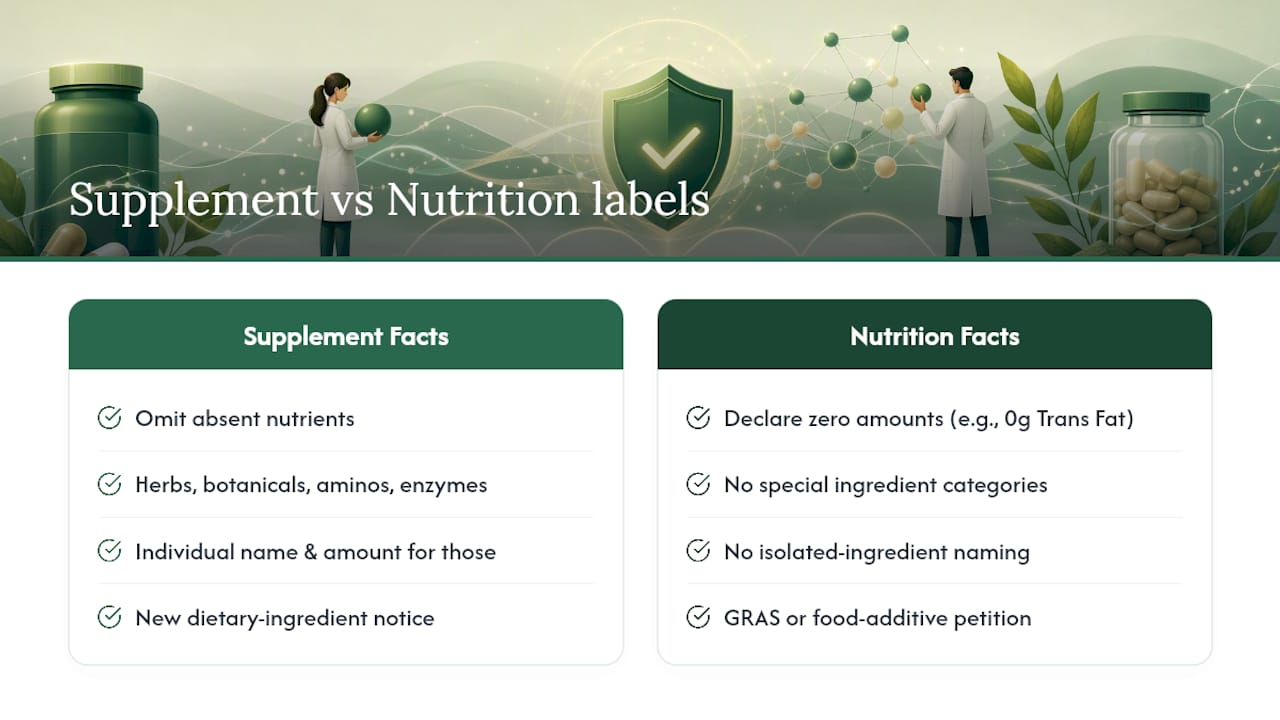
Pre-market obligations diverge sharply too. New food ingredients generally require categorization as Generally Recognized as Safe or go through a food additive petition process. New dietary ingredients in supplements follow a separate notification pathway, and the burden of proving safety and accurate labeling sits primarily with the manufacturer rather than a mandatory FDA pre-approval step. That difference is exactly why the reading skills covered in this guide matter more for supplements than for a box of crackers. You’re doing verification work that the regulatory system doesn’t fully do for you before the product reaches a shelf.
Reading Daily Values on Supplements Versus Food
Daily Value percentages work off the same reference numbers whether you’re looking at a cereal box or a bottle of vitamin D, but supplements put those percentages to different use. A targeted supplement is often built specifically to deliver a meaningful percentage, sometimes intentionally above 100%, of one or two nutrients.
That distinction changes how you should read the number. On a food label, a modest %DV is simply informational. On a supplement label, a %DV that’s unexpectedly low relative to the product’s marketing claims is a signal worth investigating, because the entire purpose of that product is usually to deliver a specific, meaningful dose.
Nutrients without an established Daily Value, many botanicals and specialty compounds among them, show up on supplement panels with no %DV column entry at all, just the ingredient name and amount. Food labels rarely include this category of ingredient, so supplement shoppers need to get comfortable evaluating raw milligram or microgram amounts without a percentage to lean on. That’s where knowing typical research doses for a given ingredient becomes genuinely useful, since the label alone won’t tell you if 200 mg is a meaningful amount or a token gesture.
What the Label Rules Get Right, and Where They Fall Short
The regulatory framework behind Supplement Facts panels does its job reasonably well when it comes to format consistency. Any consumer who learns the six-step reading process once can apply it to virtually any product, and that consistency is genuinely valuable in a category with thousands of brands and constant new product launches.
Where the system falls short is disclosure depth, not format. Proprietary blends remain legal, which means the label can satisfy every formatting requirement in 21 CFR 101.36 while still telling you almost nothing about individual ingredient doses. That’s a real gap, and no amount of consumer education fully closes it. You can spot a blend, but you can’t calculate what’s inside one from the label alone.
The conventional advice to “just check the %DV” oversells what that number can tell you, since plenty of meaningful ingredients, most botanicals included, have no DV at all. What actually protects a consumer is the combination covered here: serving math, chemical form, blend disclosure, and third-party verification, cross-checked against a real database rather than marketing copy. Prioritize brands that disclose individual ingredient amounts voluntarily. That single habit does more for your safety and your wallet than any other single reading tip in this guide.
— Organic
Where Pureblue Fits Once You Know What to Look For
Once you’ve learned to spot a proprietary blend and check chemical form, you’ll want a product that doesn’t ask you to guess. Pureblue publishes full ingredient breakdowns rather than combined blend totals, so the label you check against this guide is the label you actually get.
The flagship Quantum Vitality NAD+ Booster+ Detox combines energy, clarity, and detox support in one organic formula, third-party tested and made in an FDA-registered facility, with every ingredient amount listed individually on the product page. If you want to try it before committing to a full bottle, the free sample offer gives you the same panel to review firsthand. For anyone stacking multiple products, the Power Bundle covers a fuller routine at a fixed price without requiring you to piece together ingredient doses across separate brands. Pull up any of these product pages, run the panel through the checklist above, and see for yourself what full disclosure actually looks like.
This article is general information, not a substitute for advice from a qualified doctor. Consult a qualified healthcare professional about your own circumstances before acting on anything here.
Sources
- Dietary Supplement Labeling Guide: Chapter IV. Nutrition labeling | FDA
- 21 CFR 101.36 – Nutrition labeling of dietary supplements. | LII
- Dietary Supplement Label Database (DSLD) | NIH Office of Dietary Supplements