Cart
0

Combining L-theanine and caffeine produces small but measurable gains in reaction time, attention switching, and alertness, according to multiple randomized trials. It also blunts the jittery edge of caffeine alone for many people. The catch: the effects are acute, dose-dependent, and task-specific, not a permanent upgrade to your brain and nowhere close to a prescription stimulant.
TL;DR:
- The cognitive benefits of L-theanine and caffeine are modest and task-specific, mainly improving attention and alertness in sleep-deprived or controlled settings.
- The most-researched doses are around 100 mg theanine with 50 mg caffeine and 200 mg theanine with 160 mg caffeine, taken together about 30 to 60 minutes before focus tasks.
- Combining them shifts brain activity toward calm alertness, reducing jitters while maintaining or enhancing attention, but effects are not guaranteed across all tasks or doses.
- Higher doses of theanine may attenuate caffeine’s effects, and safety is generally good but caution is advised for those with cardiovascular issues, pregnancy, or on stimulant medications.
- Long-term effects and tolerance are unstudied, but the combination may help reduce caffeine-related side effects, especially jitters and blood pressure spikes.
Table of Contents
- Do L-Theanine and Caffeine Actually Improve Focus?
- How L-Theanine and Caffeine Work Together in the Brain
- L-Theanine and Caffeine Ratio, Dosage, and Timing That Match the Research
- Is L-Theanine and Caffeine Safe? Side Effects and Interactions
- What Happens With Long-Term Use of L-Theanine and Caffeine
- L-Theanine and Caffeine vs. Caffeine Alone and Other Nootropics
- Side Effects and Contraindications Beyond Jitters
- How to Trial the Stack Responsibly and Judge if It Helps You
- Pure Blue’s Approach to Organic, Third-Party-Tested Supplements
- Key Studies and Reviews Behind This Article
- A Practical Bottom Line on Testing This for Yourself
- Try Pureblue’s Organic Supplements for Everyday Energy and Clarity
- Sources
Do L-Theanine and Caffeine Actually Improve Focus?
The strongest human evidence comes from a handful of controlled trials, and they largely agree on the same story: this pairing sharpens certain kinds of attention without the shakiness of caffeine on its own.
The foundational trial here is Haskell et al. (2010), which tested combinations built around 100 mg of L-theanine and 50 mg of caffeine, roughly what you’d get from two cups of coffee paired with a concentrated tea extract. Compared with placebo, participants showed better accuracy on task-switching exercises, faster reaction times, and higher self-reported alertness. That’s a meaningfully different profile than caffeine by itself, which tends to speed people up while making them sloppier on tasks that require shifting attention between competing demands.
Kelly et al. (2008) added a neurophysiological layer to that picture. Using EEG, the researchers found that the same 100:50 combination shifted alpha-band brain activity, the frequency range associated with calm, focused wakefulness rather than either drowsiness or overstimulation. Alpha waves increased in a pattern that correlated with the behavioral improvements in attention tasks. That’s a rare case in nutrition research where the brain-wave data and the performance data actually point the same direction.
A more recent and more demanding test pushed the dose higher. A double-blind crossover trial in acutely sleep-deprived adults gave participants 200 mg of L-theanine with 160 mg of caffeine, roughly the caffeine content of a large coffee, and measured both behavior and brain response. The results were notable:
- Hit rates on a sustained-attention task improved significantly versus placebo (P = 0.02).
- Reaction times improved by a measurable amount consistent with improved attention tasks.
- P3b event-related potential amplitude increased and latency shortened, a signature of faster neural allocation of attention.
That P3b shift matters because it’s an objective marker, not a self-report. When someone says they “feel more focused,” that’s subjective and easy to dismiss. When their brain’s own electrical response to a target stimulus arrives faster and stronger, that’s harder to wave away, especially in a population, the sleep-deprived, where attention lapses are common and costly.
Statistic to note: in that sleep-deprivation trial, the reaction-time improvement of 38.1 milliseconds might sound trivial until you consider that in driving-simulator and vigilance research, differences of that magnitude are often what separate a caught error from a missed one.
Not every study paints an unambiguous picture, though. Systematic reviews that pool results across multiple trials find the effect on attention switching is real but modest, and it doesn’t show up uniformly across every task type. One meta-analysis of clinical trials on L-theanine reported small-to-moderate pooled effect sizes for attention and alertness, alongside a consistent, if modest, reduction in subjective jitteriness and headache compared with caffeine alone. The heterogeneity across studies, different doses, different tasks, different populations, means you should treat any single number as a range rather than a guarantee.
A broader review assessing whether L-theanine’s reputation matches its science reached a similar verdict: the combination is generally well tolerated and supports acute attention, but it’s not a stand-in for pharmaceutical-grade stimulants, and researchers still want larger, more standardized trials before treating any specific dose as settled.
One more wrinkle worth flagging before you assume more theanine automatically means more benefit: at lower, tea-like doses, Dodd et al. (2015) found theanine sometimes eliminated caffeine’s cognitive and mood effects rather than boosting them. The relationship between the two compounds isn’t a simple dose-up-benefits-up line. It bends.
How L-Theanine and Caffeine Work Together in the Brain
Caffeine and L-theanine push on different levers, and that’s exactly why combining them changes the experience rather than just adding two similar effects together.
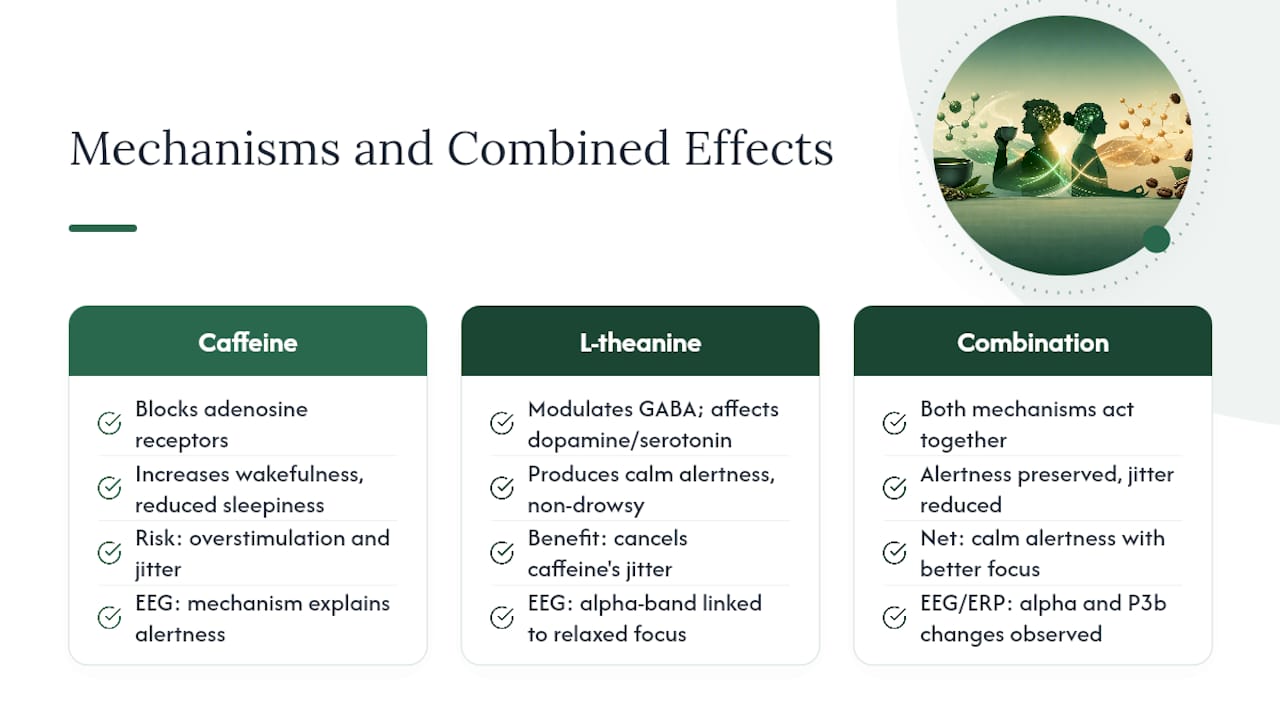
Caffeine works primarily by blocking adenosine receptors. Adenosine builds up in your brain over the course of the day and binds to receptors that promote drowsiness. Caffeine occupies those receptor sites without activating them, which is why you feel more awake, not because caffeine adds energy, but because it stops your brain from registering how tired it already is. That mechanism is well established and explains both caffeine’s alertness benefits and its downside: block adenosine hard enough, and you get overstimulation, racing thoughts, and the jittery, wired feeling familiar to anyone who’s had too much coffee on an empty stomach.
L-theanine, an amino acid found naturally in tea leaves, works differently. It appears to modulate GABA activity, the brain’s primary calming neurotransmitter system, while also influencing dopamine and serotonin pathways involved in mood and motivation. Unlike sedatives, it doesn’t cause drowsiness. Instead, it seems to promote a state researchers describe as “calm alertness,” which is the practical reason people pair it with caffeine in the first place: it’s trying to cancel out the jittery overstimulation piece of caffeine’s profile while preserving, or even enhancing, the alertness piece.
The EEG evidence backs this up at a physiological level. The alpha-band changes Kelly and colleagues documented reflect a brain state associated with relaxed focus, distinct from both anxious hyperarousal and sleepy disengagement. The P3b changes from the sleep-deprivation trial point to something more specific: faster and stronger neural signaling when the brain detects a target it needs to attend to. Put together, the EEG and ERP data suggest the combination doesn’t just make people feel different, it changes measurable patterns of brain electrical activity in ways that track with better performance on attention tasks.
This is also why nearly every trial dosed the two compounds together rather than staggering them. Simultaneous administration is the only pattern that’s actually been tested in controlled research, and it makes mechanistic sense: caffeine’s adenosine blockade and theanine’s GABA modulation appear to occur on overlapping timeframes, so taking them apart defeats the purpose of pairing them. If you’re going to try this combination, take both at the same time, not one before the other.
L-Theanine and Caffeine Ratio, Dosage, and Timing That Match the Research
Most of what you’ll read online cites a 2:1 theanine-to-caffeine ratio as the gold standard. That convention is worth knowing, but it’s not what most of the actual trials used.
Here’s what the research base actually looked like:
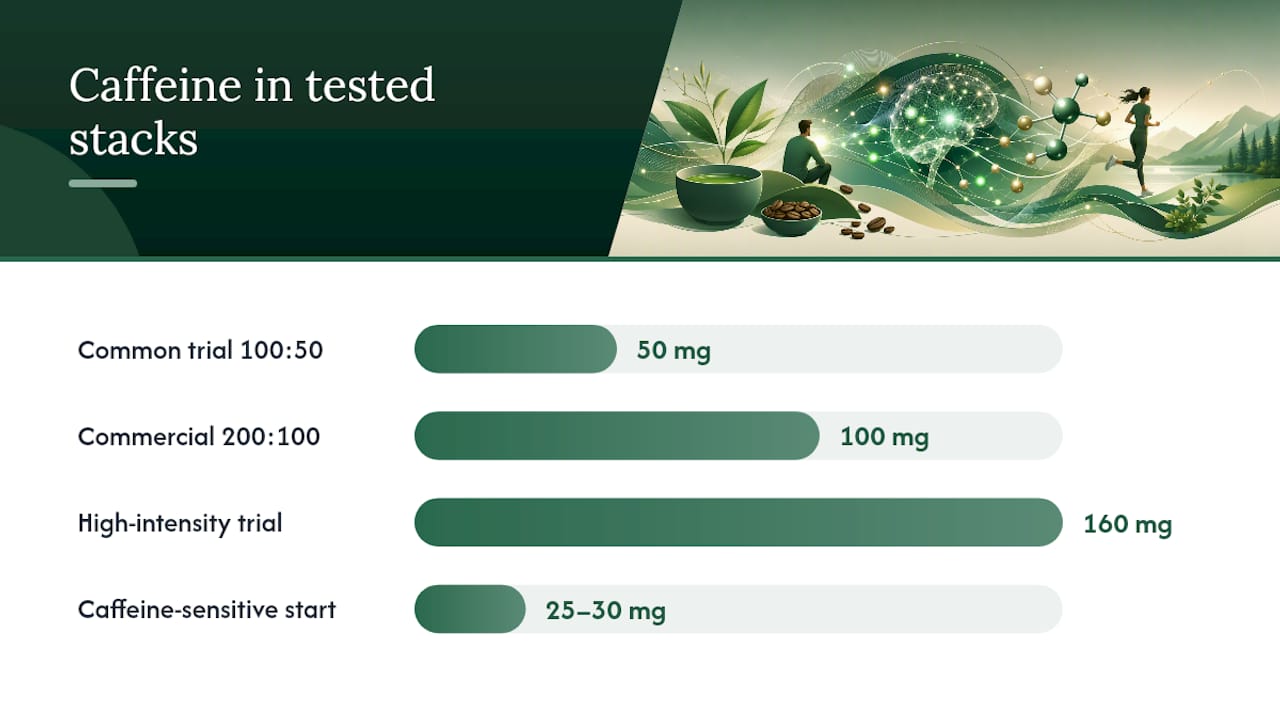
- The most-replicated dose cluster is 100 mg L-theanine paired with 50 mg caffeine, a 2:1 ratio, but at fairly low absolute amounts, roughly what you’d get from a strong green tea plus a modest coffee.
- The high-intensity trial dose was 200 mg L-theanine with 160 mg caffeine, closer to a 1.25:1 ratio, tested specifically in sleep-deprived adults who needed a bigger cognitive push.
- The commercial 2:1 ratio (often marketed as 200 mg theanine to 100 mg caffeine) is a popular convention, but it’s an extrapolation from the lower-dose trials rather than a separately validated formula in its own right.
Onset typically falls in the 30 to 60 minute range for both compounds, with peak effects showing up shortly after and a working window that extends somewhere from two to five hours depending on your metabolism and caffeine tolerance. If you’re using this stack before a specific task, plan the timing so the dose has cleared the onset window before you actually need peak focus.
For anyone trying this for the first time, a stepwise approach beats guessing:
- Start conservative. Try 100 mg theanine with 50 mg caffeine on a day with no major deadlines, so you can observe the response without pressure.
- Track your reaction for at least three hours. Note alertness, any jitteriness, heart rate if you’re inclined to check it, and how sustained attention tasks feel.
- Adjust only after multiple trials. If 100:50 feels underwhelming after several honest attempts, consider working up toward the higher trial dose (200 mg theanine, 160 mg caffeine) rather than jumping straight there.
- Give caffeine-sensitive readers a lower floor. If you already feel edgy on a single cup of coffee, start with 25 to 30 mg of caffeine paired with 100 mg theanine before going anywhere near the standard dose.
Pro Tip: Don’t assume doubling your theanine dose will double the calming effect. The Dodd et al. data suggest low, tea-level theanine doses can sometimes cancel out caffeine’s benefits rather than balance them, so more isn’t automatically better here. Stick close to trial-tested amounts rather than freelancing your own ratio.
If your primary source of theanine is brewed tea rather than a supplement, it helps to know what you’re actually getting. A cup of green tea’s caffeine content varies quite a bit by preparation and leaf type, which makes it harder to hit a precise ratio through tea alone compared with a measured supplement.
Is L-Theanine and Caffeine Safe? Side Effects and Interactions
Tolerability data on this combination is generally reassuring, but “generally well tolerated” isn’t the same as “risk-free for everyone,” and a few specific interactions deserve attention.
L-theanine itself has a strong safety profile across the doses used in trials, with minimal side effects reported even at 200 mg. Caffeine is the variable that carries most of the risk, and the standard reference point is the FDA’s guidance that healthy adults can generally handle up to 400 mg of caffeine per day, roughly four cups of coffee, without significant issues. That ceiling matters if you’re stacking this combination on top of your normal coffee habit rather than in place of it.
Blood pressure findings are genuinely mixed, and this is where nuance matters more than a clean headline. Some trials using higher theanine doses found it attenuated the blood-pressure spikes that caffeine alone can cause. Other trials using lower theanine amounts found no such protective effect, and in some cases caffeine’s typical BP increase showed up unopposed. The takeaway: don’t assume theanine cancels out caffeine’s cardiovascular effects at every dose. The protective signal seems tied to the higher end of tested amounts, not guaranteed at every ratio.
A few groups and situations call for extra caution:
- Anyone on prescription stimulants (for ADHD or narcolepsy, for example) should talk to a doctor before adding caffeine and theanine, since stacking stimulant-adjacent compounds can compound side effects unpredictably.
- Pregnant individuals should stick to established caffeine limits for pregnancy and treat any added supplement, theanine included, as a conversation for a prenatal care provider rather than a personal experiment.
- People with existing cardiovascular disease or arrhythmia should be more conservative with caffeine dosing generally, given the mixed blood-pressure evidence described above.
- People with certain CYP1A2 genetic variants metabolize caffeine much more slowly, which means a “standard” dose can behave like a much larger one for them; this is one reason identical doses produce wildly different subjective effects from person to person.
- Anyone combining this with other stimulant-containing supplements or medications (some GLP-1 medication regimens, for instance, interact with caffeine intake in ways worth reviewing with a clinician) should check for overlap before adding another caffeine source.
When in doubt about how this combination interacts with a specific medication or condition, that’s a conversation for a healthcare provider, not a supplement label.
What Happens With Long-Term Use of L-Theanine and Caffeine
The trial evidence here is almost entirely acute, meaning researchers measured what happened over hours, not months, so any claim about long-term benefits stretches beyond what’s actually been tested.
That gap matters because caffeine tolerance is well documented: your adenosine receptors adapt to regular caffeine exposure, which is why habitual coffee drinkers often need more to get the same lift a newcomer feels from a single cup. Whether regular L-theanine co-administration slows that tolerance curve, speeds it up, or does nothing at all hasn’t been rigorously studied over extended timeframes. Anecdotal reports suggest some people feel the calming, anti-jitter piece stays consistent even as caffeine’s alertness effect fades with regular use, but that’s a pattern, not a proven mechanism.
The more grounded, evidence-backed potential upside of long-term use is behavioral rather than pharmacological: swapping a plain caffeine habit for a theanine-paired one may reduce the cumulative jitteriness, afternoon crash, and blood-pressure spikes tied to caffeine alone, especially for people who already notice those effects. That’s a quality-of-life improvement worth something on its own, separate from any claim about sustained cognitive enhancement.
If you’re considering this as a daily habit rather than an occasional tool for a demanding task, treat it as an open question rather than a settled benefit, and keep an eye on whether your caffeine tolerance is creeping upward regardless of the theanine.
L-Theanine and Caffeine vs. Caffeine Alone and Other Nootropics
Caffeine by itself reliably increases alertness and reduces perceived fatigue, but it does so at the cost of jitteriness, and its benefits on tasks requiring sustained, flexible attention are less consistent than on simple vigilance tasks. Adding L-theanine doesn’t eliminate caffeine’s stimulant effect. It reshapes it, trading some of the raw jolt for steadier, more evenly distributed alertness and better performance on attention-switching tasks specifically.
Compared with other popular nootropic combinations, L-theanine and caffeine has one major advantage: it’s the best-studied pairing in this category, with multiple double-blind, placebo-controlled trials and EEG data behind it. Many other stacks marketed as cognitive enhancers rely on far thinner evidence, often a single small study or purely mechanistic reasoning without human trial confirmation. That doesn’t mean other nootropics don’t work; it means the theanine-caffeine pairing has a more mature evidence base to actually evaluate.
It’s also worth being clear about what this combination is not. It’s not a substitute for prescription stimulants used to treat ADHD or narcolepsy, and the review literature is explicit that its cognitive effects, while real, are considerably more modest than those of pharmaceutical-grade compounds. Think of it less as a performance drug and more as a way to get more consistent value out of a caffeine habit you probably already have.
Side Effects and Contraindications Beyond Jitters
Jitteriness gets most of the attention, but it’s not the only thing worth watching for with this combination.
Headaches can occur, particularly if you’re not used to regular caffeine intake or if you’re sensitive to rapid changes in it, including caffeine withdrawal headaches on days you skip your usual dose. Some people report mild gastrointestinal discomfort from caffeine specifically, independent of the theanine. Sleep disruption is a real risk if the combination is taken too late in the day. Even though theanine has a calming reputation, caffeine’s half-life of several hours means afternoon or evening doses can still interfere with sleep onset that night.
There’s also a less obvious consideration: because L-theanine can have a mild calming effect on its own, combining it with other calming supplements, sleep aids, or alcohol may compound sedation in ways that haven’t been specifically studied together. That’s a reasonable thing to flag with a doctor if you’re already taking something for anxiety or sleep.
Finally, anyone with a diagnosed anxiety disorder should know that while theanine is often marketed for calming effects, its net impact when combined with a stimulant hasn’t been extensively studied in clinical anxiety populations specifically, as opposed to healthy adult volunteers in cognitive trials. The safest approach for that group is a conversation with a treating clinician before experimenting.
How to Trial the Stack Responsibly and Judge if It Helps You
Self-experimentation with supplements works best when it looks like a mini-study, not a vibe check. Here’s a structure that mirrors what the actual trials did.
- Run a baseline day first. Track your normal caffeine intake, your subjective alertness at a few points during the day, and your performance on whatever task matters most to you, work focus, a specific cognitive task, whatever you’re actually trying to improve. No theanine involved yet. This is your control condition.
- Run a controlled dose day. Pick a starting protocol, 100 mg theanine with 50 mg caffeine is the best-supported entry point, or a more conservative 100 mg theanine with 25 mg caffeine if you’re caffeine-sensitive. Take both together, 30 to 60 minutes before the window where you want peak focus.
- Track the same measures you tracked on baseline. Subjective alertness, any jitteriness or its absence, and objective performance on your chosen task. Write it down. Memory is a poor substitute for a same-day note.
- Compare across multiple attempts, not just one. A single day tells you almost nothing, since sleep quality, stress, and food intake all swing your baseline. Repeat the comparison across at least three or four separate days before drawing a conclusion.
Realistic expectations matter here. The trial evidence points to the clearest benefits on simple, sustained attention tasks and in sleep-deprived states, less so on complex executive-function work. If your goal is grinding through a repetitive vigilance task on too little sleep, this combination has real trial support. If you’re hoping it will make a genuinely difficult creative or strategic problem easier, the evidence is thinner.
Pro Tip: Keep your trial days as similar as possible in every other respect, same sleep window, same meal timing, same task difficulty. The biggest mistake in self-experimentation is changing three variables at once and then crediting (or blaming) the supplement for what your sleep schedule actually did.
Scale up only after your notes show a consistent pattern, not after one especially good day.
Pure Blue’s Approach to Organic, Third-Party-Tested Supplements
Pureblue builds its supplement line around organic ingredients, third-party testing, and manufacturing in an FDA-registered facility, standards worth looking for in any supplement, not just this one.
None of that is a substitute for the specific research on L-theanine and caffeine discussed above. Pureblue’s current lineup is not positioned as a treatment for attention deficits or a direct replica of the trial doses referenced in this article. What third-party testing and organic sourcing do offer is a baseline of manufacturing confidence, knowing what’s on the label is what’s actually in the product, which matters regardless of which specific compound you’re trying to dose accurately.
If you’re the kind of health-focused reader who wants that level of manufacturing transparency in whatever supplements you do choose, that standard is worth holding every brand to, Pureblue included.
Key Studies and Reviews Behind This Article
The claims above rest on a specific set of primary studies and reviews, not general impressions of what supplements “probably do.” Here’s the short list worth knowing if you want to read further:
- Haskell et al. (2010): the foundational RCT testing 100 mg theanine plus 50 mg caffeine on attention switching and mood.
- Kelly et al. (2008): the EEG study linking the combination to alpha-band changes and attention-task performance.
- High-dose L-theanine–caffeine RCT in sleep-deprived adults: the crossover trial using 200 mg theanine and 160 mg caffeine, with P3b ERP data.
- Dodd et al. (2015): the study showing lower, tea-like theanine doses can blunt rather than enhance caffeine’s effects.
- Meta-analysis of clinical L-theanine trials: pooled effect sizes across multiple studies, useful for calibrating expectations.
- Review on L-theanine’s evidence base: a broader assessment of whether the science matches the marketing.
- Review on L-theanine from tea leaf to supplement: regulatory and safety context, including caffeine intake ceilings.
A Practical Bottom Line on Testing This for Yourself
The research on L-theanine and caffeine is more solid than most supplement pairings you’ll encounter, but it’s also narrower than the marketing around it suggests. If you’re a healthy adult who wants steadier focus without the jitter of coffee alone, and especially if you’re working on too little sleep, this combination has real trial support behind the 100:50 and 200:160 dose ranges. If you’re expecting it to solve a chronic attention problem or replace medical treatment, it won’t, and no honest reading of the evidence claims otherwise.
The biggest open questions aren’t about whether it works acutely, they’re about what happens with regular, long-term use, whether tolerance develops to the theanine side the way it does to caffeine, and whether the popular 2:1 ratio actually beats the lower doses that were tested more rigorously. Nobody has run that trial yet.
Start with a documented, honest experiment on yourself rather than a leap of faith, and loop in a doctor if you’re on other medications, pregnant, or managing a cardiovascular condition.
— Organic
Try Pureblue’s Organic Supplements for Everyday Energy and Clarity
If you’re testing L-theanine and caffeine to smooth out your energy without the crash, the same principle, quality ingredients you can actually verify, applies to everything else you put in your body. Pureblue’s organic supplement lineup is built on that idea: third-party tested, manufactured in an FDA-registered facility, and free of artificial fillers, so you’re not layering uncertainty on top of your own experiment.
The flagship Quantum Vitality NAD+ booster and detox formula is built for readers who want organic support for energy and mental clarity alongside whatever focus routine they’re already running. If you want to try it before committing, the free Quantum Vitality sample offer is a low-risk way to see how it fits your routine, and the Power Bundle is worth a look if you’d rather stock up on multiple products at once. None of this replaces medical advice, but if organic sourcing and verified testing matter to you the way they should matter in any supplement decision, start with the product page and see which option fits what you’re already trying to build.
Sources
L-theanine shows up naturally in tea leaves, particularly green and black tea, but the amount varies enormously depending on the leaf, brewing time, and water temperature, which makes precise dosing through tea alone unreliable if you’re trying to hit a specific trial-tested amount.
Fermented tea beverages carry their own variability too. If kombucha is part of your routine, know that its caffeine and theanine content depends heavily on the tea base used in fermentation, so it’s not a consistent substitute for a measured dose.
For anyone trying to replicate what the research actually tested, a standardized supplement form, capsule or powder with a clearly labeled milligram amount, is the more reliable option. It lets you hit the 100 mg or 200 mg marks used in trials without guessing at tea concentration. Look for products that specify L-theanine content explicitly rather than listing a proprietary blend, since blend labeling often hides the actual dose you’re getting. Third-party testing adds another layer of confidence, since it verifies that what’s on the label matches what’s in the capsule.
- Haskell et al. (2010) — effects of L-theanine and caffeine
- High-dose L-theanine–caffeine RCT in sleep-deprived adults (2025)
- Review: l-theanine — does the science match the hype (2021 review source included)
- Kelly et al. (2008) — L-theanine and caffeine in combination affect human cognition