Cart
0

You can raise NAD+ reliably by combining regular exercise, consistent sleep, and a diet rich in vitamin B3 with, when appropriate, an oral precursor like NR or NMN. Supplements provide precursors that support the pathways your cells use to build NAD+, rather than delivering NAD+ directly. Talk to a clinician before starting any precursor, especially if you take other medications.
TL;DR:
- Lifestyle factors like consistent exercise, quality sleep, and moderate alcohol intake are the most reliable ways to support NAD+ levels naturally.
- Oral precursors such as nicotinamide riboside and NMN can raise blood NAD+ but their effectiveness varies based on gut microbiome activity and individual metabolism.
- Supplements are most effective when paired with healthy habits, but high doses, especially of niacin, carry risks like skin flushing or liver toxicity.
- Intravenous NAD+ therapy lacks strong human evidence and is generally less supported than oral precursors for most health and aging benefits.
- Proper product choice requires transparent labeling, third-party testing, and consultation with a clinician, as the supplement market often overstates claims.
Table of Contents
- Top Practical Ways to Boost NAD+: Lifestyle, Diet, Supplements, and Clinical Options
- How NAD+ Precursors Work and What Clinical Trials Show
- Safety, Side Effects, and Dosing Basics
- Route Comparison: Oral Precursors Versus IV NAD+
- Research Summary and Open Questions
- How Pureblue Approaches NAD+ Product Quality
- Try Quantum Vitality if You’re Ready to Move Past Diet Alone
- Sources
Top Practical Ways to Boost NAD+: Lifestyle, Diet, Supplements, and Clinical Options
The habits with the strongest, most consistent support for raising NAD+ don’t come in a bottle. Exercise, sleep, and alcohol moderation form the foundation, and clinicians generally recommend nailing those down before layering on anything else. The Cleveland Clinic notes that lifestyle factors like consistent physical activity, adequate sleep, and limiting alcohol intake support the body’s own NAD+ production, alongside eating enough of the nutrients that feed it.
Here’s what actually moves the needle, in order of evidence strength:
- Exercise, especially aerobic and interval training. Muscle tissue burns through NAD+ during exertion, and the body responds by upregulating the enzymes that resynthesize it.
- Sleep of consistent length and timing. NAD+ metabolism follows circadian rhythms, and chronic sleep disruption appears to blunt the body’s normal replenishment cycle.
- Limiting alcohol. Heavy drinking taxes the same enzymatic pathway (via alcohol dehydrogenase) that converts NAD+ to NADH, competing with your cells’ other uses for it.
- Managing chronic stress. Sustained cortisol elevation is linked to metabolic dysfunction that indirectly strains NAD+ balance, though this connection is less quantified than exercise or sleep.
Diet matters, but mostly as a baseline rather than a booster. Foods don’t contain meaningful NAD+ itself. Instead they supply the precursor nutrients, mainly vitamin B3 forms and tryptophan, that your body converts into NAD+ through its own biosynthesis pathways. Turkey, tuna, chicken breast, peanuts, and mushrooms are decent tryptophan or niacin sources, but the quantities in a normal diet rarely come close to the doses used in clinical NAD+ research. That gap is exactly why supplement categories exist.
Four precursor types show up across the supplement market, with differing evidence and profiles:
- Nicotinamide riboside (NR): a vitamin B3 derivative studied in human trials for its ability to raise circulating NAD+.
- Nicotinamide mononucleotide (NMN): structurally closely related to NAD+, also shown in trials to increase blood NAD+ levels.
- Nicotinamide (Nam): a common B3 form with weaker evidence for raising NAD+ compared to NR and NMN.
- Nicotinic acid (NA): classic niacin, effective at raising NAD+ but associated with skin flushing at certain doses.
Product quality varies enormously within each category. Look for third-party testing, a transparent ingredient list stating actual precursor content (not just a proprietary blend), and manufacturing in a registered facility. A supplement like Quantum Vitality can help fill the gap between diet and clinical dosing, though it works best paired with the lifestyle habits above, not instead of them.
Intravenous NAD+ therapy exists as a clinical option delivering NAD+ directly into the bloodstream rather than relying on oral absorption and conversion. Evidence supporting it is limited compared to oral precursors, so this distinction is important before considering it.
How NAD+ Precursors Work and What Clinical Trials Show
Your body can’t just absorb NAD+ from a pill and put it to work. The molecule is too large and unstable to survive digestion intact, which is why every legitimate supplement on the market delivers a precursor instead, a smaller molecule your cells convert into NAD+ through one of two biosynthetic routes. Dietary NAD±boosting compounds rely on either the salvage pathway, which recycles nicotinamide and NR back into NAD+, or the Preiss-Handler pathway, which processes nicotinic acid. Oral NAD+ itself never gets to enter either pathway efficiently, which is why no credible supplement lists NAD+ as its active ingredient.
The human evidence for NR and NMN is genuinely encouraging on one specific point: they raise circulating NAD+. A randomized, placebo-controlled trial comparing NR, NMN, and Nam found that NR and NMN, but not Nam, significantly increased circulating NAD+ over 14 days. That same study surfaced something most consumer marketing skips entirely.
The effects of NR and NMN on circulating NAD+ appear to depend partly on their conversion by gut bacteria into nicotinic acid before the body can use them systemically.
That finding reframes how you should think about “bioavailability.” It’s not just about what you swallow. It’s about what your gut microbiome does with it before your bloodstream ever sees a change. That helps explain why two people taking the identical dose of NR can show different blood NAD+ responses: their gut bacteria are running different conversion efficiencies. The same research found that NR and NMN also shifted gut microbial metabolism and short chain fatty acid production, suggesting these supplements might be doing more than just feeding the salvage pathway.
Here’s the catch that separates hype from reality: biochemical increases in blood NAD+ are not the same thing as proven clinical benefits. A comprehensive review of human NAD±boosting studies concluded that while NR and NMN reliably raise NAD+ metabolites, translating that into consistent improvements in energy, cognition, or aging markers has been inconsistent across trials. Some studies show modest gains in specific populations; others show no meaningful difference from placebo. The effect appears context-dependent, and people with a demonstrable NAD+ deficiency or existing metabolic strain may see more benefit than an already-healthy adult taking the same dose.
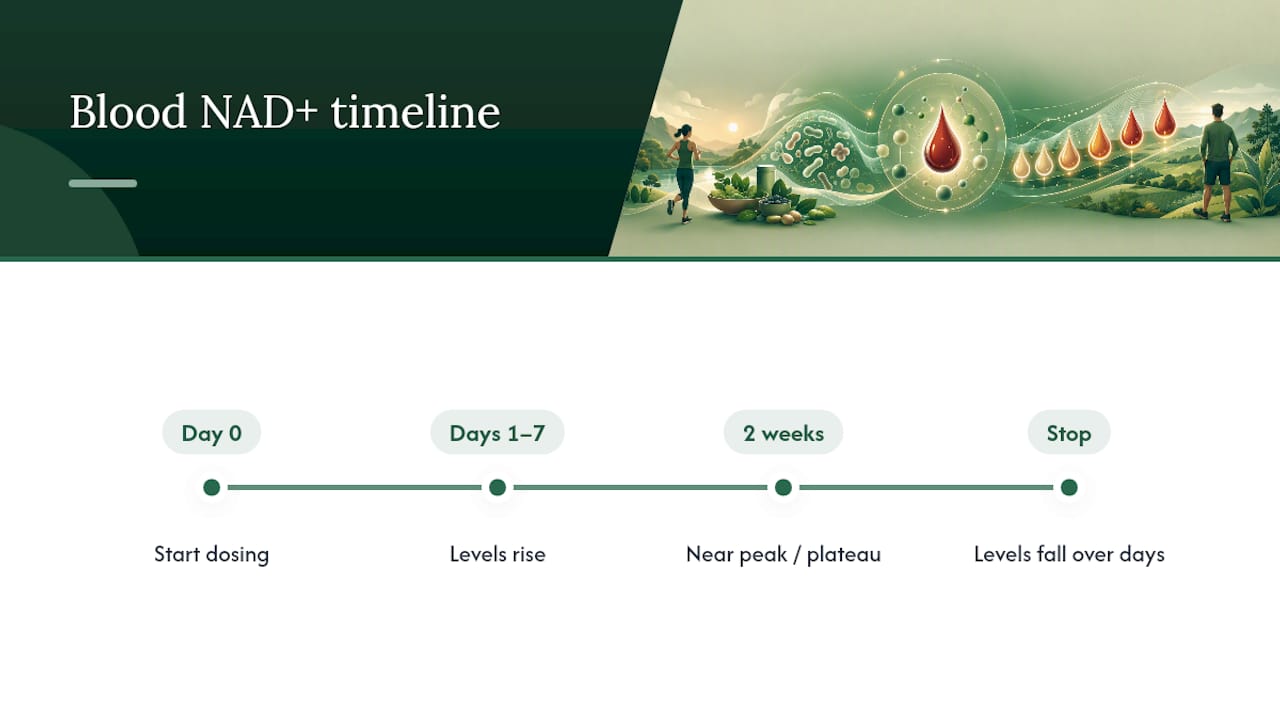
Timeline matters if you’re deciding whether a supplement is “working.” Blood NAD+ levels typically rise over days to a couple of weeks of consistent daily dosing before plateauing, and levels decline over several days after stopping. That’s a meaningfully different pattern than something like caffeine, where you feel an effect within an hour. If you start an NR or NMN regimen expecting next-day energy, you’re measuring against the wrong timescale. Give it the full two weeks before judging whether it’s doing anything, and understand that stopping means losing the accumulated effect within a week.
Active research is still filling in the picture. Clinicaltrials lists ongoing and completed studies on NAD+ precursors and related interventions, reflecting a field that’s evidence-active but still maturing rather than settled.
Safety, Side Effects, and Dosing Basics
NAD+ precursors are generally well tolerated at the doses used in published research, but “generally well tolerated” isn’t the same as “risk-free for everyone.” The most common side effect, and the one most people actually experience, is niacin flushing: a warm, reddish, sometimes itchy skin reaction tied specifically to nicotinic acid (NA) rather than NR or NMN. Gastrointestinal upset, mild nausea, or headache show up occasionally across precursor types too.
The more serious concern is dose-dependent. Clinical guidance flags that very high doses of niacin carry a risk of liver toxicity, a risk that scales with dose rather than appearing at typical supplemental amounts. This is why the tolerable upper intake level for niacin exists in nutrition science, and why “more is better” is a bad assumption to bring into any NAD+ regimen.
Certain groups should loop in a clinician before starting any NAD+ precursor:
- Pregnant or nursing individuals, since safety data in these populations is limited.
- Anyone with a history of cancer, because NAD+'s role in cellular metabolism and DNA repair raises theoretical questions researchers haven’t fully resolved.
- People with existing liver disease, given niacin’s known hepatic burden at high doses.
- Anyone on medications that affect liver enzymes or blood pressure, since interactions haven’t been comprehensively mapped.
Three dosing principles keep you on the safer side of this. Start low and increase gradually rather than jumping to the highest dose you find online. Prefer products whose dose matches what’s actually been studied in trials rather than proprietary blends that hide the numbers. And watch out for combination products stacking multiple B3 forms, since it’s easy to unknowingly exceed a sensible niacin intake when NR, Nam, and NA are all present in the same formula.
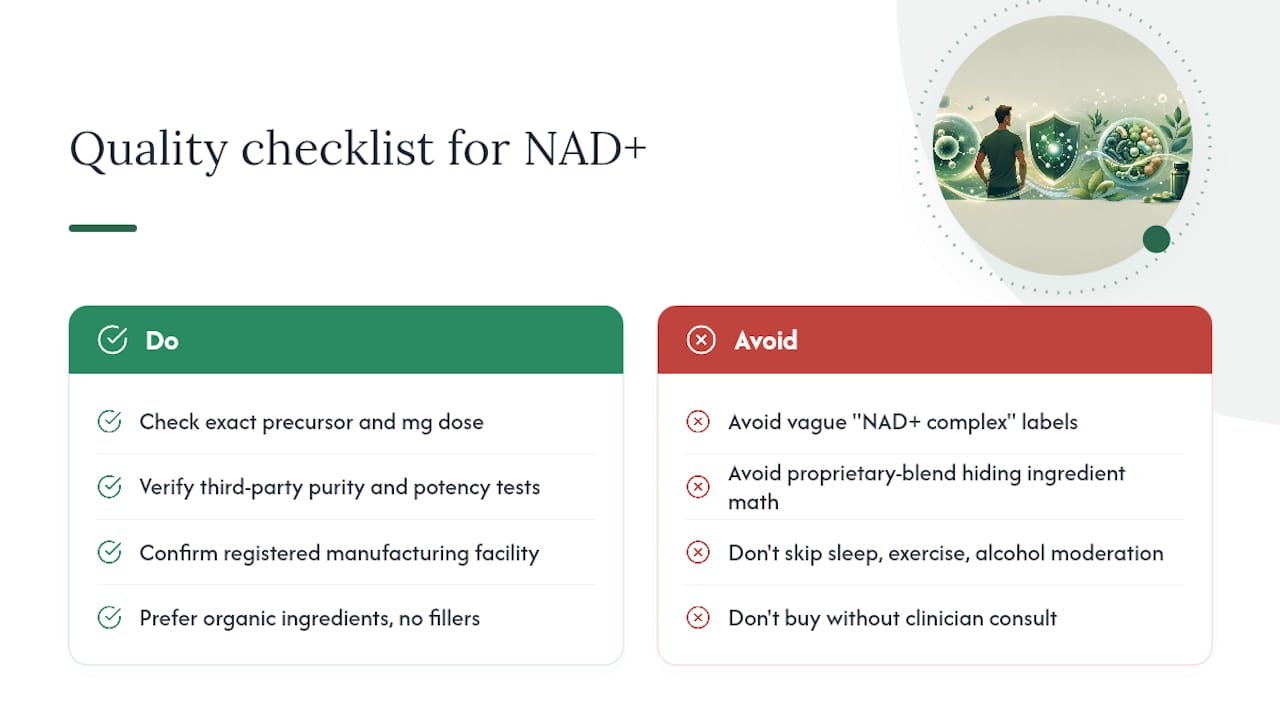
Quality indicators separate a serious supplement from a marketing exercise. Third-party testing for purity and potency, a transparent ingredient list with actual milligram amounts (not “proprietary NAD+ complex”), and manufacturing in an FDA-registered facility are the baseline signals worth checking before you buy anything.
Pro Tip: Check the supplement facts panel for the exact precursor and dose, not just the words “NAD+” on the front label. A product can legally say “NAD+ support” while containing a fraction of the dose used in the human trials that generated the evidence you’re relying on.
Route Comparison: Oral Precursors Versus IV NAD+
Oral supplements and IV infusions behave differently in the body, which influences which approach may make sense.
- Speed and duration. Oral NR and NMN produce a slower, sustained rise in blood NAD+ that builds over roughly two weeks of daily dosing. IV NAD+ produces a rapid spike that peaks quickly and declines just as fast, meaning the elevated levels don’t stick around.
- Evidence strength. Human trial data is considerably deeper for oral NR and NMN, including the randomized comparisons already covered on their effect on circulating NAD+. IV NAD+ has far less rigorous human research behind it, and most of what exists comes from small, uncontrolled case series rather than the kind of randomized trials that back oral precursors.
- Practical trade-offs. Oral precursors fit into a daily routine, cost less per dose, and don’t require a clinical setting. IV NAD+ requires a trained provider, ongoing monitoring during infusion, and a real cost per session that adds up if you’re doing it regularly.
- When IV might make clinical sense. Some clinical contexts, such as supervised protocols for specific conditions, use IV NAD+ under direct medical oversight. For general wellness use outside that setting, it remains an experimental approach without the outcome data to back routine use.
For most health-conscious adults chasing sustained cellular support rather than a one-time boost, daily oral dosing lines up better with how NAD+ metabolism actually works. That’s also the more studied, more accessible, and more affordable route.
Research Summary and Open Questions
The gut microbiome angle is probably the most underappreciated variable in the entire NAD+ conversation. Multiple people can take the same NR or NMN dose and land on genuinely different blood NAD+ outcomes, and a meaningful share of that variability appears to trace back to how efficiently each person’s gut bacteria convert these precursors into nicotinic acid before systemic absorption. That single mechanism might explain a good chunk of the “it works great for me but did nothing for my friend” anecdotes that circulate around NAD+ supplements.
Interindividual differences in gut microbiome composition and deamidation pathways may explain why identical precursor doses produce different circulating NAD+ responses across people.
Dose-response modeling adds another layer of nuance that consumer marketing tends to flatten. Mathematical modeling of NAD+ biology indicates the relationship between precursor dose and resulting NAD+ levels is nonlinear, shaped by age, metabolic state, and route of administration. In plain terms: doubling your dose doesn’t reliably double your result, and there’s likely a point of diminishing or even counterproductive returns that current research hasn’t fully mapped for any specific precursor.
Three gaps stand out as the ones future research needs to close before this field graduates from “promising” to “settled”:
- Tissue-specific uptake. Raising NAD+ in blood doesn’t confirm it’s rising in the tissues (muscle, brain, liver) where the aging and energy benefits are theorized to happen.
- Long-term outcomes. Most human trials run weeks to a few months. Whether sustained years-long supplementation changes disease risk or aging trajectories remains unanswered.
- IV pharmacokinetics. The rapid-peak, fast-decline pattern of IV NAD+ is documented, but how that translates into any lasting cellular benefit is still poorly characterized.
For now, the actionable takeaway is to treat NAD+ supplementation as a complement to lifestyle fundamentals, not a replacement for them, and to expect individual variation rather than a guaranteed universal response.
How Pureblue Approaches NAD+ Product Quality
Most of the NAD+ supplement market runs on vague marketing rather than verifiable specifics, and that gap is where consumers get burned. A useful checklist before buying anything: does the label state the exact precursor and milligram dose, not just “NAD+ complex”? Has the product been third-party tested for purity and potency, with results you can actually find? Is it manufactured in a registered facility with documented quality controls?
Many formulations in the supplement market aim to meet these standards. Some products use organic ingredients free of artificial fillers, undergo third-party testing for purity and potency, and are produced in registered manufacturing facilities. That’s not a claim we make to sound impressive. It’s a direct response to how much of this category hides its actual ingredient math behind proprietary blend labels.
None of that replaces the fundamentals covered earlier in this guide. Consistent sleep, regular exercise, and moderate alcohol intake still do more heavy lifting for your cellular energy than any capsule will. A supplement earns its place only after those basics are in order, and only alongside a conversation with your clinician about dose and any conditions or medications that call for caution. If you’re still weighing whether supplementation makes sense for you at all, our explainer on when supplements are actually worth it is a reasonable place to start before you spend money on anything.
Try Quantum Vitality if You’re Ready to Move Past Diet Alone
If you’ve already tightened up sleep, exercise, and alcohol intake and you’re looking at oral precursors as the next step, Quantum Vitality NAD+ Booster+ Detox gives you a 3-in-1 formula built around NAD+ support and gentle detox, using organic ingredients with no artificial fillers.
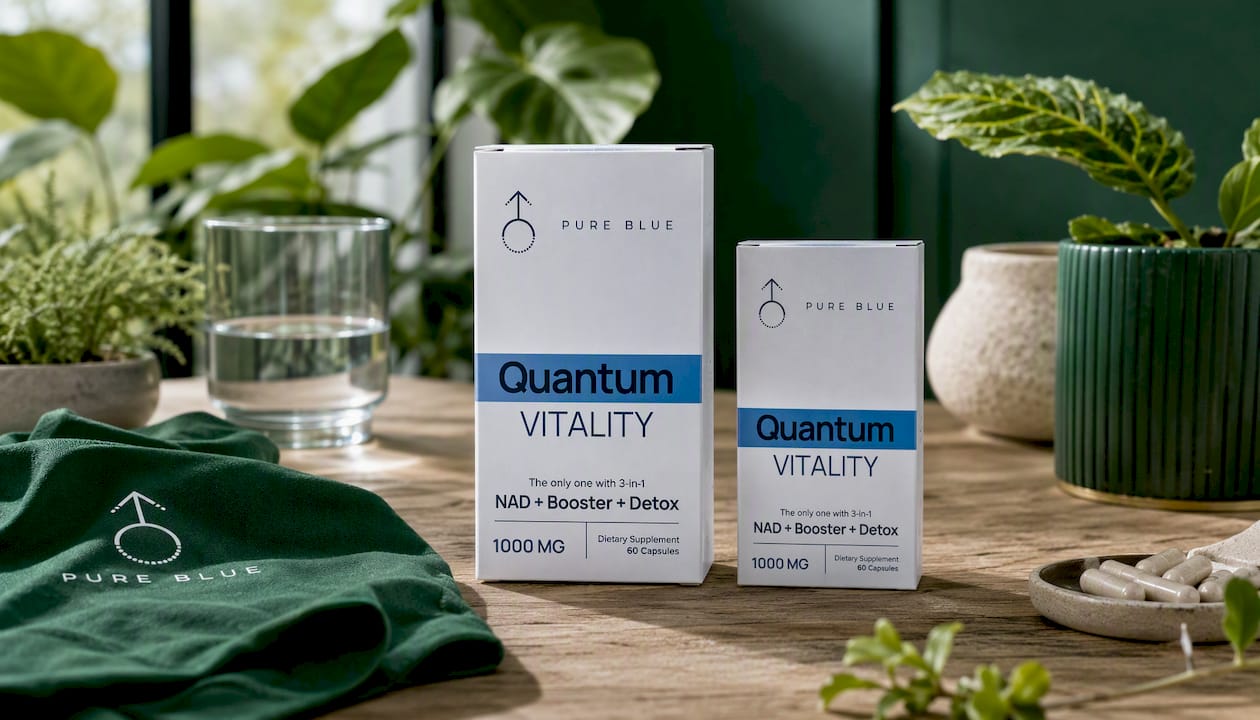
Some supplement batches are third-party tested for purity and potency, and are manufactured in registered facilities, which are quality markers worth checking on any NAD+ product before you buy it. The ingredient list is transparent rather than hidden behind a proprietary blend, which matters given how much this category depends on you being able to see the actual dose you’re taking.
If you’d rather test it before committing, the free Quantum Vitality trial offer lets you try the formula firsthand. Either way, run your dose and any existing conditions or medications by your clinician first, particularly if you fall into one of the caution categories covered above. From there, ordering takes a few minutes, and subscription options are available if you decide it’s worth keeping in your daily routine.
Sources
For readers who want to go deeper than this guide, these are the primary sources behind the claims above: the PMC review of NAD±boosting compounds in humans, the Nature Metabolism head-to-head trial on NR, NMN, and Nam, the Cleveland Clinic’s consumer explainer on NAD+ supplements, the Springer review on NAD+ biology and clinical perspectives, and an active clinical trial listing on ClinicalTrials.gov for readers tracking ongoing research. For background on adjacent peptide research, Pure Peptide’s overview of NAD-related peptides is worth a look, and Data Peptides’ work on gut health mechanisms connects usefully to the microbiome findings covered above.
This article is general information, not a substitute for advice from a qualified doctor. Consult a qualified healthcare professional about your own circumstances before acting on anything here.
- Dietary Supplementation With NAD±Boosting Compounds in Humans: Current Knowledge and Future Directions — PMC
- The differential impact of three different NAD+ boosters on circulatory NAD and microbial metabolism in humans — Nature Metabolism
- NAD+ Supplements: Can They Really Slow Down Aging? — Cleveland Clinic