Cart
0
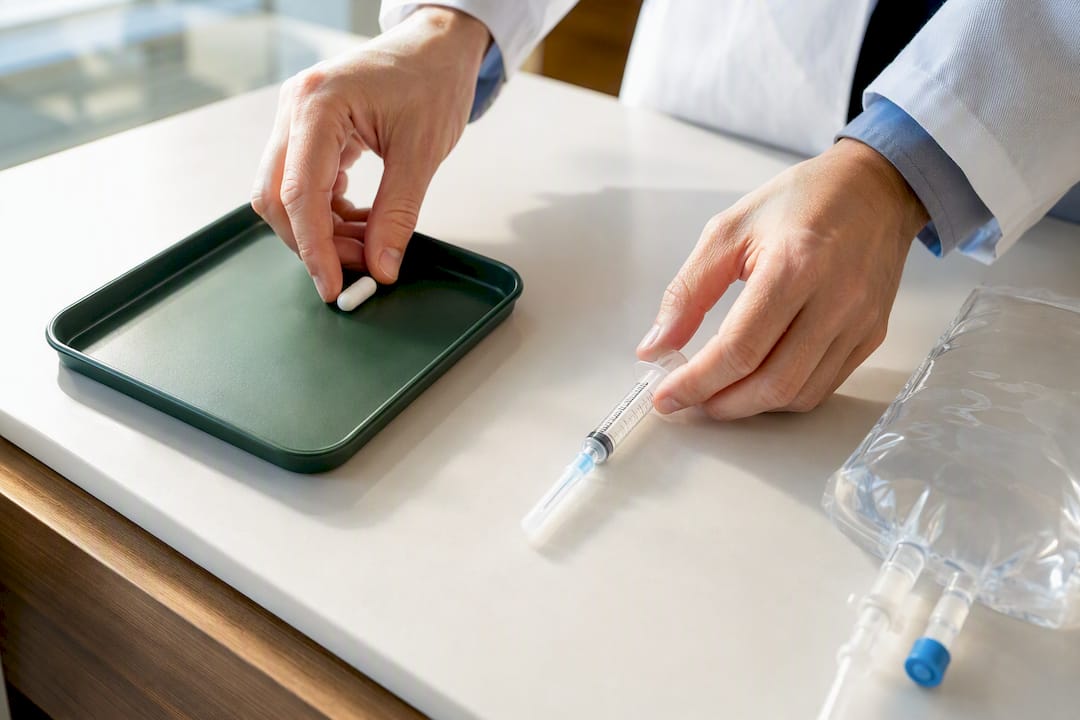
Most adults start oral NMN or NR at moderate daily doses, with common maintenance targets varying by source. Practice-reported IV sessions typically use doses in the mid-hundreds of milligrams, and subcutaneous injections tend to fall in the tens to low hundreds of milligrams per dose, always under clinical supervision. There is no FDA-approved NAD drug and no official government dosage, so every number below reflects trial data and clinical practice, not a regulated standard. Talk to a clinician before you start, especially at higher doses.
TL;DR:
- Oral NMN doses typically start around 250 mg daily, with maintenance up to 500 mg and some reports reaching 1,000 mg, but long-term effects are unclear.
- IV infusions generally range from a few hundred milligrams per session, with higher loading doses over one to four hours, but these are based on practice rather than controlled studies.
- Clinicians tailor NAD doses based on individual factors like age, health, medications, and goals, often starting low and gradually increasing with ongoing assessment.
- There is no FDA-approved NAD drug, and most clinic dosing practices are based on provider experience, not regulatory standards, making transparency and testing crucial.
- Choice of route influences speed, cost, and convenience; oral is most affordable but slow, SubQ offers faster absorption, and IV provides rapid effects for short-term loading.
Table of Contents
- What Are the Typical NAD Supplement Dosage Ranges?
- How Do Clinicians Decide Your NAD Dose?
- Is NAD Supplementation Safe, and What Are the Regulatory Limits?
- Oral vs. Subcutaneous vs. IV: Which Route Fits Your Goal?
- What Does a Realistic NAD Dosing Protocol Look Like?
- How Do You Choose a Quality NAD Supplement?
- When Should You Talk to a Clinician Before Starting?
- What Pureblue Gets Right About NAD Dosing
- Try Quantum Vitality Before You Commit to a Full Protocol
- Sources
What Are the Typical NAD Supplement Dosage Ranges?
Dosing depends entirely on which form you’re taking, and the differences are bigger than most people expect. An oral capsule, an IV bag, and a subcutaneous injection are not interchangeable milligram for milligram. Absorption rates, first-pass liver metabolism, and how fast NAD+ actually gets used by your cells all shift depending on the route.
Oral NMN (nicotinamide mononucleotide) shows up in the research with a wide spread. Entry-level protocols often start at 250 mg/day, common maintenance sits near 500 mg/day, and some clinical contexts report doses up to 1,000 mg/day. A 2023 review in the American Journal of Physiology cites this 250 to 1,000 mg range as standard across published protocols, though it notes that data on sustained daily dosing beyond a few months remains thin.
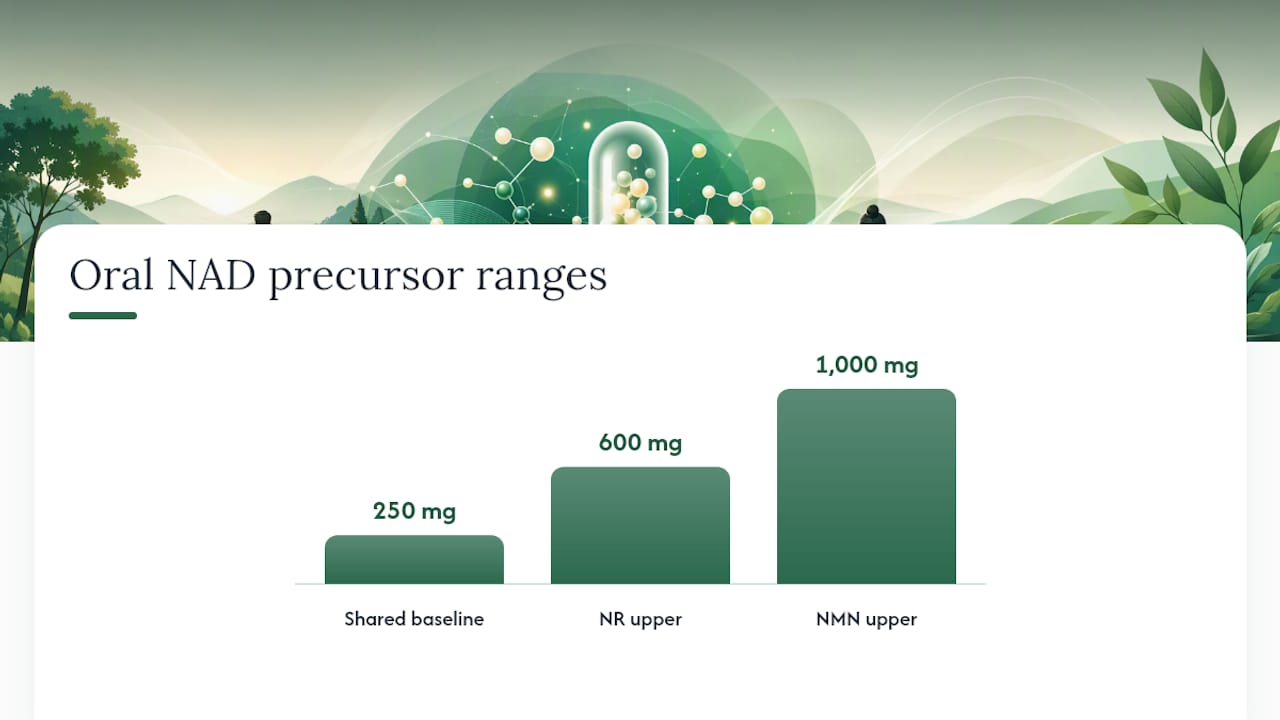
Oral NR (nicotinamide riboside) trials tend to run lower. Martens and colleagues, in a study covered by a PMC review of NAD±boosting compounds, found that chronic NR supplementation raised blood NAD+ levels in adults and was well tolerated at the doses tested. Reported ranges cluster around 250 to 600 mg/day, and the physiology review above places common maintenance at 300 to 600 mg/day.
NADH, the reduced form of NAD, gets dosed very differently. It’s used mostly in lower milligram ranges, often for fatigue-specific protocols rather than general longevity use, and the two forms are not directly comparable on a milligram-per-milligram basis.
IV and subcutaneous (SubQ) protocols live almost entirely in clinical practice rather than randomized trials, which matters for how much confidence you should place in any specific number. A dosage guide compiled from compounding pharmacy and clinic protocols reports:
- IV infusions: commonly between a few hundred milligrams per session, with some clinics reporting higher doses for loading phases, typically infused over one to four hours.
- Subcutaneous injections: typically tens to a couple hundred milligrams per injection, administered two to three times weekly for maintenance.
- Intramuscular (IM) dosing: less standardized, generally mirroring SubQ ranges but delivered in a single, smaller-volume shot.
This spread comes from clinical practice patterns rather than controlled trials, so treat it as a description of common use, not a validated dosing chart. A dosage guide summarizing IV and SubQ practice patterns lays out these ranges in more detail, though it reflects provider-reported data rather than peer-reviewed dosing studies.
Onset timing separates these routes sharply. IV delivery bypasses digestion entirely, so people often report feeling something within a session or two. Oral precursors work through a slower conversion pathway, meaning most people won’t notice measurable change in energy or blood NAD+ markers for four to twelve weeks of consistent daily dosing.
How Do Clinicians Decide Your NAD Dose?
There’s no chart a provider pulls out and matches you against. Dosing decisions in this space are individualized because the variables that matter (your age, existing conditions, medication list, and goals) change the calculus every time.
A clinician weighing your protocol typically considers:
- Age and baseline metabolic health. Older adults or those with metabolic syndrome markers sometimes start lower to gauge tolerance before increasing.
- Current medications. Certain drugs metabolized through similar pathways can interact, so a full medication review comes before any dose decision.
- Prior cancer history. NAD+ supports cellular energy production broadly, including in rapidly dividing cells, so a history of cancer changes the risk conversation entirely.
- Primary goal. Someone chasing daily energy and mental clarity gets a different protocol than someone pursuing a short-term IV loading phase.
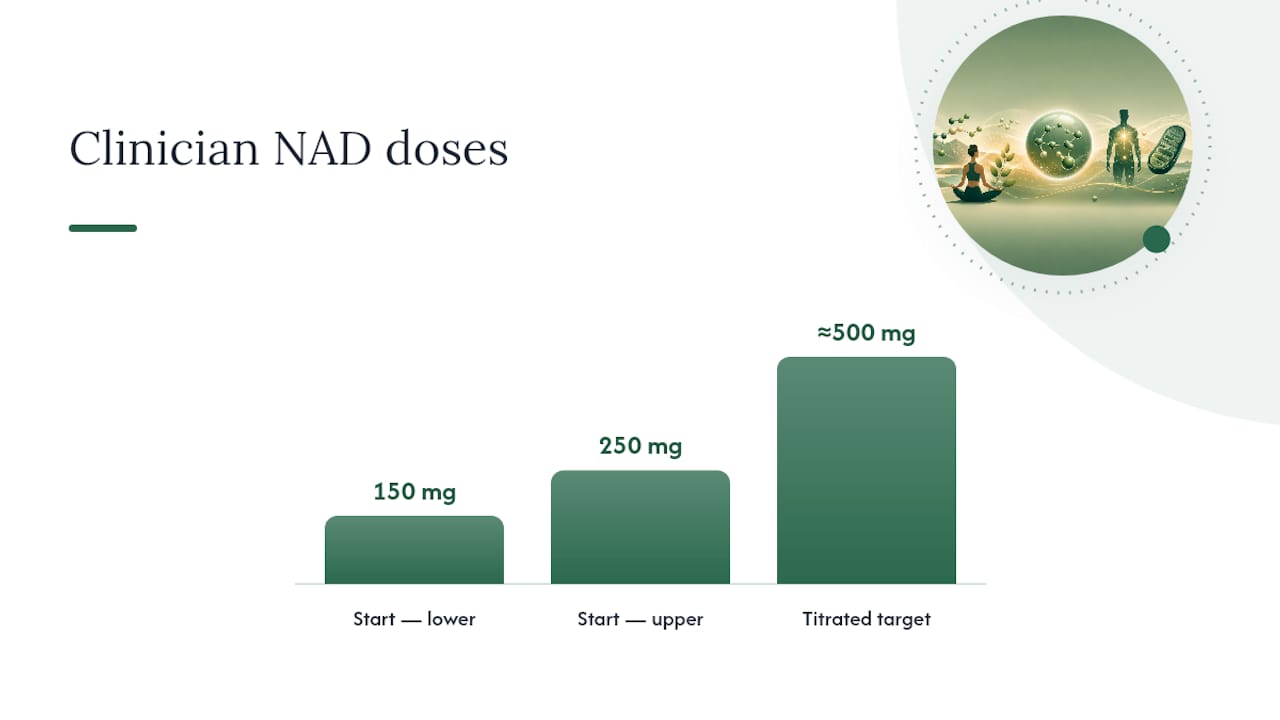
The general approach clinicians describe is start low, hold steady, then reassess. A typical sequence might look like starting oral NMN or NR at 150 to 250 mg for one to two weeks, watching for gastrointestinal upset or flushing, then stepping up toward the 500 mg range if tolerance is good. Some practitioners retest after a titration window using whole-blood NAD+ assays, though these tests are not yet standardized across labs and results can vary by methodology.
Pro Tip: Keep a simple daily log for the first month, noting dose, timing, and how you feel by early afternoon. That single habit gives your clinician more useful information than a lab test taken in isolation.
Clinicians frequently pair higher-dose precursor protocols with methyl donor support, such as trimethylglycine (TMG), because NAD+ precursor metabolism consumes methyl groups. Without that support, some people report headaches or fatigue at higher doses, a pattern several practitioners attribute to methylation load rather than the NAD+ pathway itself.
Is NAD Supplementation Safe, and What Are the Regulatory Limits?
Here’s the fact that should shape every decision you make: the FDA has not approved any NAD+ drug product, which means there is no official recommended dose, no agency-reviewed safety profile for injectable NAD+, and no regulatory body setting the numbers you see in clinics and online guides. Everything discussed above, IV ranges especially, comes from provider experience and compounding pharmacy practice, not FDA-evaluated data.
That gap matters most for a few groups. Cleveland Clinic guidance flags active cancer or metastatic disease and pregnancy or breastfeeding as situations requiring individualized risk and benefit discussion with a specialist before any NAD+ supplementation, oral or injectable. Severe liver disease is another category where caution applies, since NAD+ metabolism runs largely through hepatic pathways.
What the numbers actually tell us: Trial data on NR and NMN generally shows good short-term tolerability at studied doses, but sample sizes tend to be small and trial durations short, often weeks to a few months. Long-term safety data at higher doses, especially IV protocols, is not well established.
Common side effects reported at oral doses include mild gastrointestinal upset, occasional flushing, and headaches, most of which resolve with dose reduction. IV administration carries its own risk profile, including infusion site discomfort and, in poorly supervised settings, reactions tied to infusion rate.
- Start at the lower end of any range and increase gradually rather than jumping to a maintenance dose on day one.
- Avoid IV or SubQ protocols from any provider unwilling to discuss dosing rationale and monitoring.
- Disclose your full medication list, since NAD+ metabolism interacts with pathways used by several common drug classes.
- Treat any claim of a “proven” or “optimal” dose skeptically. The evidence doesn’t support that level of certainty yet.
Oral vs. Subcutaneous vs. IV: Which Route Fits Your Goal?
The route you choose changes everything from cost to how fast you’ll notice anything, and each has a distinct trade-off profile worth understanding before you commit to one.
Oral NMN and NR win on convenience and cost. You take a capsule, there’s no clinic visit, and the evidence base for raising blood NAD+ over weeks of consistent use is reasonably solid for maintenance purposes. The trade-off is speed. Because oral precursors pass through digestion and liver metabolism before conversion, most users report a four to twelve week window before they notice meaningful change.
Subcutaneous injection sits in the middle. Bioavailability is generally considered higher than oral dosing since it skips first-pass digestion, and once a clinician establishes a protocol, many people can self-administer at home. Typical maintenance schedules run two to three injections weekly at 50 to 200 mg each, which for some people replaces or supplements a daily oral routine.
IV infusion is the fastest and most supervised option, but also the most demanding on time and money. Sessions run one to four hours, require clinic supervision, and are usually reserved for loading phases or short-term intensive protocols rather than daily long-term use. The PMC review of NAD±boosting compounds describes a “load and maintain” pattern used in practice: an initial clinician-supervised IV phase to raise NAD+ levels quickly, followed by a switch to SubQ injections or oral precursors for sustainable daily upkeep.
- Oral: lowest cost, slowest onset, best evidence for sustained daily use.
- SubQ: moderate cost, faster absorption than oral, workable for home maintenance after clinic setup.
- IV: highest cost and highest supervision requirement, fastest perceived effect, best suited to short-term loading rather than indefinite use.
Foundational habits still matter more than any route you pick. If your energy dips are driven by poor sleep or an afternoon crash from blood sugar swings, addressing that directly often produces bigger, faster gains than any NAD+ protocol alone.
What Does a Realistic NAD Dosing Protocol Look Like?
Concrete numbers help more than vague ranges when you’re actually trying to build a plan with your clinician. Here’s how a reasonable starter-to-maintenance sequence tends to unfold in practice.
- Weeks 1 to 2 (entry phase): Start oral NMN or NR at 150 to 250 mg, taken in the morning since some users report sleep disruption when dosing late in the day. Watch for GI upset or headaches.
- Weeks 3 to 6 (titration): If tolerance is good, step up toward the common maintenance range of 500 mg/day for NMN or 300 to 600 mg/day for NR. This is also when a methyl donor like TMG sometimes gets added.
- Weeks 6 to 12 (assessment window): This is the realistic timeline for oral precursors to produce measurable change in subjective energy or whole-blood NAD+ markers. Reassess with your clinician here rather than expecting results in the first two weeks.
- For IV/SubQ loading protocols: A clinic-supervised sequence might involve two to three IV sessions over one to two weeks at 250 to 500 mg each, followed by a step-down to SubQ maintenance injections two to three times weekly.
Cycling is common in practice, with some clinicians recommending periodic breaks or reassessment every few months rather than indefinite daily dosing at the same level. If you notice no change after twelve weeks of consistent oral dosing at maintenance levels, that’s a signal to revisit the plan with your provider rather than simply increasing the dose further.
How Do You Choose a Quality NAD Supplement?
Milligram count on a label means very little if the product inside the bottle doesn’t match it. This market has no FDA approval process for NAD+ products, which means quality control depends entirely on the manufacturer’s own standards, not a government checkpoint.
Cleveland Clinic guidance is direct on this point: choose third-party tested products and avoid proprietary blends, because proprietary blends hide the actual dose of each ingredient behind a combined total. That single omission makes it impossible to know if you’re getting 50 mg or 500 mg of the compound you actually care about.
A product’s value comes down to whether you can verify what’s inside it. Third-party testing, a certificate of analysis (COA), and manufacturing in an FDA-registered facility following current good manufacturing practice standards are the checkpoints that actually tell you something. A high milligram number on a label with none of that backing is not a stronger product; it’s an unverified claim.
Before buying any NAD supplement, check for:
- A certificate of analysis (COA) available on request or published on the product page.
- Non-proprietary blends with clear milligram amounts per ingredient, per serving.
- Third-party lab testing for purity and potency, not just internal quality control.
- Manufacturing in an FDA-registered facility, which signals adherence to baseline manufacturing oversight even though it doesn’t equal FDA product approval.
- Realistic marketing language, since terms like “clinically proven” or “guaranteed results” are red flags in a category where the FDA has approved zero NAD+ drugs.
Formulations that follow this checklist include organic ingredient sourcing, third-party testing for purity and potency, and manufacturing in an FDA-registered facility with COAs available for review. Whether or not you buy from Pureblue, run every NAD supplement you’re considering through this same list first.
When Should You Talk to a Clinician Before Starting?
Anyone considering IV, subcutaneous, or higher-dose oral protocols should loop in a qualified provider before starting, not after questions come up. That typically means a physician, nurse practitioner, or integrative medicine specialist familiar with NAD+ protocols, and for injectable formulations, a licensed compounding pharmacy that can speak to sourcing and sterility standards.
Bring these questions to that conversation:
- What’s the rationale for the specific starting dose and route you’re recommending for my situation?
- How will we monitor for side effects, and what’s the plan if I don’t tolerate the initial dose?
- What’s your protocol for reassessing and adjusting dose over time?
- Where does this product or compound come from, and can I see testing documentation?
Watch for red flags that suggest a provider or clinic isn’t operating carefully: infusions administered at a rapid rate without discussion of your medical history, no informed consent process before an IV or injection, or no follow-up plan after your first session. A provider confident in their protocol will walk you through the reasoning, not just the price list.
What Pureblue Gets Right About NAD Dosing
The biggest misconception in this space is that a bigger milligram number automatically means a better result. It doesn’t. NAD+ metabolism, methylation load, and individual tolerance all shift the equation, which is why the same 1,000 mg dose that works fine for one person produces headaches in another.
Pureblue built its approach to Quantum Vitality around that reality: an evidence-informed formulation, transparent labeling with no proprietary blend hiding ingredient amounts, and third-party testing to verify what’s actually in each serving. That doesn’t mean skipping the conversation with your own clinician, especially if you’re weighing higher oral doses or considering IV or subcutaneous protocols on top of a daily supplement. It means starting that conversation with a product whose label you can actually trust and whose testing documentation is available for you to look at directly on the product page.
Good dosing decisions start with good information, not the biggest number on the loudest label.
— Organic
Try Quantum Vitality Before You Commit to a Full Protocol
Every batch goes through third-party testing for purity and potency, manufactured in an FDA-registered facility, which means you can request the certificate of analysis rather than take a label’s word for it.
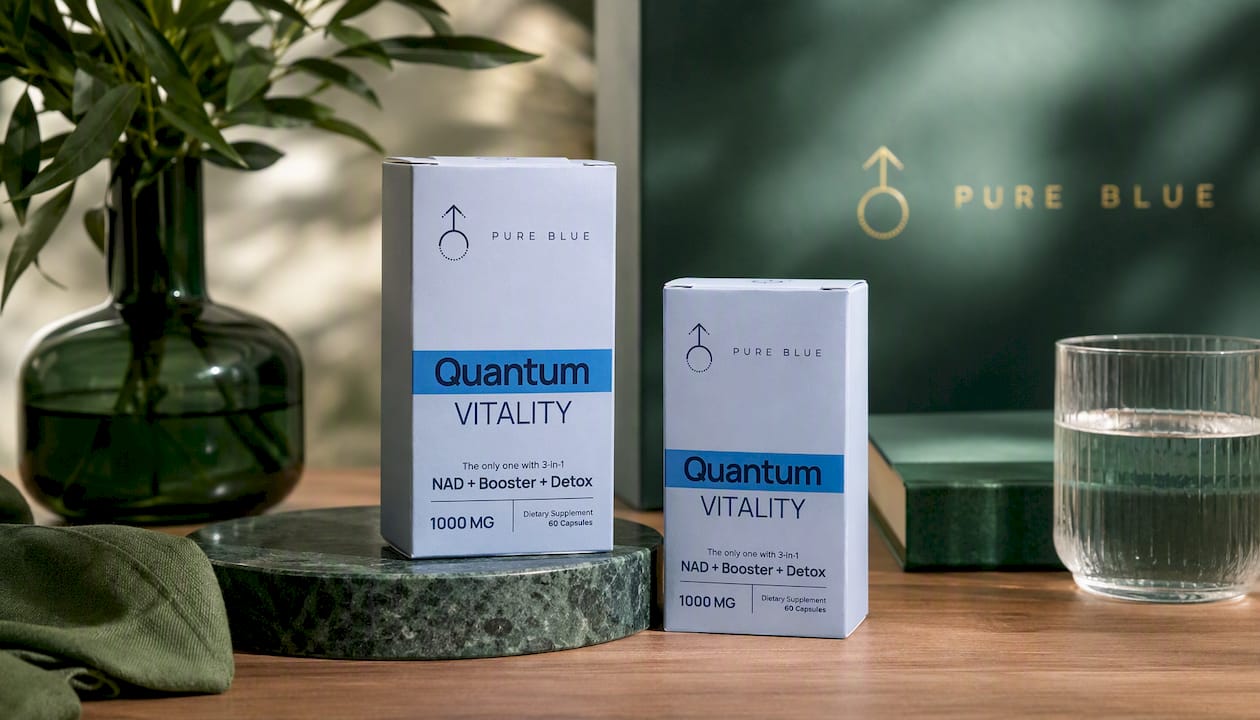
If you’re still deciding whether daily oral supplementation makes sense for your energy and clarity goals, start with the free trial offer before committing to a full-size order. For anyone ready to move forward, the Quantum Vitality product page includes full ingredient transparency and COA access. Whichever you choose, talk to your clinician before escalating dose or starting IV or subcutaneous protocols. Foundational habits like strength and nutrition basics after 40 still do more heavy lifting than any supplement alone, and some supplement formulas are built to support that work, not replace it.
Sources
- Dietary supplementation with NAD±boosting compounds in humans: current knowledge and future directions (PMC)
- U.S. Food & Drug Administration — official site
- American Journal of Physiology - Endocrinology and Metabolism review (2023)
- Cleveland Clinic — NAD supplement guidance
This article is general information, not a substitute for advice from a qualified doctor. Consult a qualified healthcare professional about your own circumstances before acting on anything here.