Cart
0

Magnesium stearate is generally recognized as safe at the small amounts used in supplements and foods, backed by decades of regulatory review and genotoxicity testing showing no evidence of harm. A few groups, including people with severe kidney impairment and infants, warrant extra caution and a conversation with a clinician. For nearly everyone else, the additive that shows up on so many supplement labels is one of the least worrisome ingredients in the bottle.
TL;DR:
- Magnesium stearate is classified as safe by regulators, with extensive toxicology tests showing no genotoxic or harmful effects at typical supplement doses.
- Its main function is as a manufacturing aid, helping pills flow smoothly and release uniformly, with amounts kept low to avoid affecting tablet dissolution.
- People with severe kidney impairment should consult a healthcare professional due to magnesium accumulation risks, while most others have negligible exposure and effects.
- Claims that magnesium stearate suppresses immunity or blocks absorption lack scientific support; adverse reactions are rare and usually linked to allergies or high occupational exposure.
- The key concern for consumers is tracking cumulative magnesium intake from all sources, especially when combining multiple supplements containing magnesium.
Table of Contents
- Is Magnesium Stearate Safe? What It Is and Why It’s in Your Supplements
- What Regulators and the Best Studies Say About Safety
- Health Effects, Rare Sensitivities, and Who Should Be Cautious
- How Much Magnesium Stearate Are You Actually Getting?
- Common Myths About Magnesium Stearate, Debunked
- Pureblue’s Approach to Excipients and Formulation Quality
- Why the Magnesium Stearate Panic Never Made Sense to Me
- Pureblue Skips the Filler Debate Entirely
- Sources
Is Magnesium Stearate Safe? What It Is and Why It’s in Your Supplements
Magnesium stearate is a magnesium salt of stearic acid, a saturated fatty acid found naturally in foods like butter, cocoa butter, coconut, and animal fats. When you swallow a tablet containing it, your digestive system breaks the compound apart into magnesium and stearic (or palmitic) acid, both of which the body already knows how to process because they show up in ordinary meals.
Manufacturers don’t add magnesium stearate for nutrition. They add it because it solves a mechanical problem. During tablet production, powdered ingredients need to flow smoothly through machinery and release cleanly from molds. Magnesium stearate acts as:
- A flow agent, helping powder blends move evenly through manufacturing equipment without clumping
- A lubricant, preventing ingredients from sticking to the metal punches and dies that compress tablets
- A boundary film, coating particles so tablets release from molds without crumbling
The catch is dosage. Formulation research published in Dissolution Technology shows that magnesium stearate works as an effective lubricant at low concentrations, but too much of it, or poor mixing, can create a hydrophobic coating that slows how fast a tablet breaks down and releases its active ingredients. That’s why reputable manufacturers keep the percentage low and control mixing time closely rather than treating it as a filler to add freely.
What Regulators and the Best Studies Say About Safety
The strongest evidence on magnesium stearate safety comes from two places: government regulatory review and peer-reviewed toxicology testing, and both point the same direction.
In the United States, the FDA classifies magnesium stearate as Generally Recognized as Safe (GRAS) under 21 CFR 184.1440, provided it’s manufactured from edible-source stearates and used according to good manufacturing practice. GRAS status doesn’t mean “untested.” It means the FDA has reviewed the available safety data and concluded that qualified experts agree the substance is safe for its intended use, a bar that requires substantial toxicology and usage history to clear.
The toxicology side is where things get genuinely reassuring. A peer-reviewed genotoxicity battery, conducted under Good Laboratory Practice (GLP) standards and published in PMC, tested magnesium stearate across multiple OECD-recommended assays: bacterial reverse mutation testing, in vitro chromosome aberration analysis, and an in vivo micronucleus assay. Every test came back negative. No genotoxic response was detected in any of them.
By the numbers: Toxicology reviews cited by USDA/industry technical documentation put the LD50 for magnesium stearate above 10 grams per kilogram in rats, a threshold so high it’s classified as practically nontoxic. The Joint FAO/WHO Expert Committee on Food Additives (JECFA) went a step further and assigned magnesium salts of stearic and palmitic acids an acceptable daily intake of “not specified,” the designation reserved for substances whose safety margin is wide enough that a numeric daily limit isn’t necessary.
That JECFA conclusion, documented in the WHO chemical database, reflects international consensus rather than a single country’s regulatory opinion. Where the evidence is thinner: long-term human trials specifically isolating magnesium stearate’s effects over years of daily use don’t really exist, mostly because it’s used in such small amounts alongside other ingredients that isolating its individual effect is impractical. Regulators have responded not by raising alarms but by recommending something more targeted, tracking cumulative magnesium exposure across the multiple additives and supplements a person might consume in a day, rather than treating magnesium stearate in isolation.
Health Effects, Rare Sensitivities, and Who Should Be Cautious
The realistic risk profile for magnesium stearate breaks into three categories, and only one of them applies to most people.
Gastrointestinal effects. Magnesium has a well-documented laxative effect at pharmacologic doses, the kind you’d get from a magnesium supplement taken specifically to relieve constipation. But the magnesium stearate in a typical tablet contributes only a tiny fraction of that dose. Healthline’s consumer summary notes that typical supplement amounts are unlikely to cause side effects on their own; the GI symptoms people associate with “too much magnesium” almost always trace back to therapeutic magnesium supplements, not the stearate used as a manufacturing aid.
Kidney function. This is the group that genuinely needs a different conversation. People with chronic kidney disease clear magnesium less efficiently, which means magnesium from any source, food, supplements, or additives, can accumulate over time. Verywell Health’s review points to case reports of magnesium accumulation in patients with renal impairment, and clinicians generally recommend individualized review for this group rather than a blanket rule.
Rare sensitivities and occupational exposure. A small number of case reports describe allergic-like reactions to magnesium stearate, and inhalation of the powder form has caused respiratory irritation in manufacturing settings where workers handle it in bulk. Neither scenario resembles swallowing a coated tablet, but they’re worth knowing about if you notice an unusual reaction.
Watch for:
- Unexplained digestive upset that starts specifically after beginning a new supplement
- Skin reactions, hives, or swelling shortly after taking a product
- Any respiratory symptoms if you work around bulk supplement powders
Pro Tip: If a new supplement causes symptoms, stop taking it and check the full ingredient panel before assuming magnesium stearate is the cause. Most reactions trace back to an active ingredient or a different excipient entirely, and a clinician can help you sort out which one.
How Much Magnesium Stearate Are You Actually Getting?
A single tablet typically contains magnesium stearate in the low milligram range, a small fraction of the tablet’s total weight, since formulators use it as a processing aid rather than a bulk ingredient. Compare that to elemental magnesium, where adult recommended daily intakes run into the hundreds of milligrams, and the additive amount looks proportionally minor.
The concern regulators actually flag isn’t any single tablet. It’s the cumulative math. If you take a multivitamin with magnesium stearate, a separate magnesium supplement, and a fortified snack bar in the same day, the magnesium from all three sources adds up, and JECFA’s guidance specifically calls out this cumulative exposure as the variable worth tracking rather than any one additive.
Here’s a practical way to check your own intake:
- Read the supplement facts panel on every product you take regularly, not just the ones marketed as magnesium supplements.
- Estimate the elemental magnesium per serving, which is usually listed separately from any magnesium-containing excipient.
- Add up your daily total across supplements, fortified foods, and any magnesium-based medications like antacids.
- Compare that sum to your recommended daily intake, keeping in mind that needs vary by age and sex.
- Avoid stacking multiple magnesium-containing products unless a clinician has reviewed your combined intake, especially if you already take a dedicated magnesium supplement like magnesium glycinate for sleep or muscle support.
Common Myths About Magnesium Stearate, Debunked
Search “magnesium stearate” and you’ll find claims that go well beyond what the evidence supports. Three come up constantly.
“It suppresses your immune system.” This claim traces back to isolated cell-culture studies where researchers exposed T-cells directly to magnesium stearate in a lab dish. That’s a different scenario than digesting small amounts in a tablet, and no human clinical evidence backs the immune-suppression claim at supplement-level exposure.
“It blocks absorption of the active ingredients.” The mechanistic concern is real in formulation science, excessive magnesium stearate can slow tablet dissolution, as the dissolution research confirms. But that’s a manufacturing quality issue tied to excessive use levels, not a universal effect that applies to every tablet containing the additive.
“It’s an industrial toxin in disguise.” Magnesium stearate is derived from the same fatty acids found in butter and coconut oil, and its GRAS status reflects genuine regulatory review, not a loophole. When you see alarmist claims online, ask whether they’re citing a specific dose and exposure route or just gesturing at “chemical” as if that alone settles the question.

Pureblue’s Approach to Excipients and Formulation Quality
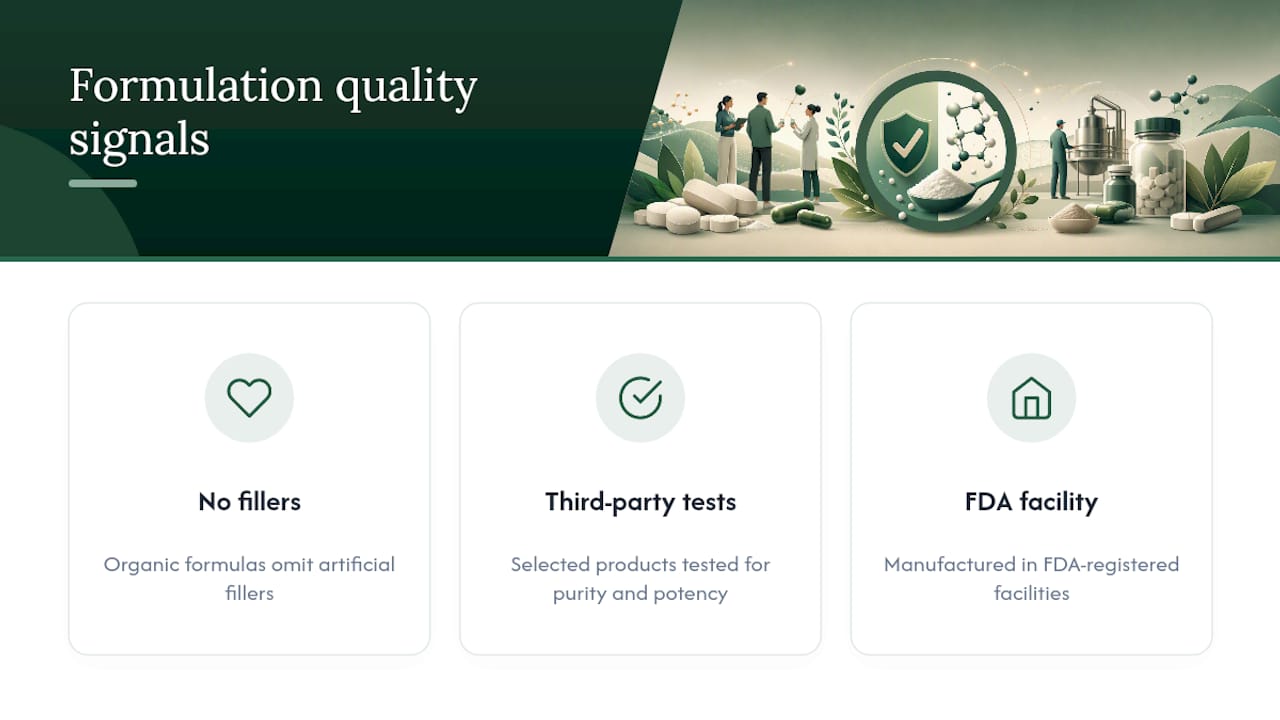
Some organic supplements are formulated without artificial fillers. Select products undergo third-party testing for purity and potency and may be manufactured in FDA-registered facilities. That combination of label transparency and independent verification gives cautious consumers a way to check formulation claims rather than take them on faith, which matters more than any single excipient debate.
Why the Magnesium Stearate Panic Never Made Sense to Me
The loudest warnings about magnesium stearate rarely cite a dose, a route of exposure, or a regulatory finding. That gap between alarm and evidence is the real story here, not the additive itself. If you’re on dialysis or managing advanced kidney disease, talk to your doctor before adding any magnesium source, stearate included. Otherwise, check a product’s lab reports before you worry about a milligram of lubricant.
— Organic
Pureblue Skips the Filler Debate Entirely
If you’ve read this far because you’re wary of unnecessary additives, Pureblue built its formulas around that exact concern. The Quantum Vitality NAD+ Booster+ Detox combines energy support, mental clarity, and detox ingredients in one organic formula, third-party tested for purity and made without artificial fillers.

Every batch comes from an FDA-registered facility, and the ingredient panel is built to be checked, not just trusted. If you’d rather try before committing, the free trial offer on Quantum Vitality lets you test the formula firsthand. For the brand’s full organic supplement lineup, visit the Pure Blue product page and review the lab certificates for yourself before you decide.
This article is general information, not a substitute for advice from a qualified doctor. Consult a qualified healthcare professional about your own circumstances before acting on anything here.
Sources
- Magnesium stearate, a widely-used food additive, exhibits a lack of in vitro and in vivo genotoxic potential
- Magnesium Stearate: Side Effects, Uses, and More — Healthline
- How magnesium stearate works in oral solid dosage forms — Dissolution Technology (Aug 2024)