Cart
0
For most health-conscious adults trying to raise glutathione, N-acetylcysteine (NAC) is the practical first choice, backed by decades of clinical use, a dosing range of 600 to 1,800 mg daily, and reliable evidence it boosts intracellular glutathione. Specialized delivery forms like liposomal glutathione matter more for rapid repletion or specific clinical needs. Skip both, or check with a doctor first, if you’re pregnant, have kidney disease, or take nitroglycerin or certain chemotherapy drugs.
TL;DR:
- NAC is generally more effective, less expensive, and has a longer clinical history than oral glutathione, especially for rapid absorption needs.
- Liposomal and sublingual glutathione bypass digestion, leading to better bioavailability, but are often more costly than NAC supplements.
- Clinical evidence strongly supports NAC’s use in acute cases like acetaminophen overdose and respiratory conditions, while oral glutathione shows slower, preparation-dependent benefits.
- Safety considerations include avoiding supplementation during pregnancy or kidney disease without medical advice and being cautious with drug interactions, particularly with nitrates or chemotherapy.
- For broad health support or energy detoxification, products like Quantum Vitality combine NAD+ boosting with detox ingredients, offering an alternative to managing multiple individual supplements.
Table of Contents
- Glutathione vs NAC: How Each One Actually Works in the Body
- What Do Clinical Trials Actually Show?
- NAC and Glutathione Dosing: Ranges, Timing, and Who Should Be Careful
- NAC or Glutathione: Matching the Supplement to Your Goal
- Where Pureblue’s Quantum Vitality Fits Into This Picture
- The Bottom Line on NAC vs Glutathione
- What the Research Actually Tells Us to Prioritize
- Ready to Support Your Body’s Natural Detox and Energy Pathways?
- Sources
Glutathione vs NAC: How Each One Actually Works in the Body
The core difference comes down to chemistry, and it explains almost everything else in this comparison. NAC is a precursor. Glutathione is the finished product. That distinction determines how well each one survives digestion, and it’s the single biggest factor in whether a supplement does anything once it’s in your system.
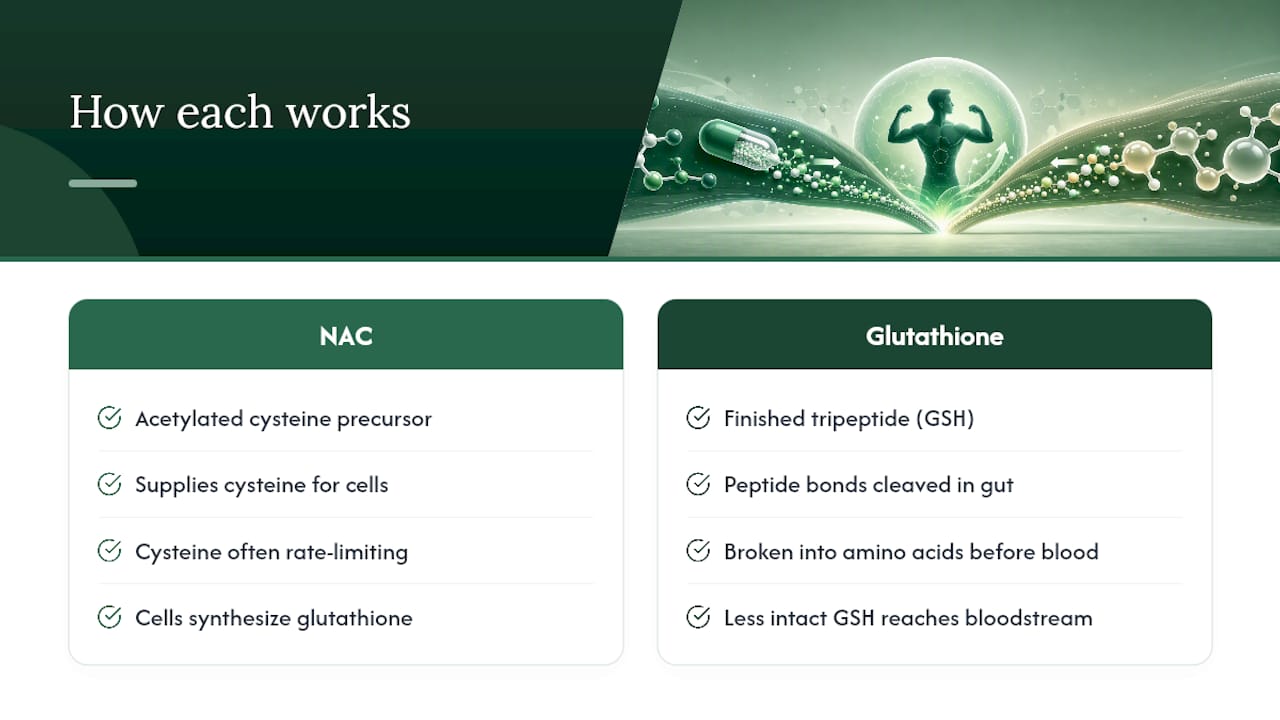
NAC (N-acetylcysteine) is an acetylated form of the amino acid cysteine. Once absorbed, your cells use that cysteine as raw material to manufacture glutathione internally, alongside glutamate and glycine. This matters because cysteine availability is usually the rate-limiting step in glutathione production. Feed the body more cysteine, and in most people, glutathione synthesis follows. NAC’s broad clinical evidence base includes decades of use as the antidote for acetaminophen overdose precisely because it reliably restores intracellular glutathione when the liver’s own supply gets depleted.
Glutathione (GSH), by contrast, is already the finished tripeptide: glutamate, cysteine, and glycine linked together. Swallow it in standard oral form, and you run into a structural problem. Your gut is lined with peptidases, enzymes whose job is to break peptide bonds apart. Glutathione is a peptide. Before much of it reaches your bloodstream intact, a large share gets dismantled into its individual amino acids, the same building blocks you’d get from NAC or a decent diet, just less efficiently.
That’s not a fringe theory. It’s the reason so much of the supplement industry has pivoted toward delivery innovations rather than simply raising the milligrams on the label.
Comparing delivery forms and what they actually do
Here’s how the common forms stack up in terms of what reaches circulation:
- Standard oral reduced glutathione (GSH): Cheapest option, but largely degraded by digestive peptidases before absorption.
- Liposomal glutathione: Glutathione wrapped in a lipid bilayer that shields it from stomach enzymes; human data show improved blood glutathione levels compared with standard oral capsules in some trials.
- S-acetyl glutathione: A modified form designed to resist enzymatic breakdown, though independent human trials remain limited.
- Sublingual glutathione: Dissolved under the tongue to bypass first-pass digestion; a 2015 comparative crossover study tested a sublingual form alongside NAC and standard oral GSH, finding meaningful variability across preparations. Sublingual delivery in general has documented absorption advantages for other nutrients that share the same digestive vulnerability.
- IV glutathione: Injected directly into the bloodstream, bypassing digestion entirely and delivering near-complete bioavailability, used clinically under medical supervision for acute repletion.
- NAC (oral): Small, stable molecule that survives digestion well and gets converted into glutathione inside the cell rather than needing to arrive intact.
Pro Tip: Check the supplement facts panel, not just the front label. A bottle that says “glutathione support” often lists NAC as the only active ingredient. That’s not dishonest, since NAC genuinely supports glutathione synthesis, but it’s not the same product as one containing actual glutathione. Ingredient panel differences between the two categories catch a lot of buyers off guard.
The practical tradeoff is straightforward. NAC costs less per effective dose, tolerates room-temperature storage, and has the deeper track record. Liposomal and sublingual glutathione cost more, sometimes significantly more, but sidestep the degradation problem that plagues standard oral GSH. If you’re buying based on delivery format alone, options like Au Peptide Labs’ glutathione line illustrate how manufacturers differentiate on formulation rather than just dose.

What Do Clinical Trials Actually Show?
The evidence for NAC is deeper and more clinically established than the evidence for oral glutathione, which is the main reason most clinicians reach for NAC first. NAC’s use in emergency medicine for acetaminophen toxicity rests on a mechanism now confirmed across many trials: it reliably raises intracellular glutathione fast enough to prevent liver failure in overdose cases. That same mechanism underlies the smaller but still meaningful trial signals for NAC in chronic respiratory conditions and certain psychiatric contexts, where oxidative stress is thought to play a role.
Oral glutathione’s evidence picture looks different: promising, but narrower and more preparation-dependent. A randomized trial using doses of 250 to 1,000 mg per day found increases in glutathione measures across several body compartments, but only after months of continuous supplementation, not days or weeks. That timeline matters if you’re expecting fast results.
Trial callout: The 2015 crossover study comparing NAC, standard oral glutathione, and a sublingual glutathione preparation found that oral NAC supplementation is effective at increasing glutathione levels, while also confirming that oral glutathione preparations vary meaningfully in how well they get absorbed. That variability is the crux of the whole NAC versus glutathione debate. Not all “glutathione” on a supplement shelf behaves the same way once swallowed.
Liposomal formulations complicate the simple “oral glutathione doesn’t work” narrative. Because the lipid coating protects the molecule from peptidase breakdown, comparative bioavailability data show meaningfully higher blood glutathione after liposomal dosing than after standard capsules in some study populations. IV glutathione sits at the far end of the bioavailability spectrum, delivering the molecule directly and bypassing digestion altogether, though it requires medical administration and isn’t something you order online for home use.
A few honest limitations deserve mention before anyone treats this as settled science:
- Most oral glutathione trials involve modest sample sizes and run for a few months at most, not years.
- Liposomal comparisons often measure blood glutathione as a proxy, not hard clinical outcomes like disease markers or symptom scores.
- Results are preparation-specific. A liposomal product from one manufacturer isn’t guaranteed to behave like the one tested in a given study.
- NAC’s evidence base is broader partly because it’s been studied far longer and in far more clinical settings, including decades of emergency-medicine use.
The honest summary: NAC has more trial volume and clinical history behind it. Oral glutathione, especially in advanced delivery forms, has a growing but still developing body of human data.
NAC and Glutathione Dosing: Ranges, Timing, and Who Should Be Careful
Dosing that trials actually used, not marketing copy, is the safest starting point.
- NAC: Clinical studies commonly use 600 to 1,800 mg per day, often split into two doses. Some people find splitting doses reduces the mild stomach upset NAC can cause; taking it with food helps for most.
- Liposomal glutathione: Typical consumer dosing runs 250 to 500 mg per day, generally taken once daily. Higher doses appear mainly in supervised or clinical contexts rather than routine self-supplementation.
- IV glutathione: Reserved for clinical settings under direct medical supervision, used for acute repletion needs where oral absorption timelines aren’t fast enough.
Side effects for NAC tend toward the mild end: gastrointestinal discomfort, nausea, and a sulfur-like smell some people find unpleasant. Glutathione supplements, in oral or liposomal form, are generally well tolerated at standard doses, though data on long-term high-dose use remains limited.
The real cautions apply to specific groups. Anyone with kidney disease should talk to a doctor before starting either supplement, since both involve amino acid and sulfur metabolism that impaired kidneys may not handle the same way. Pregnant or breastfeeding individuals should get medical clearance first, since robust safety data for either compound in pregnancy is limited. NAC in particular carries known interaction risks with nitroglycerin, where it can amplify blood-vessel-dilating effects, and with certain chemotherapy agents, where the antioxidant effect could theoretically blunt treatment efficacy.
Pro Tip: If you’re on any prescription medication, especially nitrates, chemotherapy, or anything affecting the kidneys, run NAC or glutathione supplementation past your prescribing doctor first. The interaction risk is specific enough that “it’s just an antioxidant” isn’t a safe assumption.
Stop and check in with a clinician if you notice unusual fatigue, changes in urination, or persistent GI symptoms after starting either supplement.
NAC or Glutathione: Matching the Supplement to Your Goal
The right choice depends less on which supplement is “stronger” and more on what you’re actually trying to accomplish.
Everyday antioxidant support on a budget. Start with NAC. It’s the cheaper option, has the longest clinical track record, and works through a mechanism your body already knows how to use. Pairing it with sulfur-rich foods like garlic, onions, and cruciferous vegetables gives your cysteine supply an extra assist without added cost.
Older adults, or anyone concerned about declining glutathione with age. Consider GlyNAC, the combination of NAC and glycine. A clinical study in older adults found glycine addition enhanced glutathione restoration compared with NAC alone. The logic here is straightforward: glycine can become a limiting ingredient in glutathione synthesis as people age, so supplying both precursors at once removes a bottleneck that NAC alone doesn’t address.
Rapid repletion needs or clinical contexts. This is where IV glutathione or medically supervised liposomal protocols earn their higher cost and complexity. Someone recovering from acute oxidative stress, or under a physician’s care for a specific condition, may need glutathione levels to move faster than oral precursor supplementation allows. This isn’t a do-it-yourself category. It requires medical oversight.
Skin brightening and detox marketing claims. Be skeptical here. Glutathione is heavily marketed for skin lightening and “detox,” and while there’s mechanistic plausibility (glutathione does play a role in melanin pathways and phase II liver detoxification), the trial evidence supporting cosmetic skin outcomes from oral supplementation is thin compared to the evidence for its role in general antioxidant status. If a product’s entire pitch is skin tone change, ask what dose and delivery form the claim is based on, and whether it’s backed by an actual trial or just a testimonial page.
A rough decision rule: if your goal is general wellness support, cost matters, and you’re not dealing with a diagnosed condition, NAC is the sensible entry point. If you have a specific absorption concern, a diagnosed deficiency, or a clinician actively managing your care, that’s when the more specialized and more expensive glutathione delivery systems justify their price.
Where Pureblue’s Quantum Vitality Fits Into This Picture
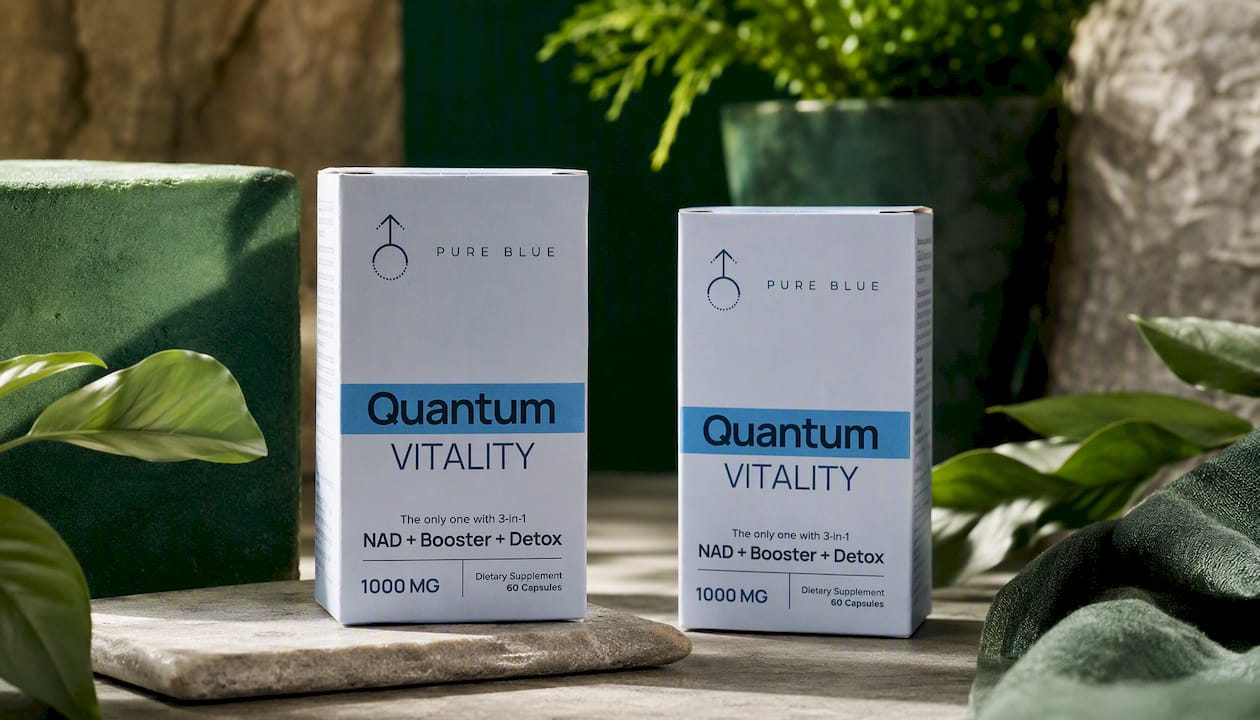
Not every reader wants to assemble a supplement stack from individual ingredients, and that’s a legitimate preference, not a shortcut. Pureblue built Quantum Vitality as a 3-in-1 NAD+ booster and detox formula, using 100% organic ingredients with no artificial fillers, manufactured in an FDA-registered facility and third-party tested for purity and potency. The brand reports a user rating of 4.9 out of 5.
Here’s how the proof points line up against what this comparison actually requires:
| Attribute | What it means for antioxidant strategy |
|---|---|
| 100% organic, filler-free formula | No unnecessary additives diluting the active ingredients |
| Third-party tested for purity and potency | Independent verification that label claims match contents |
| FDA-registered manufacturing facility | Meets baseline federal manufacturing oversight |
| 3-in-1 NAD+ booster and detox design | Targets cellular energy and detox pathways alongside antioxidant support |
| 4.9 out of 5 user rating | Reflects reported customer satisfaction |
Quantum Vitality is formulated as a detox and cellular energy complement, not a direct substitute for a dedicated NAC or glutathione trial regimen. If your specific goal is raising glutathione for a documented deficiency or a clinical concern, start with NAC as outlined above, and talk to your doctor about targeted glutathione forms if needed. If your goal is broader, energy, mental clarity, and supporting your body’s detox pathways alongside antioxidant status, a formulated option like Quantum Vitality addresses more ground at once. Some readers use both: NAC or glycine-paired NAC for targeted glutathione support, and a formulated product for the wider energy and detox picture.
The Bottom Line on NAC vs Glutathione
Start with NAC if you’re a healthy adult looking to support glutathione status without medical supervision. Save specialized glutathione delivery, liposomal or IV, for documented deficiency, absorption concerns, or a clinician’s specific recommendation.
Three concrete next steps: First, if you’re new to this, start with NAC at a standard trial dose and give it a few weeks before judging results. Second, read supplement labels carefully; confirm whether a product contains actual glutathione or just NAC marketed as “glutathione support.” Third, if your goal is broader energy and detox support rather than a narrow glutathione target, look at a formulated NAD+ and detox option designed to cover multiple pathways at once.
Whatever you choose, loop in a doctor first if you’re pregnant, have kidney disease, or take nitroglycerin or chemotherapy medications. The mechanism differences between these two supplements are real, but so is the need to match the choice to your actual health situation.
What the Research Actually Tells Us to Prioritize
The conventional wisdom treats this as a brand-versus-brand fight: NAC supplements against glutathione supplements, each claiming superiority. That framing misses the point entirely. NAC and glutathione aren’t competing products, they’re different stages of the same biochemical pathway, and the real question is where in that pathway your body needs help.
What gets underestimated is how much delivery form matters more than raw dose. A 500 mg liposomal glutathione capsule and a 500 mg standard capsule are not remotely the same product once digestive peptidases get involved, yet they sit next to each other on store shelves with nearly identical labels. That’s the detail most buying guides skip past.
What should the reader prioritize first? Not brand loyalty, and not chasing the highest milligram count. Match the format to the goal. Precursor support for routine wellness. Specialized delivery for documented, clinician-guided repletion needs. Everything else is secondary.
— Organic
Ready to Support Your Body’s Natural Detox and Energy Pathways?
If you’ve read this far and landed on “I want broad antioxidant and energy support without assembling three separate supplements,” that’s exactly the gap Pureblue built Quantum Vitality to close. Instead of choosing between a precursor pill and a specialized glutathione delivery system, Quantum Vitality combines NAD+ boosting with a detox formula in one organic, third-party tested product, made without artificial fillers in an FDA-registered facility.
It suits readers who want a formulated approach to cellular energy and detox support rather than managing multiple bottles and dosing schedules, particularly active individuals who value ingredient transparency and independent testing over marketing claims alone. If NAC still makes sense as your starting point for targeted glutathione support based on what you’ve read here, that’s a reasonable path too. But if you’re ready for a broader energy and detox formula backed by real manufacturing standards, you can try Quantum Vitality risk-free and see how it fits into your routine.
This article is general information, not a substitute for advice from a qualified doctor. Consult a qualified healthcare professional about your own circumstances before acting on anything here.
Sources
- Effects of N-acetylcysteine, oral glutathione (GSH) and a novel sublingual form of GSH on oxidative stress markers: A comparative crossover study.
- Review of N-acetylcysteine clinical uses and mechanisms.