Cart
0

Capsules win when you need precise, high-dose, or clinically meaningful amounts of a nutrient; gummies win when the real obstacle is remembering to take anything at all. The trade-off comes down to sugar, potency limits, and stability against convenience and taste. If you’ve decided gummies fit your life better, a well-made option like Pureblue’s Blue Bear line closes most of the quality gap that gives gummies a bad reputation.
TL;DR:
- Gummies typically contain 2 to 8 grams of added sugar per serving, which can quickly use up a significant portion of daily sugar limits for adults.
- Capsules can hold much higher doses of active ingredients, often 500 milligrams or more, without affecting taste or texture.
- Gummy vitamins struggle to preserve sensitive nutrients like iron, high-dose B vitamins, and creatine, often resulting in reduced potency or stability.
- Vitamin D absorption may be higher from gummies in some cases, but evidence is limited to one small study; broader absorption differences are generally minor.
- For therapeutic needs or precise dosing, capsules are more reliable, while gummies benefit individuals who have difficulty swallowing pills or forget to take supplements.
Table of Contents
- Gummies vs Capsules: A Quick Comparison
- Why Gummies Can’t Hold Every Nutrient
- What the Evidence Actually Shows About Absorption
- Which Format Fits Your Situation
- How to Read a Supplement Label Like You Mean It
- What Pureblue’s Manufacturing Standards Actually Address
- Are Gummy Vitamins Regulated the Same as Capsules?
- Our Take: Stop Treating This Like a Loyalty Test
- Ready to Try a Gummy That Doesn’t Cut Corners
- Sources
Gummies vs Capsules: A Quick Comparison
The real differences between these two formats show up in four places: what they taste like, how much sugar rides along, how much active ingredient they can hold, and how well they survive sitting in your medicine cabinet.
Taste is the most obvious split. Capsules are usually flavorless because the shell isolates the ingredients from your tongue. Gummies are built to taste like candy, which is exactly why adherence tends to be higher with them.
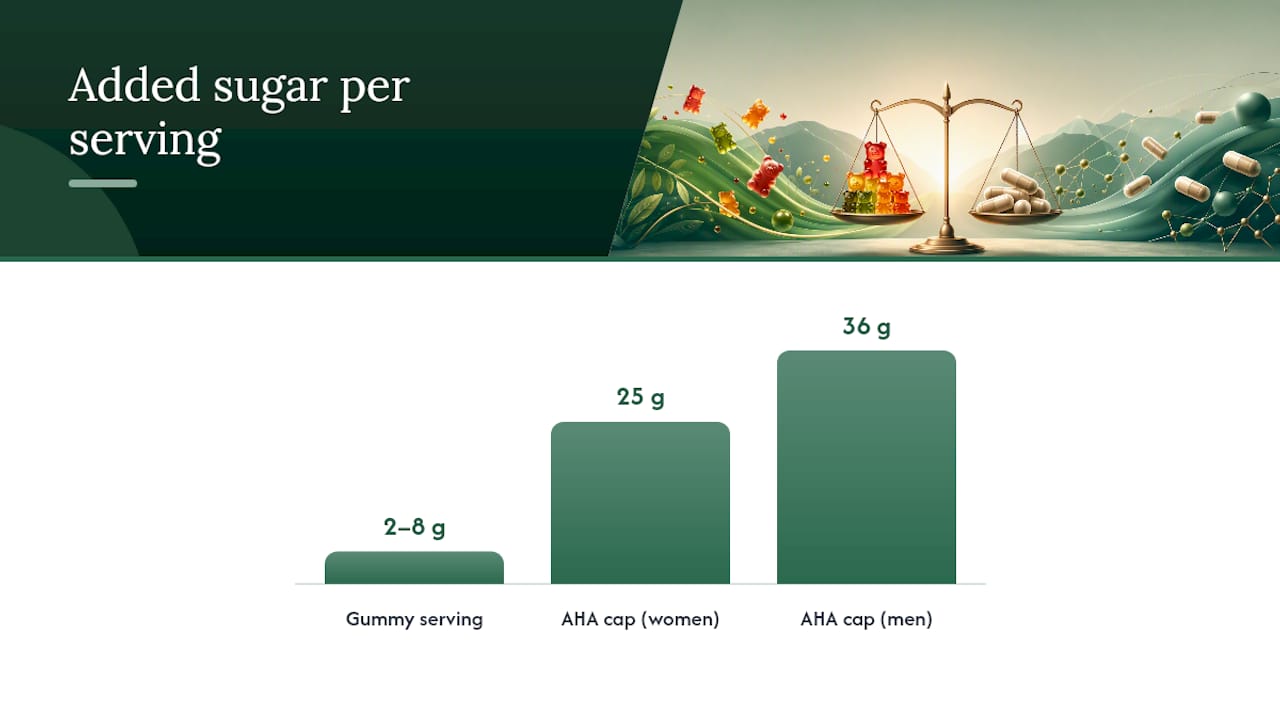
Sugar is the hidden cost. Most gummy vitamins carry 2 to 8 grams of added sugar per serving, and the American Heart Association caps daily added sugar at 25 grams for women and 36 grams for men. Two or three gummies a day can eat up a meaningful chunk of that budget before you’ve had breakfast.
Dose capacity is where capsules pull ahead. A single capsule can pack 500 milligrams of an active ingredient without anyone noticing; a gummy that dense would taste chalky or turn rubbery. That’s why gummy servings are often split across two or three pieces to hit the same dose a single capsule delivers in one shot.
- Taste: Gummies win outright; capsules are neutral or bitter.
- Sugar load: Gummies add 2–8 g per serving; capsules add none.
- Dose per unit: Capsules can carry far higher concentrations without texture problems.
- Shelf stability: Capsules resist heat and humidity better; gummies can soften, clump, or lose potency in a hot car or damp bathroom.
- Convenience: Gummies require no water and taste like a treat, which matters more than it sounds for daily consistency.
Why Gummies Can’t Hold Every Nutrient
Gummy manufacturing is a cooking process, not a filling process. Heat, moisture, and the acidic pH needed to set the gel can break down sensitive compounds before the candy ever hits the shelf. That’s a fundamentally different challenge than capsules face, since capsule shells just enclose a dry powder without cooking anything.
Certain nutrients consistently struggle in this environment. Iron, high-dose B-complex vitamins, creatine, and large mineral salts are difficult to formulate into a gummy without ruining the taste, texture, or stability of the batch. Iron in particular tends to taste metallic and can discolor the gel, so it’s often left out or included at token doses.
The practical fallout is twofold. Manufacturers frequently add “overages,” extra ingredient beyond the label claim, to account for degradation between production and expiration. And gummy production is generally more complex and costlier than capsule filling, which pushes up per-unit price and makes storage conditions matter more.
- Iron: rarely included at effective doses; can taste metallic and stain the gel.
- High-dose B vitamins: bulk and bitterness make large amounts impractical.
- Creatine: requires gram-level dosing that gummies can’t physically accommodate.
- Large mineral salts (calcium, magnesium): bulky and gritty at effective doses.
Pro Tip: If a label lists calcium, magnesium, or iron in a gummy at what looks like a full daily dose, check the percentage carefully. It’s often a fraction of what a capsule delivers, split across a much larger serving size.
What the Evidence Actually Shows About Absorption
For vitamin D specifically, one crossover trial found that a gummy produced roughly double the blood exposure (AUC) compared with a tablet in the same participants. That’s a striking result, but it came from a small study sample, and it applies to one nutrient in one delivery comparison, not gummies broadly.
A single crossover trial isn’t a verdict on every gummy versus every capsule. It tells you vitamin D absorbs unusually well from a gummy matrix in that specific study, nothing more.
The takeaway in numbers: the vitamin D study reported an AUC of roughly 1,474 ng·h/mL for the gummy versus 774 ng·h/mL for the tablet, a statistically significant gap in that trial. For most other nutrients, absorption is broadly comparable between well-made gummies and capsules, according to Cleveland Clinic, though gummies tend to carry fewer minerals and lose potency faster over time.
Where the evidence is thin, caution beats confidence. If you’re managing a diagnosed deficiency, don’t assume a gummy will replicate a clinical trial result for a nutrient nobody has actually tested that way. Ask for third-party test reports and, if you’re correcting a real deficiency, loop in a clinician rather than guessing from a gummy label.
Which Format Fits Your Situation
Match the format to the actual problem you’re solving, not to habit.
- Choose gummies if adherence is your real barrier. If you skip pills because you forget, gag, or just don’t like swallowing capsules, the most effective supplement is the one you actually take. A daily multivitamin or vitamin D gummy beats a capsule bottle gathering dust.
- Choose capsules if you have a diagnosed deficiency or need therapeutic dosing. Iron-deficiency anemia, clinical-grade B12 protocols, or multi-ingredient formulas like a NAD+ booster need exact, stable doses that gummies structurally can’t match.
- Choose capsules if you’re tracking added sugar closely. Diabetics, people on low-sugar diets, or anyone counting grams should default to capsules to avoid stacking sugar on top of supplementation.
- Ask yourself four questions before buying either: Do you have a diagnosed deficiency? Can you swallow pills without difficulty? Do you need an exact, high dose? Are you already watching added sugar intake?
If you answered yes to the first three, capsules are the safer default. If your honest answer is “I just won’t take a pill,” a quality gummy beats an empty bottle every time.
How to Read a Supplement Label Like You Mean It
The Supplement Facts panel tells you more than the marketing copy ever will, but only if you know what to check.
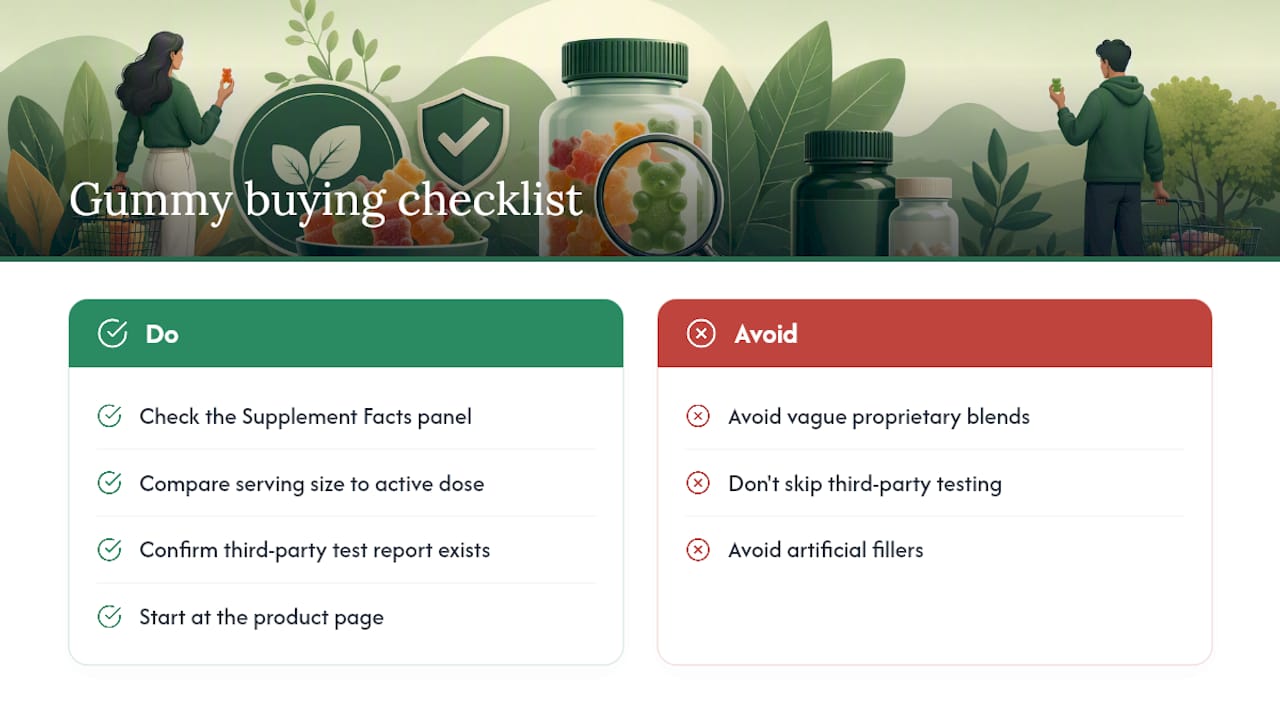
Start with active amount versus serving size. If a label lists “1,000 mg” but the serving size is three gummies, you’re getting a third of that per piece. Multiply carefully before assuming a two-gummy habit hits your target dose.
Next, look for third-party certification. Since the FDA doesn’t pre-approve dietary supplements before they reach shelves, independent testing and batch certificates of analysis are the closest thing you get to proof that a bottle contains what the label claims.
- Check for a visible third-party seal (NSF, USP, or an equivalent testing partner) rather than taking “tested” at face value.
- Avoid vague “proprietary blend” language that hides individual ingredient amounts.
- Watch for sugar alcohols like sorbitol in “sugar-free” gummies; these substitutes can cause GI distress in sensitive people, and a bottle without a digestive warning on a high dose is a red flag.
Pro Tip: Store gummies in a cool, dry cabinet, not the bathroom. Humidity and heat are exactly what breaks down the gel matrix and shortens potency well before the printed expiration date.
What Pureblue’s Manufacturing Standards Actually Address
Those controls target the exact weaknesses that give gummies a bad name: inconsistent potency, undisclosed additives, and label claims nobody verified.
Third-party testing catches the batch-to-batch drift that heat and moisture can cause in a gummy matrix. An FDA-registered facility means the production environment follows federal manufacturing standards, even though the finished supplement itself isn’t FDA-approved. Organic sourcing without filler ingredients also limits the additive load a gummy typically carries. Pureblue currently holds a 4.9 out of 5 customer rating on these products.
Honesty matters here too: for multi-ingredient, clinically positioned formulas like Pureblue’s own Quantum Vitality™ NAD+ booster, a capsule or powder delivery is the better structural choice, which is exactly why that product isn’t made as a gummy.
Are Gummy Vitamins Regulated the Same as Capsules?
Both formats fall under the same regulatory umbrella in the United States: dietary supplements, not drugs. The FDA doesn’t review or approve either gummies or capsules for safety or effectiveness before they hit the market. Instead, manufacturers are responsible for ensuring their products are safe and accurately labeled, and the FDA can act after the fact if a product proves dangerous or mislabeled.
That “no pre-approval” reality is exactly why third-party testing and batch certificates of analysis matter more for supplements than for medications. Nobody outside the manufacturer is required to verify that a bottle of gummies actually contains the vitamin D or biotin printed on the label, or that a capsule’s fill weight matches its claim.
Gummies face one additional layer of scrutiny that capsules generally don’t: added sugar and coloring additives can trigger separate labeling requirements depending on the specific ingredients used, since they function as food additives on top of the active nutrients. Capsule shells, typically gelatin or plant cellulose, carry far fewer additive concerns.
For consumers, the practical rule doesn’t change based on format. Whether you’re holding a bottle of capsules or a jar of gummies, the label claim is only as trustworthy as the testing behind it, which is why a visible third-party seal matters more than the shape of the product.
Our Take: Stop Treating This Like a Loyalty Test
The gummies-versus-capsules debate gets framed as a tribal choice, gummies for people who “don’t take their health seriously,” capsules for the disciplined. That framing is backwards. The right question isn’t which format is superior; it’s which format you’ll actually use consistently for the specific nutrient you need.
Where conventional advice falls short is treating all gummies as interchangeable junk and all capsules as clinically equivalent. Neither is true. A cheap gummy with no third-party testing deserves the skepticism it gets. A well-made one, tested for potency and free of filler additives, can outperform a capsule you never open.
Prioritize the nutrient first, then the format. If you’re correcting a diagnosed deficiency or dosing something like creatine, capsules aren’t optional. If you’re maintaining general wellness and the alternative is skipping supplementation entirely, a quality gummy is a legitimate answer, not a consolation prize.
— Organic
Ready to Try a Gummy That Doesn’t Cut Corners
If the checklist above pointed you toward gummies, Pureblue built the Blue Bear line specifically to avoid the shortcuts that give gummy vitamins a bad reputation, no vague proprietary blends, no skipped third-party testing.
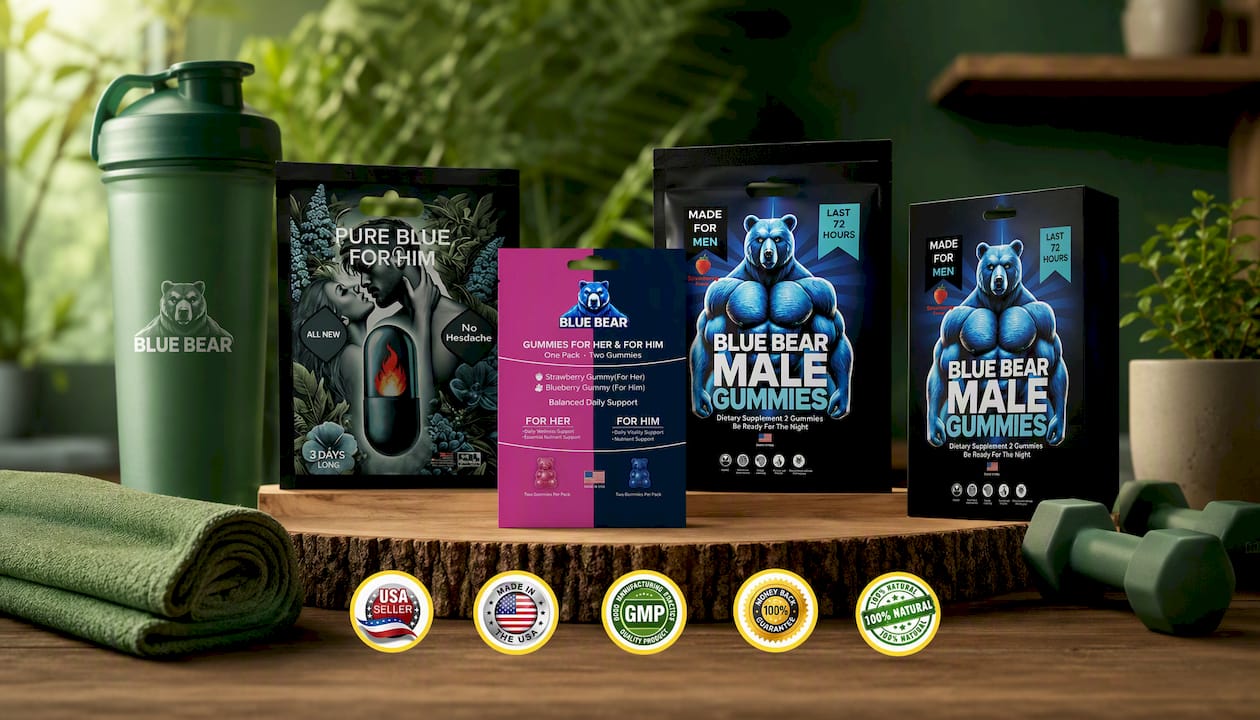
Blue Bear Gummies for Her & Him covers general daily support for adults who want consistency without the swallowing struggle. Men looking for a targeted formula can check out the Blue Bear Male Gummies, built around immune and vitality support. If you’re stocking up or want the best per-unit value, the Power Bundle combines multiple products at a lower combined cost than buying each separately.
Every batch is third-party tested for purity and potency and produced in an FDA-registered facility using organic ingredients with no artificial fillers. Before you buy anywhere, pull up the Supplement Facts panel, check the serving size against the active dose, and confirm a third-party test report exists. Start with the Blue Bear Gummies product page to see exactly what’s in the jar before it’s in your cabinet.
This article is general information, not a substitute for advice from a qualified doctor. Consult a qualified healthcare professional about your own circumstances before acting on anything here.
Sources
- Should you take gummy vitamins? | UCLA Health
- Do gummy vitamins work as well as traditional vitamins? | Cleveland Clinic