Cart
0

Yes, dietary supplements can contain hidden food and animal allergens buried in the “other ingredients” line, not just the active formula. If you suspect a reaction, stop the product immediately, keep the label or bottle, and check both the “Contains” statement and the full ingredient list. Anaphylaxis symptoms (throat swelling, breathing trouble, dizziness) mean emergency care now. Milder reactions still warrant a call to the manufacturer and a follow-up with your clinician before you take another dose.
TL;DR:
- Hidden allergens such as gelatin capsules, soy lecithin, lactose, and colorants are common in supplements and often not disclosed voluntarily.
- The Food Allergen Labeling and Consumer Protection Act mandates clear labeling for nine major allergens in the US, but many other triggers like carmine and sulfites remain unlisted.
- Reactions to supplements can be immediate or delayed, requiring specific tests; bringing the actual product to appointments improves diagnosis accuracy.
- Water-soluble vitamins and botanicals like spirulina and royal jelly pose documented allergy risks, while fatty vitamins and probiotics can trigger non-immune reactions or contain undeclared allergens.
- Always prioritize single-ingredient formulas, seek third-party tested products, and consult a clinician before re-challenging or reintroducing any supplement after a reaction.
Table of Contents
- Where Allergens Hide in Supplements: Excipients, Capsules, and Cross-Contact
- How to Read a Supplement Label for Allergens
- How Clinicians Diagnose Suspected Supplement Allergies
- Which Supplement Types Cause the Most Allergic Reactions?
- A Practical Checklist for Choosing Safer Supplements
- What Clinicians and Verified Manufacturers Recommend
- How Allergen Labeling Rules Differ Around the World
- Allergenic Additives That Labeling Laws Don’t Cover
- Treating an Allergic Reaction to a Supplement
- A Note on Balancing Benefit and Vigilance
- How Pureblue Approaches Allergen Transparency
- Sources
- FAQ
Where Allergens Hide in Supplements: Excipients, Capsules, and Cross-Contact
The active ingredient on the front label rarely causes the reaction. The problem is almost always in the fine print. Gelatin capsules, for instance, are made from animal collagen and have been tied to alpha-gal related reactions in people with mammalian meat allergies, while HPMC (a plant-derived capsule material) is a common substitute for people avoiding gelatin, according to dermatologists who track these cases.
Other common hiding spots:
- Soy lecithin, used as an emulsifier in softgels and gummies
- Lactose, a filler in tablet cores even in “dairy-free” marketed products
- Tree-nut or coconut oils, used as carrier oils in liquid formulas and softgels
- Marine-derived gelatin or fish oil residues, in capsules and omega blends
- Colorants and preservatives like carmine (a red dye made from insects), annatto, tartrazine (Yellow 5), and sulfites, all documented triggers in sensitive individuals
Here’s the part most people miss: a “may contain” statement is voluntary in the supplement category, not required. A product without one hasn’t necessarily been tested for cross-contact. It just hasn’t disclosed it. Facilities that also process tree nuts, soy, or shellfish for other product lines can introduce trace allergens even when the ingredient list looks clean.
How to Read a Supplement Label for Allergens
U.S. law gives you a real tool here, and it’s worth understanding exactly what it covers. The Food Allergen Labeling and Consumer Protection Act requires that milk, eggs, fish, crustacean shellfish, tree nuts, peanuts, wheat, soybeans, and (as of January 1, 2023, under the FASTER Act) sesame be clearly declared whenever they’re present. That’s nine major allergens, and supplement makers are legally bound to name them plainly.
Here’s how to actually use that rule at the shelf or in your medicine cabinet:
- Read the “Contains” statement first. It lists major allergens in plain language, separate from the technical ingredient names.
- Scan the “other ingredients” line in full, not just the supplement facts panel. This is where capsule material, fillers, and dyes live.
- Recheck every reformulation. Brands change suppliers and capsule materials without warning, so a product that was safe last year may not be safe this refill.
- Contact the manufacturer directly if a term is unclear, and ask for a written allergen statement if you have a severe history.
Pro Tip: Save a photo of the ingredient panel every time you buy a new bottle. If a reaction happens weeks later, you’ll have the exact formulation on hand instead of relying on memory.
How Clinicians Diagnose Suspected Supplement Allergies
Testing for a supplement reaction isn’t as clean as testing for peanut allergy. Clinicians generally split reactions into two patterns: immediate, IgE-mediated responses (hives, swelling, anaphylaxis within minutes to hours) and delayed, cell-mediated responses (contact dermatitis, eczema flares over days).
- Immediate reactions get evaluated with skin-prick testing, intradermal testing, or basophil activation tests.
- Delayed reactions are typically assessed with patch testing or lymphocyte transformation assays.
- The catch: multi-ingredient, proprietary blends and nonstandardized reagents make test interpretation genuinely difficult, since a positive result to a “blend” doesn’t tell you which of ten ingredients caused it.
- Cross-reactivity between botanical families adds another layer. Someone allergic to ragweed, for example, may react to related plants in the Asteraceae family used in herbal formulas.
Bring the actual bottle to your appointment, not just the name from memory. A symptom timeline (what you took, when, how long before symptoms started) and a list of prior exposures speed up the workup considerably. If reactions are severe or recurring, ask for a referral to an allergist or a contact dermatologist rather than working through it with a general practitioner alone.
Which Supplement Types Cause the Most Allergic Reactions?
Not every supplement category carries the same risk, and knowing where the documented cases cluster helps you prioritize what to scrutinize first.
- Water-soluble vitamins (B complex, vitamin C) have been linked to immediate hypersensitivity reactions in case reports, even though they’re perceived as “safe” because they’re not fat-stored.
- Fat-soluble vitamins in topical form have been tied to contact dermatitis rather than systemic reactions.
- Botanicals carry cross-reactivity risk tied to plant families, and a narrative review of hypersensitivity cases documents specific instances of immediate anaphylaxis linked to spirulina, royal jelly, and natto.
- Probiotics and fermented products are a bigger risk than most people assume: case reports and small studies have identified undeclared milk or egg proteins in some probiotic preparations, tied to real clinical reactions.
- Animal-derived ingredients, particularly gelatin capsules, raise alpha-gal concerns for people with mammalian meat allergy.
Not every “reaction” is even an allergy. The niacin flush and magnesium-related GI upset are predictable pharmacologic side effects, not immune responses, and telling the two apart changes whether you need an allergist or just a lower dose.
If you’re weighing whether a supplement belongs in your routine at all, this breakdown of when supplements actually make sense is worth a look before you introduce anything new. Botanical cross-reactivity is also covered in more depth in this practical guide to herbal iron sources, useful if you’re navigating plant-family sensitivities.
A Practical Checklist for Choosing Safer Supplements
You can cut your risk substantially with a few habits, applied every time you shop, not just the first time.
- Favor single-ingredient formulas over proprietary blends when you have known sensitivities. Fewer ingredients means fewer unknowns.
- Look for explicit allergen-free labeling and third-party test certificates, which confirm what’s actually in the bottle matches what’s on the label.
- Choose HPMC or vegetarian capsules over gelatin if animal-derived materials are a concern.
- After any reaction, stop the product, save the bottle, photograph the ingredient panel, and contact the manufacturer’s listed customer service line before you decide whether to try it again.
- Talk to your clinician before any re-challenge. Never reintroduce a suspect product on your own timeline.
Pro Tip: If you’ve had a documented reaction to a supplement category before, ask your pharmacist about clinician-dispensed or pharmacy-grade alternatives. They tend to carry tighter batch documentation than mass-market retail versions.
What Clinicians and Verified Manufacturers Recommend
Clinicians increasingly ask about supplement use during allergy workups, because patients often don’t volunteer it unless directly asked. Pureblue’s own practices, third-party purity testing, manufacturing in an FDA-registered facility, and organic sourcing, map directly onto that checklist. Even so, no testing regime eliminates cross-contact risk entirely, and a documented IgE-mediated allergy always calls for clinician guidance before use.
How Allergen Labeling Rules Differ Around the World
The nine-allergen standard under FALCPA and the FASTER Act applies specifically to the United States. Other countries draw the line differently, and that matters if you buy supplements internationally or order from overseas retailers.
The European Union requires declaration of 14 allergens, a longer list that adds celery, mustard, lupin, and molluscs to the American nine. The United Kingdom, post-Brexit, maintains its own version of that 14-allergen list through the Food Standards Agency, largely mirroring EU rules but enforced separately. Canada requires priority allergen declarations similar to the U.S. list but adds mustard as a required disclosure. Australia and New Zealand follow a joint food standards code with its own specific thresholds for trace contamination labeling.
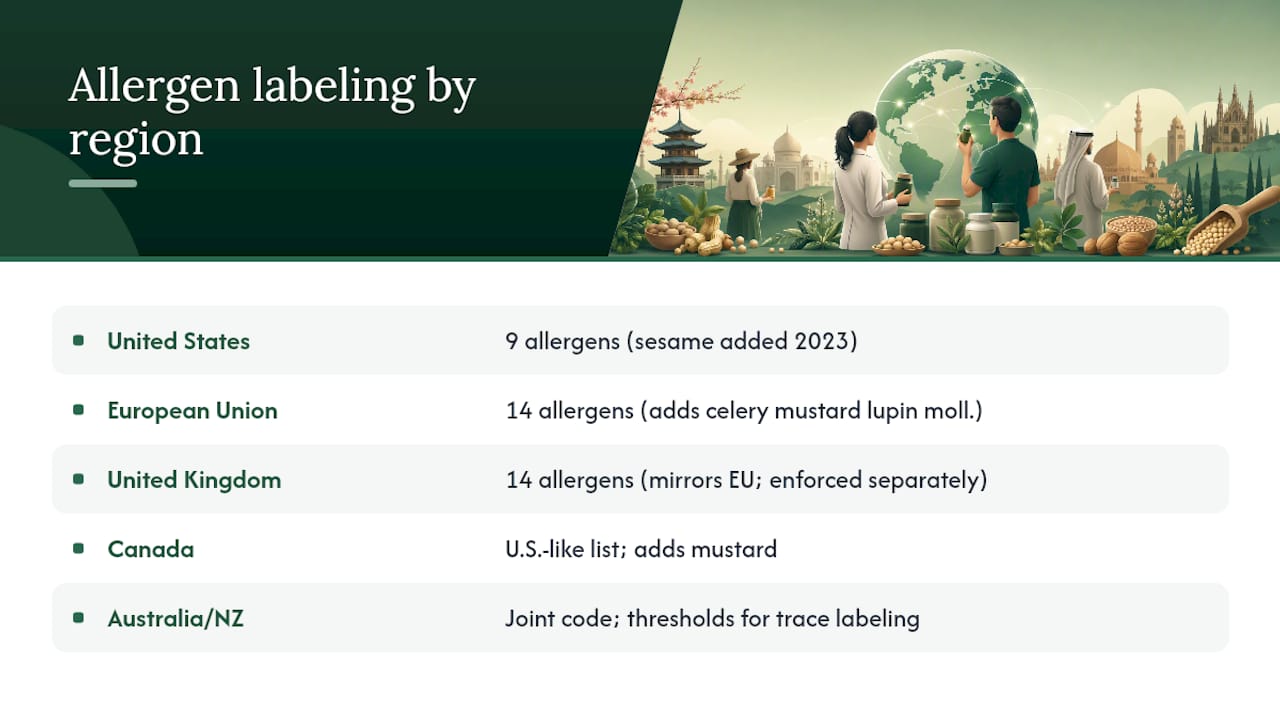
The practical takeaway: a supplement manufactured for the EU market may disclose celery or mustard exposure that a U.S. label from the same company would never mention, because U.S. law doesn’t require it. If you order supplements from an overseas retailer, don’t assume the label follows the same rules you’re used to at home. Sesame’s addition to the U.S. list in 2023 also means older stock or products manufactured before that date may not reflect current disclosure standards, which is one more reason to check the manufacture date alongside the ingredient panel.
Allergenic Additives That Labeling Laws Don’t Cover
FALCPA covers nine allergens. It does not cover everything that actually triggers reactions in supplement users, and that gap catches people off guard.
Carmine, the red dye derived from cochineal insects, causes documented allergic reactions but sits outside the major-allergen list entirely, meaning it can appear as “natural color” with no further disclosure required. Sulfites, used as preservatives in some liquid and gummy formulas, trigger reactions (particularly respiratory symptoms in sensitive individuals) but fall under a separate, narrower disclosure threshold than the major allergens. Latex-fruit cross-reactivity is another blind spot: people with latex sensitivity can react to certain plant-derived excipients with no labeling requirement connecting the two.
Botanical cross-contamination is arguably the biggest unregulated risk. A facility processing multiple herbal ingredients can introduce trace amounts of an unlisted plant into a product with no legal obligation to disclose it, unlike the strict cross-contact disclosure culture built around the major nine allergens. Heavy metal and mold contaminants, while a safety issue rather than a classic allergen, can also trigger inflammatory or hypersensitivity-like symptoms that get mistaken for allergic reactions. This is exactly why third-party testing matters beyond what any label legally requires. It catches what disclosure laws were never designed to catch.
Treating an Allergic Reaction to a Supplement
Management depends entirely on severity, and knowing the tiers ahead of time saves precious minutes if something goes wrong.
Mild reactions (localized hives, mild itching, minor GI upset) are typically managed with an oral antihistamine and discontinuation of the product. Moderate reactions involving more widespread hives or facial swelling warrant a call to your clinician the same day, even if breathing feels normal. Severe reactions, throat tightness, wheezing, dizziness, or a drop in blood pressure, are anaphylaxis until proven otherwise, and they require immediate epinephrine (if you have a prescribed auto-injector) and a call to emergency services, not a wait-and-see approach.
After any reaction, regardless of severity, the same documentation habit applies: preserve the bottle, photograph the label, and note the timing between ingestion and symptom onset. That record is what allows your clinician to actually diagnose the trigger rather than guess at it. Anyone with a history of anaphylaxis to a supplement ingredient should carry an epinephrine auto-injector and should not attempt a re-challenge without allergist supervision, the same caution that applies to any known severe food allergy.

A Note on Balancing Benefit and Vigilance
Supplements can genuinely help fill real gaps, but that benefit only holds up if you stay honest about what a label can and can’t tell you. Tell your clinician everything you take, not just prescriptions, and report reactions when they happen instead of quietly switching brands. Save your labels. If you ever reintroduce a suspect product, do it stepwise and only under clinician supervision, never on your own schedule.
— Organic
How Pureblue Approaches Allergen Transparency
Checking an ingredient panel shouldn’t feel like detective work, which is exactly why Pureblue builds its product pages around the same checklist covered above: clear ingredient lists, minimal inactive ingredients, and third-party purity testing you can actually verify. The Quantum Vitality NAD+ Booster+ Detox formula, manufactured in an FDA-registered facility with organic sourcing, lists its full ingredient panel on the product page so you can check it against your own allergen list before ordering.

The same transparency runs through the Blue Bear Male Gummies line and the Pure Blue core formula. If anything on a panel is unclear, Pureblue’s customer support can walk through the “other ingredients” line with you directly, and anyone with a documented history of severe allergic reactions should still loop in a clinician before starting something new. Review the ingredient panel on the product page that fits your goals, and reach out with allergen questions before you check out.
Sources
- Beware the Hidden Allergens in Nutritional Supplements
- Hypersensitivity reactions associated with nutraceuticals and dietary supplements: A narrative review
- Food Allergen Labeling and Consumer Protection Act of 2004 (FALCPA)
This article is general information, not a substitute for advice from a qualified doctor. Consult a qualified healthcare professional about your own circumstances before acting on anything here.
FAQ
What Are Red Flags for Supplements?
Vague “proprietary blend” labeling that hides individual ingredient amounts, missing third-party test certificates, and no clear “other ingredients” disclosure are the main warning signs to watch for.
Is It Possible to Be Allergic to Supplements?
Yes. Reactions can come from the active ingredient itself or, more often, from hidden excipients like gelatin, soy lecithin, or dyes such as carmine used as fillers and colorants.
Can You Be Allergic to Vitamin D3?
True allergy to vitamin D3 itself is rare, but reactions are sometimes triggered by the capsule material, oil carrier, or preservative used in the D3 formulation rather than the vitamin.
What Two Vitamins Should Never Be Taken Together?
This depends on absorption interactions rather than allergy risk. Calcium and iron, for instance, compete for absorption when taken simultaneously, so spacing doses apart is generally recommended. This is a nutrient interaction question, not a hypersensitivity one, and specific interaction guidance should come from your pharmacist or clinician.