Cart
0

For most people, the schedule breaks into two or three windows: energizing nutrients like B vitamins and iron go in the morning, fat-soluble vitamins ride along with a meal that has some fat in it, and calming minerals like magnesium and calcium move to the evening. Spacing matters as much as timing. Keep calcium and iron at least two hours apart, and stay consistent day to day. That consistency, more than hitting an exact minute, is what actually drives results.
TL;DR:
- Taking iron and calcium supplements at least two hours apart maximizes absorption, especially since they can significantly hinder each other when taken together.
- Morning vitamin and mineral intake should include B vitamins, vitamin C, iron, and fat-soluble vitamins like D, E, and K with a meal containing fat for proper absorption.
- Post-workout supplements such as protein and creatine deliver the most benefit when taken within 30 to 60 minutes after exercise to support muscle repair and glycogen restoration.
- Calming minerals like magnesium and calcium are best reserved for evening, with magnesium glycinate shown to modestly improve sleep quality when taken before bed.
- Spacing rules are critical; improper timing, especially with caffeine or stimulants after mid-afternoon, can disrupt sleep and negate the benefits of the supplement schedule.
Table of Contents
- Supplement Timing for Energy: A Quick Master Chart
- Which Supplements Boost Morning Energy, and Why?
- How Should You Time Supplements Around a Workout?
- Which Supplements Belong in Your Evening Routine?
- What Timing Conflicts Actually Hurt Absorption?
- Sample Supplement Schedules You Can Copy Today
- How to Audit and Build a Routine That Actually Sticks
- When Should You Take Caffeine Supplements for Energy Without Wrecking Sleep?
- When Is the Best Time to Take Rhodiola or Ashwagandha for Energy?
- Do Nootropics Belong in Your Morning or Evening Routine?
- How Does Your Chronotype Change Your Supplement Schedule?
- Which Medications Interact With Common Energy Supplements?
- How Do You Fit Supplement Timing Into a Real Daily Schedule?
- Why Timing Beats Quantity When It Comes to Supplement Energy
- How Pure Blue Fits Into a Morning Energy Routine
- Sources
- FAQ
Supplement Timing for Energy: A Quick Master Chart
Before getting into the reasoning behind each nutrient, here’s the schedule most people can start using today. A two-window system covers the basics. Add a third window only if your training or recovery needs justify a dedicated post-workout slot.
Two-window default:
- Morning (with breakfast): B-complex, vitamin C, iron (if needed), vitamin D, fish oil, CoQ10
- Evening (1 to 2 hours before bed): magnesium glycinate, calcium (if not paired with iron earlier)
Three-window option for active people:
- Morning: energizing vitamins and any fat-soluble nutrients with breakfast
- Post-workout (within 30 to 60 minutes of finishing): protein, creatine, carbohydrate source
- Pre-bed: magnesium, calcium, any calming adaptogens
A few meal rules make this stick. Fat-soluble vitamins A, D, E, and K need dietary fat to absorb well, so pair them with eggs, avocado, or a splash of olive oil rather than swallowing them dry, ideally with a meal that includes some fat. Iron works best on an empty stomach, but if that upsets your gut, take it with food, just not food that contains calcium or polyphenols. Anchor everything to something you already do, breakfast, your workout, brushing your teeth before bed, and the schedule runs itself.
Which Supplements Boost Morning Energy, and Why?
Morning is when your body handles B vitamins and iron most efficiently, and it’s also the window where you want any stimulating effect to work in your favor instead of against your sleep later.
B-complex and B12 support the enzymatic pathways your cells used to convert food into usable energy. Because they can have a mildly activating effect for some people, taking them before noon avoids the small chance of restlessness at night.
Iron absorbs best on an empty stomach, and pairing it with vitamin C improves nonheme iron uptake further. Coffee, tea, and calcium all blunt absorption, so keep iron away from your morning latte and any dairy by a couple of hours.
Fat-soluble vitamins (D, E, K, plus CoQ10 and fish oil) can absolutely go in the morning, as long as breakfast includes some fat. A tablespoon of nut butter or a couple of eggs is enough, since even modest fat amounts meaningfully improve absorption compared to taking these on an empty stomach.
Pro Tip: If mornings are rushed, set your iron and vitamin C by your coffee maker as a visual cue, but take them before you pour the cup, not after.
How Should You Time Supplements Around a Workout?
The window right after exercise does real metabolic work, and stretching it out too long costs you some of the benefit.
- Protein and carbohydrates within 30 to 60 minutes post-exercise accelerate glycogen restoration and support muscle repair, which translates into less next-day fatigue and faster recovery between sessions.
- Creatine timing is flexible. The exact minute matters less than taking it every day; pairing it with your post-workout shake just makes it easy to remember.
- Caffeine and stimulant-based pre-workouts need a cutoff. Most people should avoid them after 3 or 4 PM, and anyone sensitive to caffeine may need to stop even earlier to protect sleep onset.
For readers who train intensely, dialing in intra-workout carbohydrate strategy alongside this window adds another layer of recovery support.
Which Supplements Belong in Your Evening Routine?
Evening is where you shift from energizing to calming, and the mineral choices here directly affect how well you sleep.
- Magnesium glycinate, taken 30 to 60 minutes before bed, is the form most often used in the trials that show modest improvements in sleep onset and quality, typically in ranges used under clinical supervision rather than casual self-dosing.
- Calcium fits better at night than in the morning, mainly because it competes with iron for absorption. Calcium citrate absorbs well with or without food, while calcium carbonate needs food to absorb properly, so factor that into when you take it.
- Melatonin, if you use it, works best in small doses taken about 30 minutes before your target bedtime. It can be habit forming for some routines and isn’t something to escalate in dose without checking with a doctor first.
What Timing Conflicts Actually Hurt Absorption?
A few pairings cause enough interference that they deserve their own rule, not just a general “space things out” suggestion.
- Calcium and iron: separate by at least two hours; calcium can reduce iron absorption substantially when taken together.
- Levothyroxine and calcium or iron: space at least several hours apart, since this interaction is well documented and clinically significant.
- Zinc and copper, and zinc and iron: high-dose zinc can interfere with both, so if you’re supplementing any of these individually, don’t stack them in the same dose.
- Coffee or tea and iron: wait one to two hours in either direction; the tannins bind iron and cut absorption.
One spacing rule stands out for how often it’s ignored: even a small fat source, roughly a tablespoon of oil or a handful of nuts, is enough to meaningfully improve fat-soluble vitamin uptake, so there’s no need to eat a heavy meal just to take vitamin D.
Sample Supplement Schedules You Can Copy Today
Pick the version that matches how complicated your routine actually needs to be.
- Minimalist two-window: Morning with breakfast, take your multivitamin, vitamin D, fish oil, and B-complex together. Evening, one to two hours before bed, take magnesium and calcium.
- Athlete three-window: Morning covers your vitamins as above. Post-workout, within an hour of training, take protein and creatine. Pre-bed, magnesium and any calming adaptogen.
- Heavy-stack adjustment: If you’re managing five or more supplements, split doses across three anchors, and check every pairing against the interaction rules above before locking in times.
Travel, shift work, and new prescriptions all shift these anchors. If your sleep schedule flips, move your “morning” window to whenever you wake up, and keep the same spacing rules relative to that new anchor rather than the clock.
How to Audit and Build a Routine That Actually Sticks
Start by writing down every supplement you take and the time you currently take it. Most people find their real routine looks nothing like what they intended.
- Flag conflicts first. Any calcium and iron within two hours of each other, or a stimulant supplement taken past mid-afternoon, gets moved.
- Check prescriptions against the list. Levothyroxine, certain antibiotics, and some blood thinners all have supplement interactions worth confirmed with a pharmacist.
- Split doses when a window gets crowded. If breakfast is carrying six pills, move the fat-soluble vitamins to dinner instead, since either meal works as long as it has some fat.
Pro Tip: A seven-day pill organizer with AM/PM compartments does more for adherence than any app reminder, mainly because you can see at a glance whether you already took something.
When Should You Take Caffeine Supplements for Energy Without Wrecking Sleep?
Caffeine works fast, usually within 20 to 45 minutes, and that speed is exactly why timing it wrong causes problems. Caffeine’s half-life runs roughly five to six hours in most adults, which means a 4 PM dose can still have half its effect circulating at 10 PM.
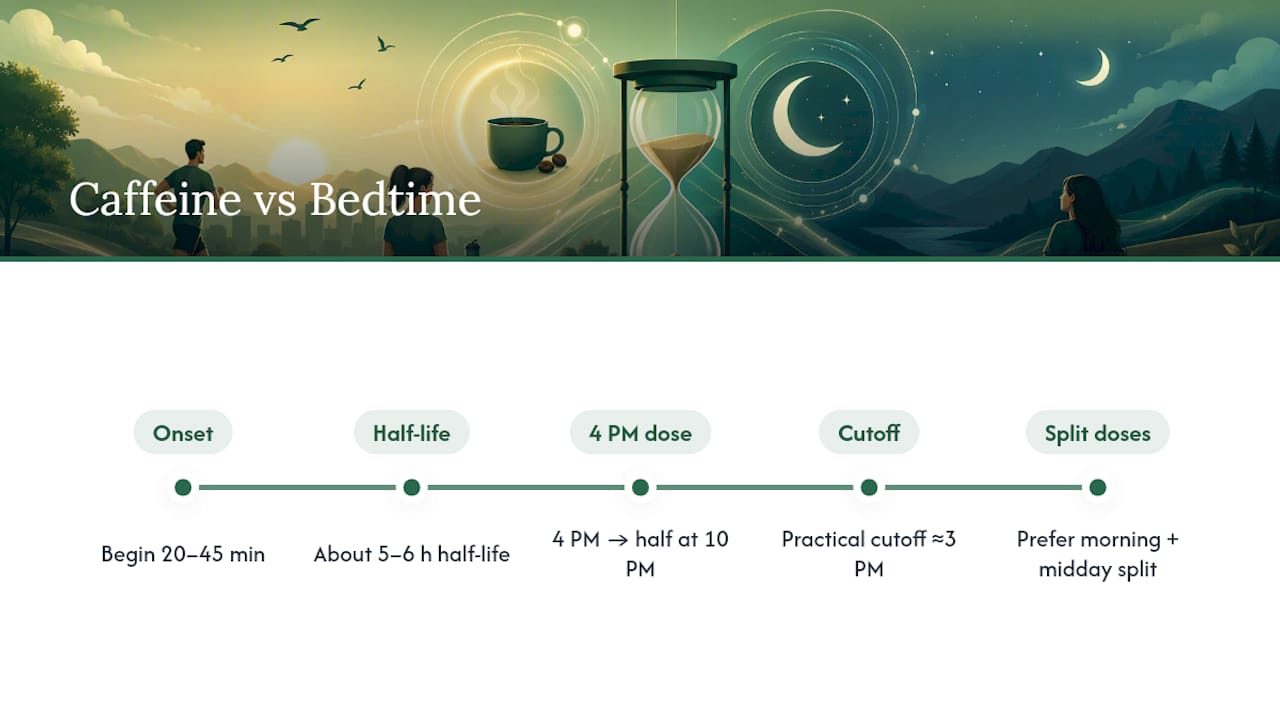
The practical cutoff for most people sits around 3 PM, earlier if you’re sensitive or over 40, since caffeine metabolism tends to slow with age. If you use a caffeinated pre-workout, schedule training for the morning or early afternoon rather than evenings, so the stimulant clears before bedtime.
Splitting your caffeine intake also helps more than one large morning dose. A moderate amount at breakfast followed by a smaller dose around midday tends to produce steadier alertness than a single spike that fades hard by 2 PM, sometimes called the afternoon crash. That crash is often what drives people to reach for more caffeine later in the day, which then pushes the sleep-disrupting window closer to bedtime.
If you’re combining caffeine with other energizing supplements, like a B-complex or an energy-focused blend, keep both in the same morning window rather than spreading stimulating ingredients across the day. Stacking two separate “wake-up” doses, one at 8 AM and another at 2 PM, is a common way people accidentally sabotage their own sleep without realizing the second dose was the problem.
When Is the Best Time to Take Rhodiola or Ashwagandha for Energy?
Adaptogens split into two rough categories, and timing depends on which effect you’re chasing. Rhodiola rosea tends to have a mildly stimulating quality for many people, which makes morning or early afternoon the more sensible window, ideally with food to reduce any stomach upset.
Ashwagandha behaves differently. Most people report a calming effect rather than a stimulating one, which is why it often gets grouped with evening supplements instead of morning energizers. Taking it an hour or two before bed can support the relaxation response without the daytime grogginess some people notice if they take it earlier and then need to be sharp for work.
That said, individual response to adaptogens varies more than it does with something straightforward like vitamin C. Some people find ashwagandha energizing rather than sedating, and the reverse is true for a smaller group with rhodiola. The practical approach is to start with the conventional timing, morning for rhodiola, evening for ashwagandha, and track how you actually feel over one to two weeks before locking in a permanent slot.
Avoid combining either adaptogen with prescription sedatives or anti-anxiety medication without checking with a doctor first, since the combined calming effect can be more pronounced than either ingredient alone.
Do Nootropics Belong in Your Morning or Evening Routine?
Nootropics cover a wide range, from caffeine-adjacent compounds to nutrients like citicoline and L-theanine, and their timing depends entirely on which side of the alertness spectrum they sit on.
Stimulating nootropics, anything marketed for focus or mental energy, follow the same logic as caffeine: morning or early afternoon only. Taking a focus-oriented nootropic blend at 6 PM to power through evening work is one of the more common ways people unintentionally push their bedtime back by an hour or more.
L-theanine is the exception worth knowing. It’s often paired with caffeine specifically because it smooths out the jittery edge without adding sedation, so it works in the same morning window as your caffeine dose rather than needing separate timing.
Compounds aimed at long-term cognitive support rather than immediate alertness, some choline sources, for example, tend to be timing-flexible since they aren’t producing an acute stimulating effect. These can go with whichever meal is easiest to remember consistently.
The mistake to avoid is treating every nootropic as automatically energizing. Some are neutral or even mildly calming, and taking a calming compound in the morning when you actually needed alertness defeats the purpose of using it at all. Read the ingredient profile, not just the marketing claim on the label, before deciding which window it belongs in.
How Does Your Chronotype Change Your Supplement Schedule?
Not everyone runs on the same internal clock, and the “morning” window this guide describes really means “your first meal after waking,” whatever time that happens to be.
Early chronotypes, the classic morning people, naturally align well with standard advice: energizing nutrients around 6 to 8 AM, calming ones by 9 or 10 PM. Late chronotypes, and genuine night owls, need to shift the entire framework later rather than forcing themselves onto an early schedule that doesn’t match their biology.
If your natural wake time is closer to 10 AM, your energizing window moves to late morning, your post-workout slot (if you train in the afternoon or evening) shifts accordingly, and your magnesium or calcium dose moves to whatever your actual pre-bed time is, even if that’s 1 AM. The two-hour spacing rules between calcium and iron, or the caffeine cutoff roughly six hours before sleep, stay the same relative to your bedtime, not relative to the clock on the wall.
Shift workers face the hardest version of this problem, since their “morning” might technically be 11 PM. The fix is the same principle applied more aggressively: treat your first meal after waking as the anchor for energizing nutrients regardless of what the sun is doing, and treat the meal or window before your sleep period as the anchor for magnesium and calming supplements.
Which Medications Interact With Common Energy Supplements?
Supplement and medication interactions are one of the more overlooked reasons a well-intentioned schedule backfires, and the levothyroxine and calcium interaction covered earlier isn’t the only one worth knowing.
Blood thinners like warfarin interact with vitamin K, found in many multivitamins and some green-focused supplements, in ways that can affect clotting time. Anyone on anticoagulant therapy needs to keep vitamin K intake consistent day to day rather than varying it, and should loop in their prescribing doctor before adding a new supplement that contains it.
Stimulant-based energy supplements, including caffeine and certain thermogenic blends, can compound the effects of prescription stimulants used for ADHD or interact with blood pressure medication. Combining the two without medical guidance risks pushing heart rate or blood pressure higher than either would alone.
Iron supplements can reduce the absorption of certain antibiotics, including tetracyclines and some fluoroquinolones, when taken too close together, similar to the calcium interaction described earlier. The same two-hour separation principle applies.
Adaptogens like ashwagandha may interact with thyroid medication and with sedatives, given their effects on cortisol and the nervous system. If you’re on any prescription medication, the safest approach is a quick conversation with a pharmacist before adding a new energy or calming supplement, not after you’ve already been taking it for a month.
How Do You Fit Supplement Timing Into a Real Daily Schedule?
The schedules and rules above only work if they survive contact with an actual busy day, which means anchoring supplements to routines you already have rather than treating them as a separate task.
Breakfast is the natural home for morning energizers and fat-soluble vitamins, since you’re already eating something with at least a little fat in it. If breakfast is often skipped or rushed, moving those supplements to whatever your first real meal is, even if that’s closer to 11 AM, works fine as long as it’s consistent.
Lunch works well as a secondary caffeine or B-complex checkpoint for people who need a midday lift, provided it stays before the 3 PM cutoff. Post-workout nutrition slots naturally after training, whenever that happens to fall in your day.
Dinner is a reasonable second home for fat-soluble vitamins if mornings are too chaotic to manage more than one or two pills. The one rule that doesn’t bend: keep calcium and iron on opposite sides of the day if you take both, since dinner-time calcium paired with breakfast iron solves the two-hour spacing problem automatically.
The pre-bed window, ideally the same time each night, is where magnesium, calcium (if not already taken at dinner), and any calming adaptogen belong. Consistency here matters more than the exact clock time, since your body starts to anticipate the routine once it’s repeated for a week or two straight.
Why Timing Beats Quantity When It Comes to Supplement Energy
Most advice about energy supplements focuses on which pill to take, not when to take it, and that’s backwards. You can buy the highest-quality B-complex on the market and still feel flat by 2 PM if you’re taking it at the wrong time relative to your iron, your coffee, or your last meal.
The bigger misconception worth pushing back on: people assume more supplements taken at once means faster results. In practice, cramming everything into one morning dose often means several of those nutrients are actively blocking each other’s absorption, calcium killing iron uptake, zinc crowding out copper, while you get none of the energy benefit you paid for.
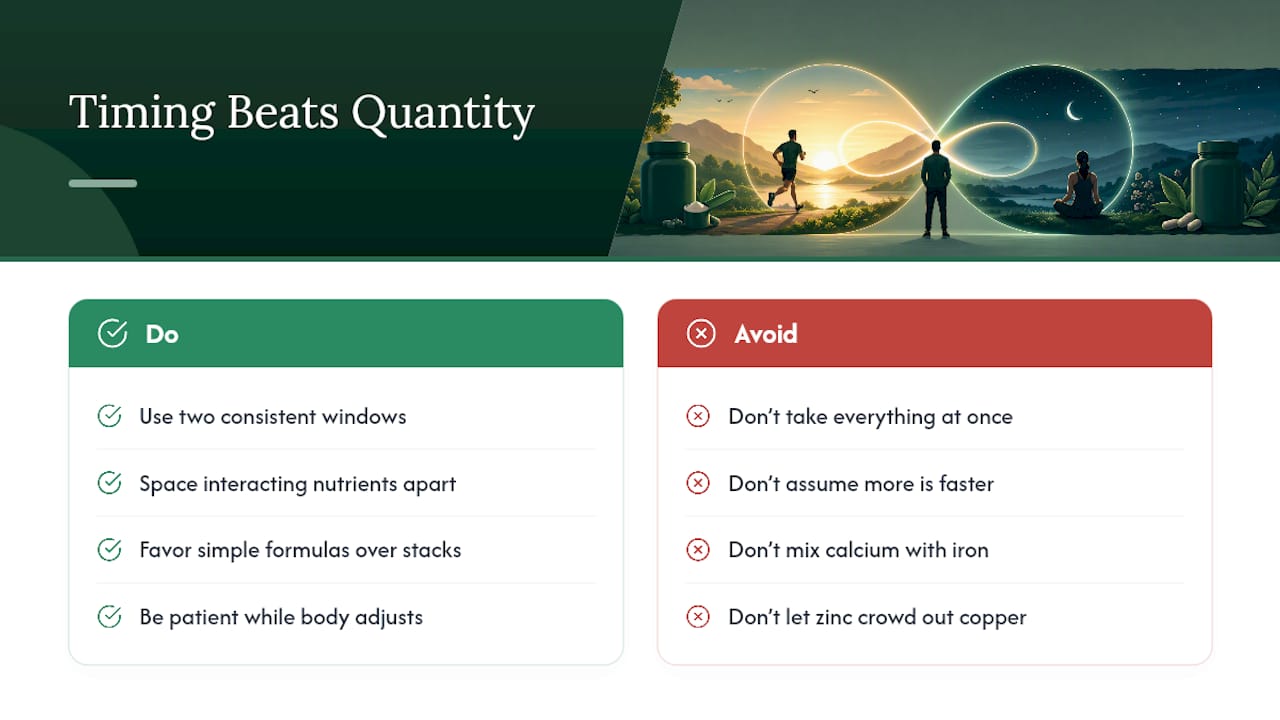
What the evidence actually supports is almost boring in its simplicity: a couple of consistent windows, basic spacing rules followed without exception, and patience while your body adjusts to a routine instead of a random daily scramble. Consistency in timing matters more than precision to the minute, and that single fact undercuts most of the elaborate hourly charts sold as premium advice.
Pure Blue built its own organic supplement formulations around this same energy-first, sleep-protective philosophy, favoring simple formulas over complicated stacks that fight each other for absorption. If you’re on levothyroxine or any other medication with known timing interactions, treat every recommendation here as a starting point, not a substitute for a conversation with your doctor or pharmacist.
— Organic
How Pure Blue Fits Into a Morning Energy Routine
Once your schedule is built around a morning energizing window and an evening calming window, the next question is what actually goes in those slots. Quantum Vitality NAD+ Booster+ Detox is formulated as a 3-in-1 energy and detox product designed for that morning window, using 100% organic ingredients with no artificial fillers, and it’s third-party tested for purity and potency so you know what’s actually in the bottle.

For readers managing more than one or two products, the Power Bundle simplifies things by pairing complementary formulas into a single, easier-to-follow two-window routine instead of juggling separate bottles with separate rules. Both are manufactured in an FDA-registered facility, and Pure Blue’s core lineup is built around the same energy-first, sleep-protective approach covered throughout this guide.
As with any supplement, follow the label dosing, and if you take levothyroxine or another prescription with known timing sensitivities, space any supplements accordingly and check with your doctor before starting a new routine.
Sources
- Vitamin C — Health Professional Fact Sheet (NIH Office of Dietary Supplements)
- Post-exercise nutrition and recovery (PMC)
- Interaction of calcium and iron absorption (PubMed)
FAQ
When Is the Best Time to Take Vitamins for Energy?
Take B vitamins, vitamin C, and iron in the morning with breakfast to support energy metabolism without risking sleep disruption later in the day.
What Supplements Give You Immediate Energy?
Caffeine and B12 tend to produce the fastest noticeable effect, usually within 20 to 45 minutes, while iron and adaptogens like rhodiola build energy support gradually over days to weeks.
When Is the Best Time to Take Vitamin D3, K2, and Magnesium?
Take vitamin D3 and K2 with a meal containing fat, ideally breakfast or dinner, and save magnesium for 30 to 60 minutes before bed to support sleep quality.
When Is the Best Time of Day to Take Vitamin B12 and Vitamin D3?
Take B12 in the morning to support daytime energy metabolism, and pair vitamin D3 with whichever meal has the most dietary fat, morning or evening both work.
Can I Take Pure Blue’s Quantum Vitality in the Morning?
Yes, Quantum Vitality is formulated for daytime energy and fits naturally into a morning routine alongside breakfast, following the label’s recommended dosing.