Cart
0

Gummy vitamins are a reasonable choice for people who won’t take a pill but will happily eat a gummy, and a weaker choice for anyone who needs a complete, high-potency supplement. The real tradeoff is adherence versus completeness: gummies win on taste and consistency of use, but often lose on mineral content, dosing precision, and shelf stability. If you’re pregnant, managing a diagnosed deficiency, or taking medications, talk to a clinician before choosing a format.
TL;DR:
- Gummy vitamins are most effective for individuals who have difficulty swallowing pills or need a simple, consistent supplement because they improve adherence.
- Many gummies contain added sugar and lack sufficient amounts of minerals like calcium or magnesium, making them less suitable for correcting deficiencies.
- High-quality gummies should have third-party testing seals, transparent ingredient lists, and dosing that matches your specific nutritional needs, especially for minerals.
- Storage in a cool, dry place and following daily serving limits are crucial to maintain potency and prevent potential overdose, especially in children.
- For targeted therapeutic doses or deficiency correction, pills or capsules are more reliable, while gummies serve as a convenient alternative when pills are refused or poorly tolerated.
Table of Contents
- When gummy vitamins actually help
- Why sugar, additives, and dosing gaps matter
- Gummies vs. pills: which actually works better?
- How to spot a genuinely high-quality gummy
- Storing and dosing gummies safely at home
- The bottom line on gummy vitamins
- What added sugar and additives really cost you
- Digestive reactions and allergy concerns to watch for
- Our take: gummies earn their place, but not as a shortcut
- Why Pureblue’s gummies meet the bar this article sets
- Sources
When gummy vitamins actually help
The whole reason gummy vitamins exist is a compliance problem, not a nutrition problem. Adults who gag on capsules and kids who refuse anything chalky will often take a fruit-flavored gummy every single day without complaint, and a supplement taken consistently beats a “better” one sitting in the cabinet.
Some nutrients absorb from gummies about as well as they do from tablets, according to Cleveland Clinic, so the format itself isn’t automatically inferior for every vitamin. University Hospitals makes a similar point: clinicians increasingly view a gummy taken daily as a genuine health win over a “perfect” pill regimen nobody actually follows, according to University Hospitals.
Gummies tend to make the most sense for:
- Adults with a diagnosed pill-swallowing difficulty or lingering pill fatigue from a long medication list
- Children who need a clinician-recommended single-nutrient supplement, like vitamin D
- Anyone who has repeatedly abandoned a pill regimen and needs literally any consistent option
Pro Tip: If a specific nutrient deficiency shows up on bloodwork, ask your provider whether a gummy version delivers enough of that nutrient before you buy it, since gummy formulas frequently underdose the exact mineral you’re trying to fix.
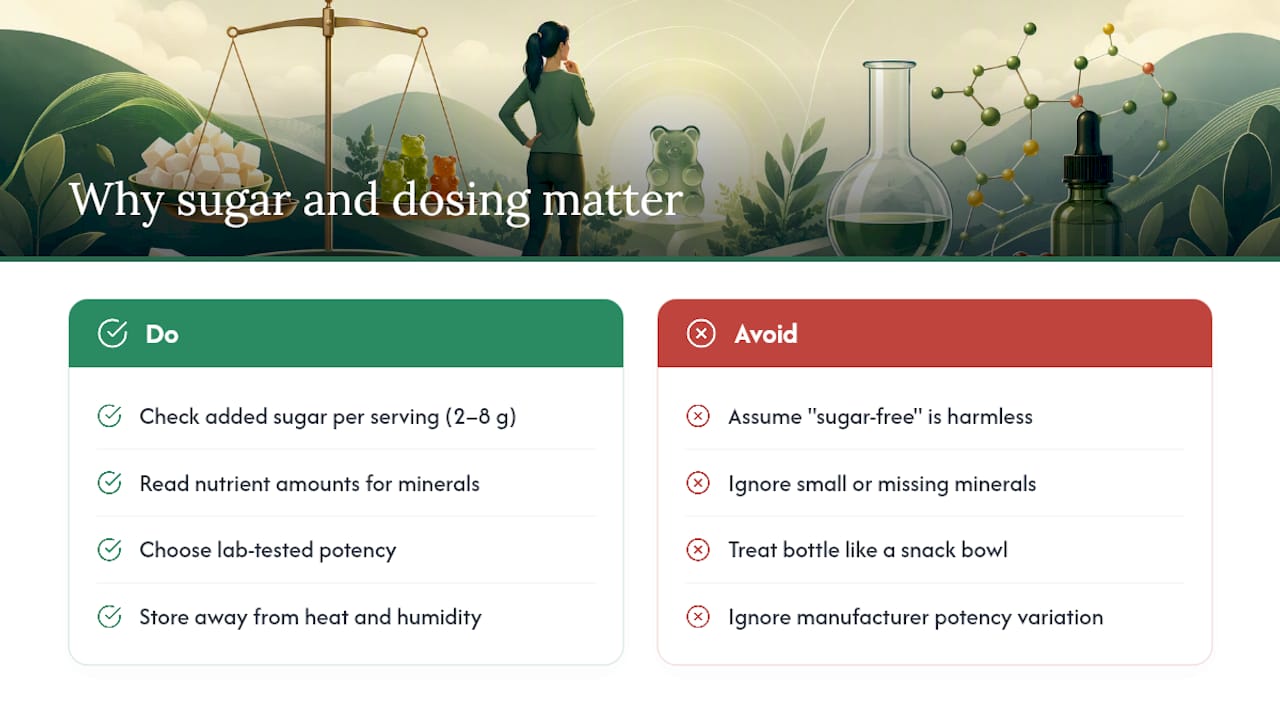
Why sugar, additives, and dosing gaps matter
Most gummy vitamins carry added sugar in every serving, and that sugar adds up faster than people expect. Healthline reports that many formulas list nutrients inconsistently and carry a real risk of overconsumption precisely because they taste like candy rather than medicine.
By the numbers: A typical gummy vitamin serving carries roughly 2 to 8 grams of added sugar, which can eat into a meaningful chunk of a daily sugar allowance before you’ve had breakfast.
Sugar-free versions aren’t automatically the safer swap. They frequently substitute sugar alcohols, and WebMD notes these can trigger digestive upset in sensitive people, plus citric acid that lingers on teeth in a sticky matrix and can erode enamel over time.
The bigger structural problem is what’s missing entirely. Minerals like calcium, magnesium, and copper are genuinely hard to work into a palatable gummy because of taste and chemistry, so most gummy multivitamins either skip them or include amounts too small to matter, according to Mayo Clinic Press.
Heat and humidity make things worse over time. Moisture degrades the gel matrix, and some manufacturers over-fortify a batch anticipating that potency loss, according to PBS Newshour, which means one bottle can dose noticeably differently than the next.
That candy-like format creates one more risk worth naming directly: accidental overconsumption by children. Fat-soluble vitamins like A, D, E, and K accumulate in the body, and a child who treats a vitamin bottle like a snack bowl can reach toxic levels faster than most parents assume.
Gummies vs. pills: which actually works better?
Neither format wins across the board, and the honest answer depends on what you’re taking it for. Absorption for many vitamins is comparable between gummies and pills, per Cleveland Clinic, but gummies routinely omit minerals or provide them in smaller amounts than a tablet does.
Tableting is a more precise manufacturing process. A compressed tablet delivers a consistent dose batch after batch, while a gel-matrix gummy can vary gummy-to-gummy depending on moisture, storage, and how evenly the mixture set.
Here’s the practical breakdown clinicians tend to use:
- Choose pills or capsules for therapeutic-dose regimens, diagnosed deficiencies, iron supplementation, or calcium needs where the amount genuinely matters
- Choose gummies when the alternative is skipping the supplement entirely because you won’t take a pill
- Avoid gummies as your only source of calcium, magnesium, or copper if you specifically need those minerals
Mineral gaps are the recurring theme. If a lab result flags low magnesium or calcium, a gummy multivitamin is one of the least reliable ways to close that gap, since those minerals are chemically difficult to fit into a chewable format at meaningful doses.
How to spot a genuinely high-quality gummy
Not all gummy vitamins are built the same way, and the label tells you most of what you need to know before you swallow anything.
- Look for third-party testing seals. Certifications from NSF, USP, or ConsumerLab confirm a product was independently checked for purity and potency, which matters more with supplements than most people realize, since the FDA regulates them as food rather than drugs.
- Scan the ingredient list for red flags. Added sugar, sugar alcohols, citric acid, and artificial dyes are common; organic or filler-free formulas cut most of that out entirely.
- Match the dose to your actual need. If you need vitamin D or B12, confirm the milligram or microgram amount against your recommended intake instead of trusting the front-of-bottle marketing.
- Skip anything hiding behind a “proprietary blend.” A brand confident in its formula publishes a certificate of analysis (COA) rather than a vague ingredient cluster with no amounts listed.
UCLA Health puts it plainly: independent certification and lower added-sugar content are the two traits worth prioritizing over flavor or marketing claims.
Pro Tip: Before buying, search the brand name plus “certificate of analysis” — if nothing comes up, that’s often a sign the company doesn’t test every batch the way it claims to.
Storing and dosing gummies safely at home
A gummy that sat in a hot car or a steamy bathroom cabinet for a month may not deliver what the label promises. Keep bottles in a cool, dry spot, away from humidity, and check the expiration date and lot code before you take one, since gummies degrade faster than tablets do.
- Store away from bathroom cabinets and kitchen counters near the stove
- Check lot codes and expiration dates each time you restock
- Keep the bottle somewhere children genuinely cannot reach, not just somewhere they usually don’t look
- Stick to the listed serving size exactly, since doubling up “for good measure” is how fat-soluble vitamins accumulate to unsafe levels
Pro Tip: If you’re pregnant, managing a chronic condition, or taking prescription medications, call your provider before starting any gummy vitamin, since some formulas interact with common drugs in ways the label won’t mention.
The bottom line on gummy vitamins
Gummy vitamins aren’t the first-line choice for comprehensive supplementation, but they’re a legitimate answer when adherence or swallowing difficulty is the real obstacle standing between you and taking anything at all.
Before buying, run through this short checklist: get bloodwork if you suspect a deficiency, pick a gummy with independent third-party testing, check the sugar content against your daily limit, and confirm the dose with a clinician if you’re pregnant or on medication. The right order of operations is diet first, clinician evaluation second, and supplement format chosen last, based on what you’ll actually take consistently.
What added sugar and additives really cost you
The sugar in a daily gummy vitamin doesn’t exist in isolation. It stacks on top of everything else you eat that day, and most people already underestimate their total added-sugar intake before a “healthy” vitamin enters the picture.
Consistent sugar intake, even in small servings, is tied to dental erosion, and a sticky gummy matrix makes that worse by clinging to tooth surfaces longer than a swallowed capsule ever would. Citric acid, often added for flavor, compounds the issue by softening enamel on contact, according to WebMD.
Artificial dyes and flavoring agents raise a separate concern for sensitive individuals, particularly children who may already react to synthetic colorants in other foods. None of this makes an occasional gummy dangerous, but it does mean the “vitamin” framing can obscure the fact that you’re eating a small piece of candy daily, sugar content and all.
For anyone managing diabetes, prediabetes, or a low-sugar diet by necessity, this matters more than for the average shopper. A daily gummy that adds several grams of sugar can conflict directly with a carefully managed carbohydrate budget, and a sugar-free swap isn’t a clean fix if it introduces sugar alcohols that cause bloating or diarrhea instead. The honest move for anyone in this position is checking the label against personal health goals rather than assuming “vitamin” automatically means “harmless.”
Digestive reactions and allergy concerns to watch for
Gummy vitamins carry a different risk profile than tablets when it comes to digestion, mostly because of what’s added to make them chewable and palatable in the first place. Sugar alcohols like sorbitol and xylitol, common in sugar-free formulas, are notorious for causing gas, bloating, or diarrhea when taken in more than small amounts, an effect WebMD documents clearly.
Gelatin or pectin, the base of most gummy matrices, can pose a separate issue for people with specific allergies or dietary restrictions, since gelatin is animal-derived and unsuitable for strict vegetarians or vegans unless the label explicitly states otherwise. Natural flavor compounds and dyes are less commonly allergenic but still worth checking if you have a known food sensitivity, since manufacturers aren’t always required to disclose every trace ingredient with the same clarity a pill label demands.
The practical fix is simple but easy to skip: read the full ingredient panel, not just the front of the bottle, before assuming a gummy is a “clean” version of a vitamin you already trust in pill form. If you notice new digestive symptoms after switching to a gummy multivitamin, the sweetener or gelatin base is a more likely culprit than the vitamins themselves.
Our take: gummies earn their place, but not as a shortcut
Most of the criticism aimed at gummy vitamins misses the actual point. They were never designed to outperform a well-formulated tablet on nutrient density, and judging them by that standard misunderstands why they exist. The real question isn’t “are gummies as good as pills,” it’s “will this person take a pill at all,” and for a huge number of adults and kids, the honest answer is no.

Where we push back on the conventional wisdom is the idea that gummies are inherently a lesser product. A poorly made gummy with mystery fillers and no testing is a lesser product. A well-formulated one, tested for purity and dosed transparently, is simply a different delivery method solving a different problem than a capsule solves. The mistake is treating all gummies as interchangeable, when the gap between a third-party-tested formula and an untested drugstore version is enormous.
Pureblue’s own approach reflects that distinction. Organic ingredients, no artificial fillers, and third-party testing aren’t marketing flourishes here, they’re the baseline that separates a supplement worth taking daily from one that just tastes good. If you’re choosing a gummy, choose it the way you’d choose any supplement: read the label, check for independent testing, and match the dose to what you actually need.
— Organic
Why Pureblue’s gummies meet the bar this article sets
Everything above points to the same conclusion: a gummy vitamin is only as good as its testing, its ingredient list, and its manufacturing standards. Pureblue built its Blue Bear line around exactly those criteria, so you’re not guessing whether the label matches what’s actually in the gummy.

Blue Bear Gummies For Her & Him are formulated for adults on either side of the adherence problem this article covers, third-party tested for purity and potency rather than relying on front-of-bottle claims alone. Blue Bear Male Gummies target men looking for a daily format they’ll actually stick with, made in an FDA-registered facility using organic ingredients with no artificial fillers. If you already know which product fits your routine, Blue Bear Male Gummies One-time purchase lets you try a single bottle before committing to a subscription.
Every Pureblue formula ships with the transparency this article recommends demanding from any gummy brand: published testing, clear ingredient lists, and a 4.9 out of 5 customer rating built on people who kept taking it. Check the Blue Bear Gummies For Her & Him page or the Blue Bear Male Gummies listing to see the full label before you decide.
Sources
- Do Gummy Vitamins Work as Well as Traditional Vitamins? | Cleveland Clinic
- Should you take gummy vitamins? | UCLA Health
- Are Gummy Vitamins a Good Idea or Bad? | Healthline
- Are gummy vitamins as effective as traditional vitamin pills? | PBS Newshour
- Are gummy multivitamins as effective as traditional pills or capsules? | Mayo Clinic Press
Talk to a clinician for guidance specific to your health history, medications, or pregnancy before starting any new supplement.
This article is general information, not a substitute for advice from a qualified doctor. Consult a qualified healthcare professional about your own circumstances before acting on anything here.