Cart
0

Moderate evidence shows choline supports attention and processing speed, but mainly when it corrects a low baseline. If your diet already meets your needs, or you’re a naturally sharp performer, expect little from a supplement, and possibly a slight dip at higher doses. Read on for the forms, doses, and safety details that determine whether it’s worth trying.
TL;DR:
- Choline supplementation offers the most benefit for individuals with low dietary intake or those experiencing cognitive deficits, especially older adults and pregnant women.
- The most effective forms for boosting focus are citicoline and alpha-GPC, which rapidly cross into circulation and have the strongest supporting evidence.
- For high-level performers already meeting choline needs, additional supplementation may offer little or even diminish processing speed.
- Typical doses for acute cognitive benefits range from 500 to 1,000 milligrams, but starting with lower doses and tracking objectively is recommended.
- Excessive intake can cause side effects like fishy body odor and gastrointestinal discomfort, and people with liver issues or genetic variants affecting choline metabolism should consult a healthcare professional before use.
Table of Contents
- Choline for Focus: How It Works in the Brain
- What Does the Human Evidence Say About Choline and Attention?
- Citicoline, Alpha-GPC, Choline Bitartrate, or Lecithin: Which Form Works Best?
- How Should You Dose and Trial Choline for Focus?
- Is Choline Safe? Side Effects and Interactions to Know
- Which Foods Are Highest in Choline?
- Who Actually Benefits Most From Choline Supplementation?
- Pureblue’s Approach to Organic Supplementation and Quality
- What Interacts With Choline in the Brain?
- How Do You Choose a Quality Choline or Focus Supplement?
- The Real Story Behind Choline and Focus
- Try Pureblue’s Quantum Vitality if You Want a Quality-Focused Adjunct
- Sources
- FAQ
Choline for Focus: How It Works in the Brain
Choline earns its reputation as a focus nutrient because of what it becomes once you eat it. The body converts choline into acetylcholine, the neurotransmitter that governs attention, memory encoding, and muscle signaling, and it also builds phosphatidylcholine, a phospholipid that makes up a large share of every neuron’s cell membrane. Without adequate choline, both processes slow down. The NIH’s Office of Dietary Supplements classifies choline as an essential nutrient for exactly this reason: your liver can synthesize a small amount, but not nearly enough to meet demand, so diet has to fill the gap.
Acetylcholine’s role in attention circuits is specific rather than general. It acts heavily on the α7 nicotinic receptor, a receptor subtype concentrated in brain regions tied to sustained attention and rapid information processing. When acetylcholine signaling in these circuits is running low, the practical result looks like slower reaction times and a harder time holding focus on a task. That’s the biological argument for why correcting a choline shortfall could sharpen processing speed, though it doesn’t mean piling on more choline once you’re already sufficient will sharpen it further.
There’s a longer-term angle too. Some research points to choline’s involvement in epigenetic regulation and brain-derived neurotrophic factor (BDNF) activity, both of which relate to how well the brain adapts and maintains function over years, not just hours. A 2024 review on choline’s role as an essential nutrient also ties it to liver health and cell membrane integrity, underscoring that choline’s job in the body extends well past cognition alone.
What this means for focus, in plain terms:
- Acetylcholine drives attention and processing speed through cholinergic circuits, particularly via α7 nicotinic receptors.
- Phosphatidylcholine keeps neuronal membranes structurally sound, which affects how efficiently neurons fire and communicate.
- BDNF and epigenetic pathways may connect choline status to longer-term cognitive resilience, not just same-day performance.
What Does the Human Evidence Say About Choline and Attention?
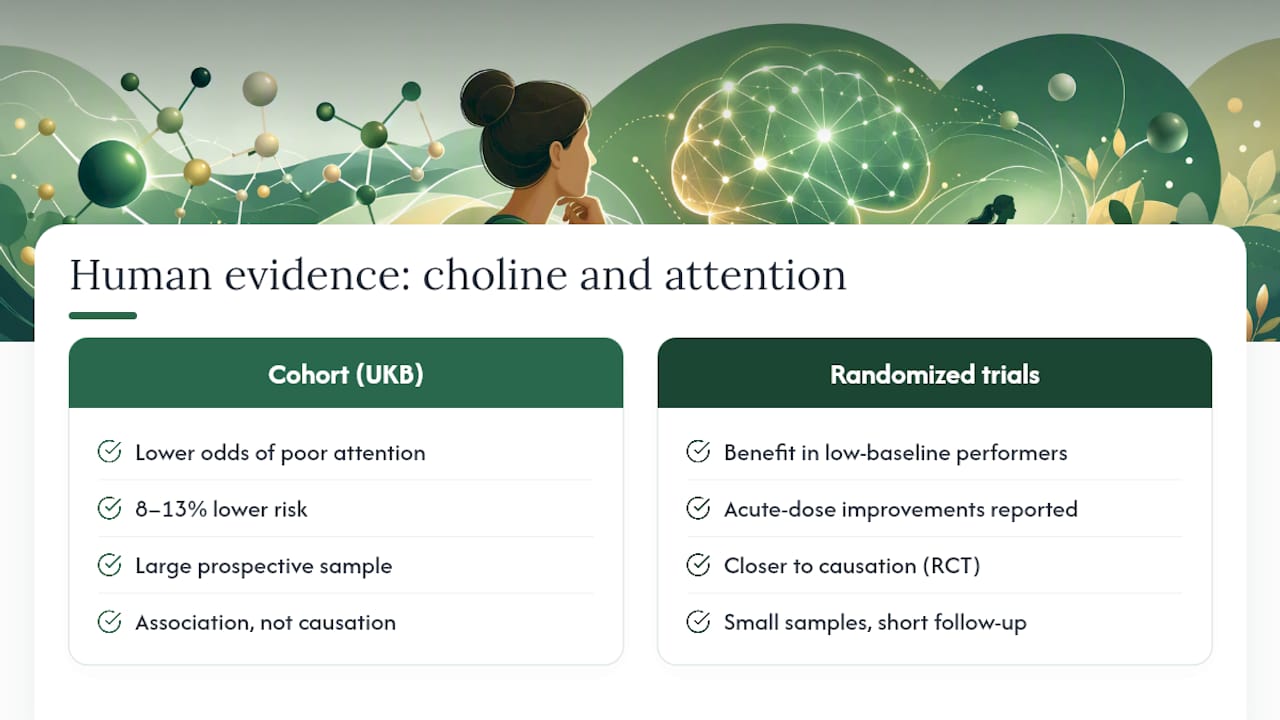
The strongest population-level data comes from the UK Biobank. A large prospective cohort study found that people with moderate dietary choline intake had lower odds of poor performance on tests of visual attention, fluid intelligence, and complex processing speed compared to those with lower intake, according to research published in the American Journal of Clinical Nutrition. That’s a meaningful signal precisely because of its scale: cohort studies of this size smooth out a lot of individual noise that smaller trials can’t.
But cohort data has a well-known limitation. It shows association, not causation. People who eat more choline-rich foods, eggs, fish, cruciferous vegetables, also tend to differ in other ways: overall diet quality, exercise habits, income, education. The UK Biobank study controls for many of these factors, but it can’t fully rule out that choline is a marker for a broader healthy-eating pattern rather than the direct cause of better attention scores.
Randomized trials get closer to causation, and here the picture gets more interesting, and more nuanced. A well-cited acute-dose study gave healthy volunteers a single dose of CDP-choline in doses tested at low and higher levels, then tested processing speed, working memory, and executive function. The results split sharply by baseline ability. Volunteers who started with lower cognitive performance showed real improvement after dosing. Volunteers who already performed at a medium or high level saw no benefit, and some showed slightly worse performance, according to the trial’s published findings.
That split matters more than any single average result would suggest. It implies choline supplementation behaves less like a universal brain enhancer and more like a correction mechanism, most useful when there’s a deficit to correct. If your processing speed is already strong, adding more choline doesn’t necessarily push it higher; it might just as easily flatten it.
The takeaway in one line: an 8–13% lower risk of poor cognitive performance tied to moderate dietary choline in a massive cohort, paired with trial data showing benefit concentrated in lower-baseline performers, points to the same conclusion from two different angles: choline helps most when you’re starting from behind.
A few caveats worth sitting with before you draw conclusions. Trial sample sizes in the choline cognition literature tend to be modest, follow-up periods are often short (days to weeks, not months or years), and study designs vary enough in dose, form, and testing method that direct comparisons are tricky. None of that erases the signal. It does mean you should read “choline improves focus” as a conditional statement, not a blanket one.
The practical inference for most readers: if you suspect your diet runs low on choline, or if you fall into a population with elevated need (more on that later), the evidence for a real attention and processing-speed benefit is reasonably solid. If you already eat a varied, choline-adequate diet and test as a high performer on cognitive measures, the upside from supplementing further looks thin, and the downside risk, however small, isn’t zero.
Citicoline, Alpha-GPC, Choline Bitartrate, or Lecithin: Which Form Works Best?
Not all choline supplements act the same way once they’re in your bloodstream, and the differences matter more than most product labels let on. Some forms deliver free choline almost immediately; others break down slowly or lean on gut bacteria to release usable choline at all.
Citicoline (CDP-choline) splits into choline and cytidine after absorption, and the cytidine converts to uridine, which appears to support membrane repair independently of the choline itself. This dual-action profile is part of why citicoline shows up repeatedly in the stronger trial data, including the acute-dose study discussed above.
Alpha-GPC (choline alfoscerate) delivers choline efficiently across the blood brain barrier and has been linked in clinical reports to increases in plasma free choline alongside improvements in memory and attention among clinical populations. Some preclinical models also associate it with elevated BDNF activity, according to a systematic review of choline supplements, though that BDNF link is still early-stage evidence rather than settled science. Separate coverage of alpha-GPC in athletic and cognitive performance contexts echoes this pattern of consistent, if modest, attention-related benefits, according to neurotraining research on alpha states.
Choline bitartrate is the plain salt form, cheap and widely available, but it shows weaker and more inconsistent cognitive results across the literature. It raises blood choline levels, but less efficiently reaches brain tissue in a form that drives noticeable acetylcholine synthesis compared to citicoline or alpha-GPC.
Lecithin (often soy or sunflower-derived) contains phosphatidylcholine but at low concentration, meaning you’d need a large serving to match the choline dose used in trials showing cognitive effects. It’s a reasonable dietary source, not a targeted cognitive intervention.
Here’s how the four stack up on the practical questions that matter:
- Fastest to raise usable choline: citicoline and alpha-GPC, both of which cross into circulation efficiently.
- Strongest human trial evidence for attention and processing speed: citicoline, backed by the acute-dose CDP-choline study, followed closely by alpha-GPC.
- Best for general dietary support rather than targeted focus: lecithin, given its low choline density per serving.
- Least consistent cognitive evidence: choline bitartrate, despite being the most common bargain option on supplement shelves.
If your goal is specifically testing whether choline affects your focus, citicoline and alpha-GPC are the forms with the clearest research trail behind them. Choline bitartrate and lecithin have their place, mainly as general nutritional support, but don’t expect the same acute cognitive signal.
How Should You Dose and Trial Choline for Focus?
The acute-dose research offers a useful starting reference: single doses of CDP-choline in the 500 to 1,000 milligram range produced measurable improvements in processing speed and working memory, but only in participants who started with lower baseline performance. That inverted-U pattern, benefit at low baseline, flat or negative response at high baseline, shows up consistently enough in the dose-response literature that it’s worth taking seriously before you assume “more is better.”
A conservative way to test whether choline does anything for you:
- Start low. Begin with a dose at the lower end of the studied range, around 250 to 500 milligrams of citicoline or alpha-GPC, taken in the morning with food.
- Hold steady for one to two weeks. Acute effects, if they occur, often show up within days, but a short trial period lets you separate a real pattern from a lucky day.
- Track something measurable. A simple reaction-time app, a consistent work-session output metric, or even how many focused Pomodoro blocks you complete without drifting off task all beat relying on vague impressions.
- Reassess honestly. If you notice no change after two weeks at a modest dose, increasing the dose is unlikely to flip that outcome, since the evidence suggests the ceiling effect works against high performers, not for them.
- Stop and reconsider if focus feels worse. A dulled or foggy feeling after dosing is a signal to scale back, not push through.
Pro Tip: Test choline on a low-stakes day, not the morning of your biggest presentation. Individual response varies enough that your first dose should be a data-gathering exercise, not a high-pressure gamble.
What you’re really measuring here isn’t a subjective “I feel sharper” impression, which is notoriously unreliable, but something closer to an objective before-and-after comparison. Give it two weeks. If nothing changes, that’s useful information too: it likely means your baseline choline status, and your baseline performance, were already in a range where supplementation has little room to help.
Is Choline Safe? Side Effects and Interactions to Know
At high doses, choline supplements can cause a distinctly unpleasant fishy body odor, along with sweating and gastrointestinal upset like nausea or diarrhea. These effects tend to cluster at intakes well above typical supplemental doses, and they’re generally reversible once you reduce the amount.
The more scientifically interesting safety conversation involves TMAO. Gut bacteria metabolize dietary choline into trimethylamine, which the liver converts into trimethylamine N-oxide, or TMAO. Some observational research has linked elevated TMAO levels to cardiovascular risk, a connection the NIH fact sheet on choline flags explicitly as a reason to favor balanced intake over aggressive supplementation. This isn’t settled causal science, TMAO research is still evolving, and correlation in observational studies doesn’t prove that choline itself drives heart disease. But it’s a reasonable argument for staying near recommended intake levels rather than mega-dosing.
A few groups should be more cautious or check with a clinician before supplementing:
- People with liver disease, since choline metabolism runs largely through the liver and impaired function changes how the body handles it.
- Pregnant people, who have genuinely elevated choline needs for fetal brain development, but should coordinate dosing and form with a doctor rather than self-select a supplement.
- Anyone on medications that affect cholinergic signaling or acetylcholine pathways, where added choline could compound or blunt drug effects.
- People with a known trimethylaminuria (a metabolic condition affecting TMA processing), for whom even moderate choline intake can cause a persistent fishy odor.
There’s also a genetic layer to consider. Some common gene variants affect how efficiently your body synthesizes choline internally, which means two people eating identical diets can end up with meaningfully different choline status. This is a real reason individual response to supplementation varies so widely, and it’s a good argument for treating your first choline trial as a personal experiment rather than assuming a one-size dose applies to you.
Which Foods Are Highest in Choline?
Food remains the more sustainable starting point for most people, and it’s genuinely not hard to hit adequate intake with a normal, varied diet. The Adequate Intake (AI) set by nutrition authorities is 550 milligrams per day for adult men and 425 milligrams per day for adult women, rising to 450 milligrams during pregnancy and 550 milligrams during lactation, when demand for fetal and infant brain development climbs.
A short list of foods that make hitting those numbers realistic:
- Beef liver (3 ounces): roughly 350 milligrams, among the most concentrated sources available.
- Eggs (one large, mostly in the yolk): about 150 milligrams.
- Soybeans (1 cup, cooked): around 105 milligrams.
- Shrimp (3 ounces): approximately 70 milligrams.
- Cruciferous vegetables like broccoli and Brussels sprouts (1 cup, cooked): 60 to 70 milligrams.
Two eggs plus a cup of broccoli at dinner already puts you well past 350 milligrams for the day, in the same range as the moderate-intake group in the UK Biobank cohort tied to better attention scores. Pairing choline-rich foods with omega-3 sources like fatty fish makes practical sense too, since DHA and EPA support the same neuronal membranes that phosphatidylcholine helps build, even though the research on combining them specifically for cognitive outcomes is still limited.
Despite how accessible these foods are, national dietary surveys consistently find that a large share of adults fall short of the AI, largely because liver and egg yolks, the most concentrated sources, have fallen out of favor in a lot of modern diets. That gap is exactly why food-first strategies deserve a real look before jumping to a supplement, a point reinforced by McGill’s Office for Science and Society in its review of choline supplementation research.
Who Actually Benefits Most From Choline Supplementation?
Not everyone stands to gain the same amount, and being honest about that upfront saves you money and false expectations.
Likely to see real benefit:
- People whose dietary intake consistently falls below the AI, especially those who avoid eggs, liver, or fish for dietary or ethical reasons.
- Older adults reporting cognitive complaints, where baseline acetylcholine signaling may already be reduced.
- Pregnant people, given the well-documented developmental role choline plays for the fetus and the elevated intake requirement during pregnancy.
- Anyone who tests as a lower-baseline performer on attention or processing-speed measures, mirroring the population that responded best in the acute-dose trials.
Unlikely to see much benefit, or possible downside:
- Healthy adults who already eat a varied, choline-sufficient diet and perform well on cognitive testing, where the inverted-U dose response suggests flat or slightly negative results.
- Anyone expecting a stimulant-like jolt; choline’s mechanism is corrective, not stimulating, so it won’t feel like caffeine.
If you’re unsure which camp you fall into, a rough self-screen helps: track your typical diet against the AI benchmarks above for a few days, and consider whether you fall into one of the higher-need groups (pregnancy, older age with memory complaints, restrictive diet). If your intake looks consistently low, that’s a reasonably strong signal supplementation is worth trying. If you’re already hitting AI through food and performing well cognitively, you’re the population least likely to notice a difference, according to the chiropractic and performance literature covering focus interventions. For genuinely uncertain cases, a plasma free-choline test or a conversation with a nutrition-focused clinician settles the question faster than trial and error.
Pureblue’s Approach to Organic Supplementation and Quality
Some supplement brands build their product lines around the premise that active adults want mental clarity and steady energy without filler ingredients. The flagship Quantum Vitality™ NAD+ Booster + Detox formula is a 3-in-1 organic blend designed to support energy, detoxification, and cognitive clarity in one product, an approach that fits naturally alongside a choline-conscious diet rather than replacing it.
Manufacturing happens in an FDA registered facility, and the brand reports high customer satisfaction among its active individual customers.
What sets this brand apart from generic wellness products is the combination of organic sourcing, third-party verification, and formulas aimed at supporting the body’s own energy and clarity pathways rather than masking fatigue with stimulants. For readers already working on choline intake through diet or targeted forms like citicoline, a broader NAD+ and detox formula addresses the adjacent systems, cellular energy production and detoxification, that also influence how sharp and focused you feel day to day.
What Interacts With Choline in the Brain?
Choline doesn’t work in isolation, and how it interacts with other nutrients and compounds affects whether supplementation actually translates into better focus.
B vitamins, particularly B12 and folate, share metabolic overlap with choline through the same methylation pathways: all three donate methyl groups for related biochemical processes. Low B12 or folate status can blunt the practical benefit of added choline, since the systems are interconnected rather than independent. Omega-3 fatty acids (DHA and EPA) complement choline’s role at the membrane level; phosphatidylcholine and DHA both contribute to neuronal membrane structure, which is one reason fatty fish paired with choline-rich foods makes nutritional sense even without dedicated trial data on the combination.
Among nootropic compounds, citicoline and alpha-GPC are sometimes stacked with racetams, a class of synthetic cognitive compounds that some users pair with choline sources specifically because racetam use can deplete acetylcholine, making supplemental choline a logical, though not universally studied, addition. Caffeine’s interaction is more anecdotal: some users report caffeine plus choline feels smoother than caffeine alone, though there’s limited controlled research to confirm a genuine synergistic effect rather than a placebo-driven perception.
The practical rule holds regardless of pairing: stacking rarely fixes a deficiency issue that isn’t actually there, and it introduces more variables when you’re trying to isolate what’s actually working.
How Do You Choose a Quality Choline or Focus Supplement?
Ingredient labels in the supplement industry vary enormously in honesty, and choline products are no exception. A few checkpoints separate a credible product from a marketing exercise.
Look for the specific form listed, not just “choline” as a vague catch-all. A label reading “citicoline (CDP-choline), 500 mg” tells you exactly what you’re getting and lets you compare it against actual trial doses. A label that just says “choline complex” without specifying form or amount tells you almost nothing.
Third-party testing matters more than marketing copy. Independent verification of purity and potency, ideally from a lab not affiliated with the manufacturer, is the closest thing to an objective quality check available to consumers. Manufacturing in an FDA registered facility adds another layer of process oversight, even though the FDA doesn’t pre-approve supplement efficacy the way it does prescription drugs.
Watch for filler ingredients and proprietary blends that hide exact dosages behind vague umbrella terms. If a company won’t tell you the milligram amount of the active ingredient, that’s a red flag worth taking seriously, not a minor omission.
The Real Story Behind Choline and Focus
The conventional wisdom around choline splits into two unhelpful extremes: either it’s dismissed as unnecessary because “most people get enough,” or it’s marketed as a universal brain enhancer that sharpens anyone who takes it. Neither holds up against the trial data. The honest read is narrower and more useful: choline supplementation looks like a correction tool, not an enhancement tool, and that distinction should drive every dosing decision you make.
What gets underrated is how much baseline performance determines outcome. The acute-dose research showing benefit in low performers and flat-to-negative results in high performers doesn’t get nearly enough attention in how choline gets marketed. If you’re already sharp, more choline isn’t the lever to pull.
Prioritize honestly assessing your diet and baseline cognitive function before spending money on any form. Food-first, form-specific, dose-conservative: that’s the sequence that actually reflects what the evidence supports.
— Organic
Try Pureblue’s Quantum Vitality if You Want a Quality-Focused Adjunct
If you’ve worked through your diet, tested a citicoline or alpha-GPC protocol, and you’re looking for a broader supplement that supports energy and mental clarity alongside your focus routine, Quantum Vitality™ NAD+ Booster + Detox is built for exactly that active, health-conscious profile.
The product is organic, free of artificial fillers, third-party tested for purity and potency, and manufactured in an FDA registered facility with reported high customer satisfaction. Read the full ingredient panel before you buy, and consult a healthcare provider if you are pregnant, nursing, or taking medications that affect cholinergic or metabolic pathways before adding any new supplement. Not sure it’s the right fit yet? Start with the free trial sample to see how it feels before committing. Ready to combine it with Pureblue’s other organic formulas? The Power Bundle packages multiple products together at one price, and it’s worth checking availability today.
Sources
- Association of dietary choline intake with incidence of dementia, Alzheimer disease, and mild cognitive impairment: a large population-based prospective cohort study
- Choline — Health Professional Fact Sheet (NIH ODS)
This article is general information, not a substitute for advice from a qualified doctor. Consult a qualified healthcare professional about your own circumstances before acting on anything here.
FAQ
Is There a Downside to Taking Choline?
Yes, at high doses choline can cause a fishy body odor, sweating, and gastrointestinal upset, and some research links high intake to elevated TMAO, a compound with observational ties to cardiovascular risk.
What Are Signs of Low Choline?
Documented signs include fatigue, muscle pain or weakness, memory lapses, and in more severe cases, liver dysfunction, since choline supports both cognitive and hepatic function. Low dietary intake is common in people who avoid eggs, liver, and fish.
What Food Is Highest in Choline?
Beef liver is the most concentrated food source, at roughly 350 milligrams per 3 ounce serving, followed by egg yolks at about 150 milligrams per large egg. Soybeans, shrimp, and cruciferous vegetables like broccoli also contribute meaningful amounts.
Can Choline Cause Brain Fog?
In healthy, high-baseline performers, some trial data shows choline supplementation can slightly worsen processing speed rather than improve it, which some people describe as a foggy or dulled feeling. This effect appears tied to the inverted-U dose response rather than a universal side effect.
Does Choline Supplementation Help Everyone’s Focus Equally?
No. The strongest benefits show up in people correcting a genuine deficiency or starting from lower baseline cognitive performance, while healthy high performers often see little to no measurable change.