Cart
0
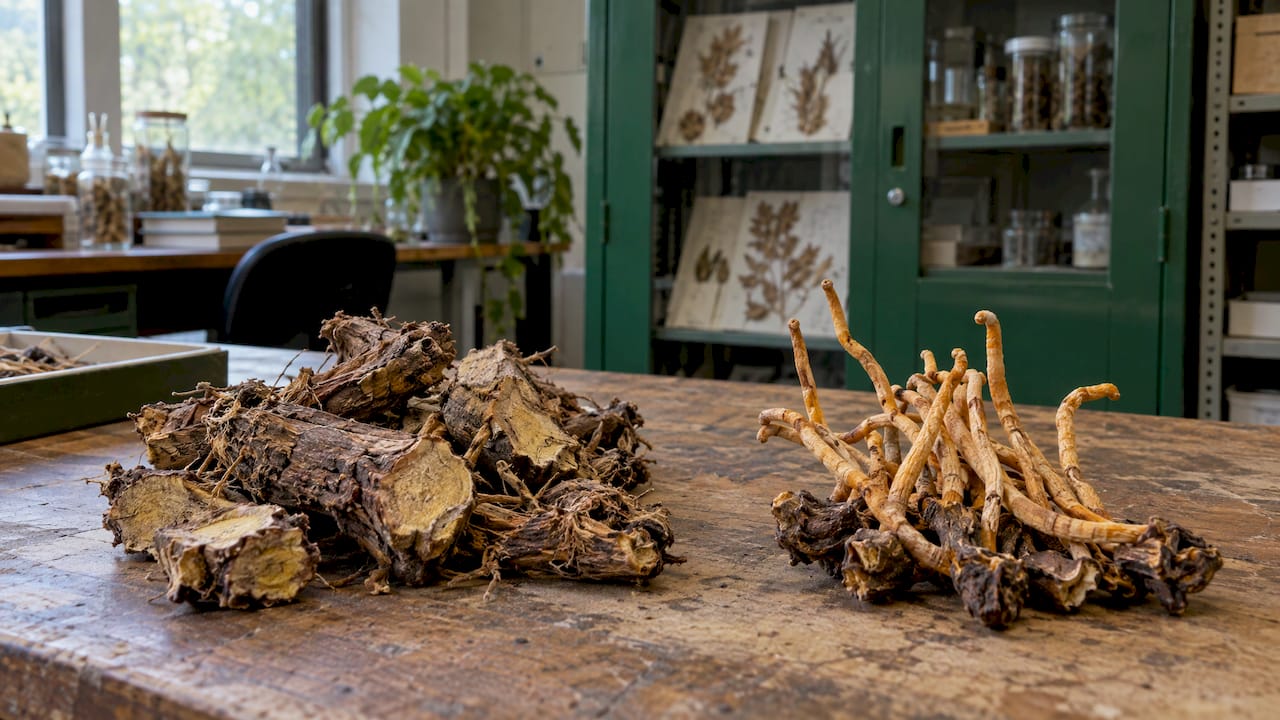
Rhodiola has the better-studied signal for mental fatigue under stress, while cordyceps has thinner data aimed at physical exercise capacity. Neither works like caffeine. Both are judged over weeks, and the human evidence for each is small and mixed. If your tiredness is mostly mental and stress-driven, rhodiola is the more logical one to read up on. If you are a trained endurance athlete looking for a marginal aerobic edge, cordyceps is the one with exercise data, though that data is modest.
This guide compares the two on what trials actually measured, what doses were used, what to look for on a supplement label, and who should talk to a clinician first. It deals with ingredient research only. Nothing here says a finished product, including anything we sell, produces these results.
TL;DR
- Rhodiola: best human signal is for mental performance and fatigue under stress. Findings on physical performance are inconsistent.
- Cordyceps: studied mostly for exercise capacity. Small trials show shifts in some measures (such as thresholds) but not in VO2max.
- Together: a few small studies tested a combination, with modest body-composition changes during training. That is early evidence.
- Safety: rhodiola can interact with antidepressants and other medicines. Cordyceps carries a caution for people on blood thinners or blood sugar medication.
- Labels: look for the species, the plant part or extract type, the standardization marker and the dose per serving, then compare them with what was studied.
Table of Contents
- The short comparison
- What adaptogen means, and how far the evidence goes
- Rhodiola: what human studies report
- Cordyceps: what human studies report
- Taking them together
- Which one fits which situation
- Doses and forms: what to check on a label
- Safety and medicine interactions
- Our perspective
- Ready to compare our catalog?
- FAQ
- Sources
The short comparison
| Rhodiola (Rhodiola rosea, sometimes R. crenulata) | Cordyceps (Cordyceps sinensis, Cs-4 and related) | |
|---|---|---|
| What it is | A root-derived herb used as an adaptogen | A fungus used in traditional Chinese medicine |
| Best-supported use in trials | Mental performance and fatigue under stress | Exercise capacity in small trials |
| Physical performance evidence | Mixed: some studies positive, some null | Inconsistent across studies |
| Typical markers on labels | Salidroside and rosavin percentages | Strain name (such as Cs-4), sometimes cordycepin or polysaccharides |
| Main medicine cautions | Antidepressants, serotonergic drugs, diabetes drugs, blood pressure drugs, warfarin, immunosuppressants | Anticoagulants, antiplatelets, blood sugar medicines |
| Common mild effects | Dizziness, dry mouth | Nausea, diarrhea, dry mouth |
The rows come from the sections below, where each claim is tied to its source.
What adaptogen means, and how far the evidence goes
Adaptogens are described as substances that promote resilience and resistance to stress. That is a category label from the research literature, not a guarantee of effect. A 2023 review of rhodiola and exercise states that results on its exercise effects are variable and not unanimous.
The U.S. National Center for Complementary and Integrative Health goes further in its caution: NCCIH says there is not enough reliable evidence to say whether rhodiola helps with any health purpose. A 2026 narrative review of adaptogens in athletes adds that doses, durations, protocols and outcome measures vary so much between studies that comparing them is hard, and it calls for work in well-characterized athletic groups.
Keep that frame as you read the rest. Both ingredients have interesting small trials. Neither has settled evidence.

Rhodiola: what human studies report
Mental fatigue under stress
The strongest signal sits here. A 2022 review of rhodiola preparations concluded that human research suggests rhodiola may improve mental performance and fatigue under stress, while studies of physical performance report mixed results. It describes a night-shift trial with 170 mg per day for 14 days that found improved mental performance and fatigue. A separate stress study used 200 mg twice daily.
Note what those trials were: specific groups, specific extracts, short windows. They do not show that any rhodiola product will make a tired person feel energetic.
Exercise and sports
The sports data pulls in both directions.
- The 2026 narrative review found inconsistent results in athletes. Rowers and marathon runners showed no significant effects on performance, VO2max or muscle damage markers, while basketball and football players showed improved aerobic performance, lower perceived fatigue and better repeated high-intensity ability.
- A 2023 review by Tinsley and colleagues covered at least 16 human investigations. Acute use of about 200 mg (roughly 1% salidroside and 3% rosavin) taken 60 minutes before exercise may prolong time to exhaustion and improve time trial performance in recreationally active people. Benefits from chronic use were limited. Higher doses of about 1,500 to 2,400 mg per day for 4 to 30 days showed effects during sprints and resistance training.
- A randomized trial in 24 male competitive football players gave 2.4 g per day (12 mg salidroside) for four weeks. The rhodiola group improved on a repeated-sprint test, in decision-making under fatigue and in post-exercise lactate compared with placebo.
- A 2014 crossover trial in 10 active men found that 3 mg per kg of body mass taken an hour before cycling lowered perceived exertion at 30 minutes and raised feelings of arousal and pleasure, without changing energy expenditure.
- A 2025 study in 30 recreationally active women paired salidroside at 150 mg per day with eccentric training. Time to exhaustion rose 45% versus 33% for training alone, with no change in VO2max.
The pattern: rhodiola may change how hard exercise feels and how long some people can keep going, in some populations, at doses that differ widely. Samples are small and the doses range from about 150 mg of an isolated compound to 2.4 g of extract.
Cordyceps: what human studies report
Cordyceps research leans toward exercise capacity rather than recovery, and it is thin.
The often-cited trial gave 333 mg of Cs-4 three times daily for 12 weeks to healthy adults aged 50 to 75. Twenty were enrolled and 15 finished. Metabolic threshold rose 10.5% and ventilatory threshold 8.5%, but VO2max did not change in either group. That distinction matters: thresholds describe how long you can work before breathing and metabolism shift, while VO2max is the headline measure of aerobic capacity.

The 2026 narrative review found some studies reporting better VO2max, time to exhaustion and ventilatory threshold, but not consistently. In trained female football players, four weeks of Cordyceps sinensis increased time to exhaustion and improved repeated sprint ability with no change in VO2max or blood parameters.
Studies on cordyceps often use particular lab-grown strains, so a result for one strain does not automatically transfer to another product with a different strain or extract.
This is also where mitochondrial biology enters conversations about physical performance. If you want a researcher-oriented read on mitochondrial signaling and muscle performance, it covers a different compound class, so treat it as background for the wider topic and not as evidence about cordyceps itself.
Taking them together
Some products blend the two, so the combination has been tested a little. A 2019 preliminary randomized study in 14 young sedentary adults combined eight weeks of endurance training with a Rhodiola crenulata and Cordyceps sinensis supplement at 20 mg per kg per day (6:4 ratio). The supplement group improved more on body weight, BMI, fat mass in the upper body and trunk, and lower-limb muscle mass than training with placebo. Blood lipids and oxidative stress markers did not differ between groups. The same paper notes a separate high-altitude study that reported improved aerobic performance.
Fourteen people, eight weeks, one ratio. It is a lead for researchers, not a basis for expecting the same result from a capsule or gummy.
Which one fits which situation
Use this as a way to organize your reading, not as a prescription.
- Your fatigue is mostly mental and tied to stress or long shifts. The rhodiola trials on mental performance and fatigue under stress are the closest match.
- You train for endurance and want to explore a small aerobic edge. Cordyceps has exercise-capacity trials, but results are borderline and VO2max has not moved in the studies above.
- You want something that kicks in the same day. Neither is built for that. Even the acute rhodiola studies used a specific dose timed an hour before exercise, in specific groups.
- You want to keep stimulants low. Both are marketed as caffeine-free, which is a product category, not a safety statement. Check every label for added caffeine or other stimulants.
For a wider view of herbs people try for tiredness, see our guide to which adaptogens work for energy and fatigue, and for rhodiola next to another popular herb, ashwagandha vs rhodiola. Our cordyceps for energy article goes deeper on trial and label questions.
Doses and forms: what to check on a label
No single dose is “right” for either ingredient. What you can do is compare a label with the ranges that were actually studied, and confirm the details on the current package and listing.
Rhodiola
- Species and extract: the studies above refer to Rhodiola rosea, and the combination study used Rhodiola crenulata.
- Standardization: Health Canada’s 2025 monograph for Rhodiola rosea describes standardized extracts with 0.8 to 3% salidroside and/or 1 to 6% rosavins, with a maximum of 680 mg of extract per day and 200 mg per single dose for adults 18 and older. That is a Canadian rule for Canadian natural health products, not a U.S. standard. It is useful because it shows how marker percentages and extract amounts relate.
- Dose: trial doses range from 150 mg of salidroside alone to 2.4 g of extract. Do not read a high study dose as a target. Our guide to judging high-potency supplements explains how to think about that.
Cordyceps
- Strain: a name like Cs-4 tells you which material may match the 333 mg three-times-daily trial. A bare “cordyceps” line does not.
- Fruiting body, mycelium or extract: the label should say which one is used and how much per serving.
- Combination blends: a proprietary blend that lists a total weight without per-ingredient amounts cannot be compared with any trial dose.
Any product
- Read the Supplement Facts panel and the Other Ingredients list. Our walk-through of six steps to verify a supplement facts label shows the order to follow.
- Look at fillers, sweeteners and colors, such as those covered in our notes on titanium dioxide in supplements and supplements without artificial sweeteners.
- Treat claims on a package as the seller’s claims. Dietary supplements are, in NCCIH’s words, not approved by the FDA before sale. Our piece on FDA supplement claims covers what to check instead.
Safety and medicine interactions
Bring the actual product label to a pharmacist or doctor if any of the following applies.
Rhodiola. The Merck Manual’s professional entry on rhodiola lists possible dizziness and dry mouth, and possible interactions with antidepressants and other serotonergic drugs (including a risk of raised heart rate or serotonin syndrome), blood sugar medicines, blood pressure medicines, warfarin and immunosuppressants. Health Canada’s monograph advises talking to a healthcare provider first if you take antidepressants, hormone replacement therapy or birth control. NCCIH notes that little is known about safety in pregnancy or breastfeeding, so ask your clinician before use in either case.
Cordyceps. Drugs.com’s monograph says cordyceps may interact with anticoagulant, antiplatelet and blood-sugar-lowering medicines, raising the risk of bleeding or low blood sugar. Reported side effects are generally mild and include nausea, diarrhea and dry mouth. If you take a blood thinner, have a bleeding disorder or have surgery planned, speak to your prescriber or surgeon before starting.
Both. Supplements can affect people differently, and a product label is not a medical assessment. Stop and contact a clinician if you notice unusual symptoms.
Our perspective
At Pure Blue we treat ingredient research and finished-product claims as two separate questions. A trial on a specific rhodiola extract or a specific cordyceps strain tells you about that material, in that group, at that dose. It does not tell you what a gummy, capsule or powder from any brand will do for you.
That is why we keep shopper guidance practical: compare the Supplement Facts panel with the studied doses, read the other ingredients, and confirm details on the current product listing and package before you order. Our catalog is built for adults who want natural-feeling energy and vitality support, and we would rather you buy with clear expectations than with a promise.
If you are weighing a daily routine, look at the formats we carry, such as gummies and our NAD+ booster and detox formula, and read each listing for what it actually contains.
Pure Blue
Ready to compare our catalog?
If you are shopping for energy and vitality support, start with the product listings, and check the ingredient panel on each one against what you have just read. Our Quantum Vitality NAD+ Booster+ Detox is a 3-in-1 formula, and the Blue Bear gummies for him and her are listed in our collection. Confirm formula details, price and purchase options on the live page before you check out.
For a wider look at labels and evidence for people with busy training weeks, our guide to active adult supplements is a good next read.
FAQ
Is cordyceps or rhodiola better for energy?
It depends on the kind of tiredness. Rhodiola has the better signal for mental fatigue under stress, while cordyceps has small exercise-capacity trials. Neither has strong, consistent evidence, so treat both as things to try carefully, not as proven fixes.
Can you take cordyceps and rhodiola together?
They appear together in some products, and a small 2019 study of 14 adults tested a combination during endurance training. The evidence is preliminary. Because both carry medicine cautions, check with a pharmacist or doctor first if you take any prescription drugs.
How long do they take to work?
The research does not support a same-day stimulant effect from either, apart from acute rhodiola studies using a timed dose before exercise. Cordyceps trials ran for 4 to 12 weeks, and the combination study ran for 8. Individual results vary and are not guaranteed.
What should you not mix with cordyceps?
The main caution is with blood thinners, antiplatelet drugs and blood-sugar-lowering medicines, where cordyceps may raise the risk of bleeding or low blood sugar. Ask your prescriber or pharmacist before combining them.
Sources
- The Effectiveness of Rhodiola rosea L. Preparations (PMC, 2022)
- Current Evidence and Practical Considerations for Adaptogen Use (PMC, 2026)
- Rhodiola rosea as an adaptogen to enhance exercise (PMC, 2023)
- Effects of Rhodiola rosea on physical and decision-making performance (PMC, 2026)
- The Effect of Acute Rhodiola rosea Ingestion on Exercise (PMC, 2014)
- Combined Rhodiola rosea and eccentric training (Frontiers in Physiology, 2025)
- Effect of Cs-4 (Cordyceps sinensis) on Exercise Performance (PMC)
- Rhodiola/Cordyceps-Based Herbal Supplement Promotes Endurance Training Adaptations (PubMed)
- Rhodiola: Usefulness and Safety (NCCIH)
- Rhodiola, Merck Manual Professional Version
- Health Canada Rhodiola rosea monograph
- Cordyceps Uses, Benefits & Dosage (Drugs.com)